CIA Dispatch 1035-960 Countering Criticism of the Warren Report
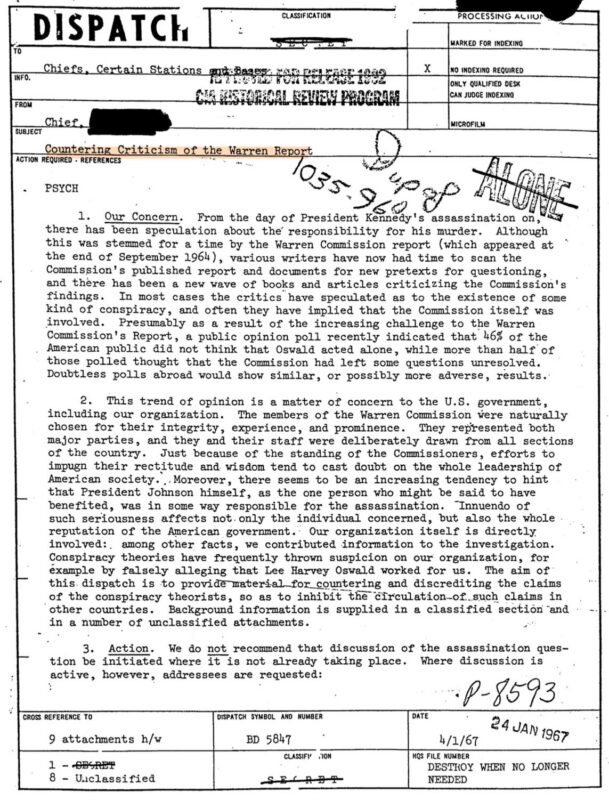
CIA Dispatch 1035-960 Countering Criticism of the Warren Report documents an official strategy to confront and diminish the influence of conspiracy theory narratives surrounding the assassination of President John F. Kennedy. Issued in April 1967, the dispatch directs CIA stations to engage political figures, editors, and other influential contacts in order to stabilize public perception and strengthen confidence in the Warren Commission’s conclusion that Lee Harvey Oswald acted alone. The text reveals a coordinated communication effort that integrates liaison discussions, targeted media interventions, and the cultivation of arguments designed to undermine alternative interpretations of the assassination.
Origins of the Communication Strategy
The dispatch responds to a surge of public skepticism. By 1967, opinion polls showed a substantial portion of Americans believed Kennedy’s death involved more than a lone gunman. Books and articles that advanced conspiracy theories gained traction, often implying official complicity. The CIA regarded this shift in perception as a matter of political stability and institutional credibility. The document frames the Warren Commission members as individuals of high integrity and bipartisan representation, underscoring that criticism of their work could erode trust in the entire leadership structure of the United States. The agency positioned itself as a stakeholder in this debate because some conspiracy theories directly named it as a participant in the events of November 1963.
Targeting Opinion Leaders
The instructions call for selective engagement. CIA stations were told not to initiate discussion of the assassination but to respond decisively when conversation arose. Officers were to focus on influential contacts capable of shaping public discourse. Politicians, editors, and other elite figures were to be reminded of the thoroughness of the Warren Commission investigation and the absence of credible new evidence. The document emphasizes that speculative discussion benefits hostile actors, including Communist propagandists, who could exploit conspiracy theories to weaken confidence in U.S. governance. The agency sought to channel the credibility of trusted intermediaries toward discouraging unverified claims.
Deployment of Media Assets
The dispatch details the use of propaganda assets to rebut attacks in print and broadcast media. Book reviews and feature articles offered an opportunity to reach audiences with curated counterarguments. Writers aligned with agency interests would receive background materials, including unclassified attachments, to support their work. The recommended approach involves portraying conspiracy theorists as committed to conclusions formed before evaluating evidence, driven by political or financial motives, prone to hasty or inaccurate research, or enamored with personal theories. By assigning these traits to critics, the strategy aimed to lower their credibility in the public eye.
Framing Historical Context
To weaken the appeal of conspiracy theories, the document proposes analogies to historical events. It dismisses comparisons to the Dreyfus affair, arguing that the assassination investigation produced no new suspects and no corroborating evidence for alternative scenarios. Instead, it suggests the Reichstag fire as a more fitting parallel, describing it as the act of a single individual later surrounded by false attributions of broader conspiracy. This framing attempts to shift the interpretive framework toward seeing the Kennedy assassination as a case with a single perpetrator, despite public fascination with broader plots.
Prioritizing Forensic Over Eyewitness Evidence
The dispatch challenges the reliability of eyewitness testimony, noting its divergence and susceptibility to selective quotation. It advises greater reliance on ballistic, autopsy, and photographic records, which the agency portrays as more stable forms of proof. The Warren Commission’s dismissal of conflicting witness accounts is framed as a reasoned decision rather than a flaw in the investigation. By elevating scientific evidence above human recollection, the strategy seeks to close avenues exploited by conspiracy theories that build narratives around contested personal accounts.
Arguments Against Large-Scale Conspiracy
The document asserts that a large conspiracy would be impossible to conceal in the United States, particularly given the potential rewards for informants. It points to figures such as Attorney General Robert Kennedy, Congressman Gerald Ford, and Senator Richard Russell as individuals with both the position and motivation to expose wrongdoing had it existed. The strategy also highlights logistical improbabilities, such as the choice of an open and unpredictable shooting location, to argue against the plausibility of a coordinated plot. These points aim to frame conspiracy theories as structurally implausible rather than merely unproven.
Defending the Commission’s Process
The Warren Commission’s composition is presented as a safeguard against bias or overcommitment to a single theory. The inclusion of members from both political parties and diverse professional backgrounds is positioned as evidence of balanced judgment. The dispatch also addresses accusations that the report was rushed, explaining that any acceleration in publication resulted from the need to address rampant speculation. This framing turns the timeline into a defense of diligence under pressure, countering claims that speed compromised accuracy.
Countering Specific Claims
The dispatch addresses high-profile allegations, including the “ten mysterious deaths” associated with the investigation. It provides mundane explanations for several of these deaths, such as natural causes or accidents, to undercut the claim of a coordinated elimination of witnesses. By breaking down individual assertions, the strategy works to dismantle the cumulative effect that such claims have on audiences receptive to conspiracy theories.
Encouraging Direct Reference to the Report
The final recommendation urges readers to engage with the Warren Report itself. CIA officers were to encourage reviewers and commentators to compare the Commission’s work with that of its critics, anticipating that such a comparison would favor the official account. The document expresses confidence that foreign audiences, in particular, would find the report’s thoroughness persuasive when contrasted with speculative literature.
Patterns of Influence and Control
Across its sections, the dispatch integrates personal persuasion, media shaping, and historical framing into a unified communication plan. The agency sought to neutralize conspiracy theories not through suppression, but through a steady counterflow of arguments that positioned the official account as both reasonable and complete. The strategy relies on trusted intermediaries, curated information, and appeals to procedural legitimacy, weaving these elements into a network of influence capable of reaching multiple audiences.
Shaping the International Narrative
The dispatch shows an acute awareness of global opinion. The CIA viewed foreign skepticism as potentially more damaging than domestic doubt, given the Cold War context and the risk of adversaries using conspiracy theories to weaken U.S. alliances. The guidance to stations abroad reflects an understanding that public perception is shaped not only by direct communication but also by the interpretive work of local influencers. The emphasis on discouraging unfounded speculation seeks to stabilize the narrative beyond U.S. borders.
The Operational Logic of Countering Conspiracy Theory
The structure of the document reveals a deliberate logic: identify credible messengers, supply them with targeted arguments, frame critics in ways that erode their authority, and reinforce the legitimacy of the Warren Commission through appeals to evidence and process. The consistent targeting of conspiracy theory proponents as flawed in method or motive reflects a broader aim to reduce the perceived legitimacy of the idea that Kennedy’s assassination was the product of a coordinated plot. The dispatch treats the spread of such theories as a communicative threat requiring sustained management.
By integrating political liaison work, controlled media interventions, and thematic framing, CIA Dispatch 1035-960 articulates an early example of coordinated narrative defense. It presents a template for how an intelligence agency might respond when an official account faces sustained public challenge. The document captures a moment when controlling the interpretation of a singular event was seen as essential to maintaining the integrity of national leadership and the stability of international perception.