The Famous Tragedy of the Rich Jew of Malta
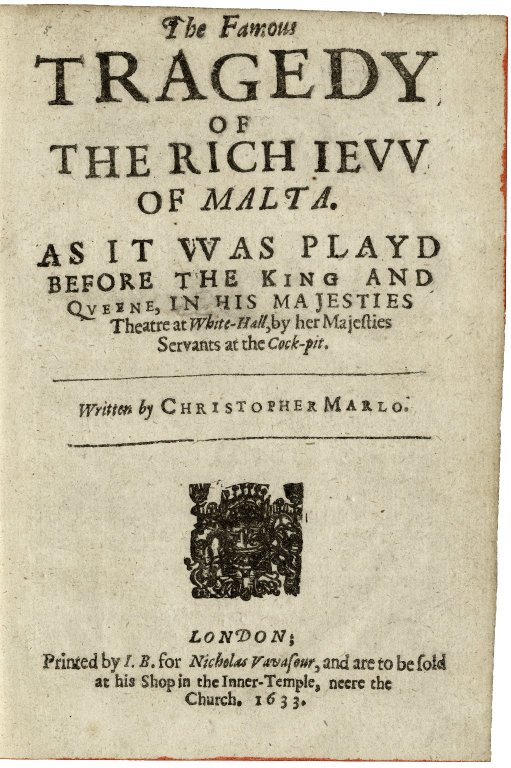
The Jew of Malta by Christopher Marlo (Marlowe) unfolds as a relentless drama of wealth, power, and vengeance. From its opening prologue delivered by Machiavelli, the play situates ambition as its governing principle and commerce as its battlefield. The figure of Barabas, the wealthy Jewish merchant of Malta, embodies the interplay of global trade, state policy, and personal retribution.
The Prologue and the Spirit of Machiavelli
The stage opens with Machiavelli addressing the audience directly, announcing his continued influence and delight in cunning. His words establish a frame in which morality submits to expedience, and power dictates justice. He declares religion a toy and ignorance the only sin, casting aside sanctity to exalt calculation. This introduction primes the audience to interpret the action as a study in strategy, a theatre of manipulation where wealth and power determine fate.
Barabas in the Countinghouse
The first sight of Barabas anchors the play in commerce. Surrounded by heaps of gold, he speaks of argosies, caravans, and markets stretching from Persia to Spain and India. He calculates profit from silks, pearls, spices, and jewels. His joy in abundance flows from his ships returning safely, his caravans arriving laden, and his accounts filling with credit. Through his speech, the audience enters a world defined by mercantile networks and global trade, where fortunes shift with winds and tides yet accumulate under a shrewd hand.
The Governor’s Levy and the Seizure of Wealth
Tension erupts when Turkish envoys arrive demanding ten years’ tribute long unpaid. The Governor of Malta, facing impossible sums, turns to the island’s Jews for payment. The council resolves to exact half their wealth, stripping Barabas of his fortune. They confiscate his house and convert it into a nunnery. This dispossession cuts into both his wealth and his pride. The injustice transforms Barabas from merchant into avenger, setting the trajectory of the play.
Abigall and the Retrieval of Treasure
Barabas’s daughter Abigall enters as his sole beloved child. To recover the hidden wealth stored within the walls of the house, now a convent, he sends her cloaked in obedience. Her role intertwines filial loyalty with deception, as she recovers her father’s gold beneath the guise of religious devotion. This moment defines the play’s recurring pattern: sacred spaces serve as covers for stratagems, and vows serve as instruments of disguise.
Vengeance as Enterprise
Barabas builds schemes as one might construct enterprises. He directs Abigall, manipulates friars, and engineers rivalries among suitors for his daughter. He orchestrates poisonings and plots, shifting from commerce to conspiracy with equal fluency. His countinghouse becomes a workshop of death as easily as it had been of trade. The logic of profit flows seamlessly into the logic of vengeance, and both become indistinguishable engines of his will.
Ithamore and the Companion in Crime
Into this orbit enters Ithamore, the slave who becomes Barabas’s accomplice. He revels in malice and executes plots with zeal. Their partnership escalates the violence. They eliminate rivals, silence friars, and dispatch victims through stratagems. Yet Ithamore’s loyalty proves transactional. Bribed by a courtesan and her associate, he exposes Barabas’s crimes in detail. Betrayal erupts from within the circle of complicity, and the servant who once enabled schemes now destroys their concealment.
The Siege of Malta
As private vengeance reaches its apex, public crisis returns. Turkish forces under Calymath press upon Malta, demanding tribute. Barabas shifts his allegiance, offering aid to the Turks. He advises, plots, and engineers assaults. The stage fills with duplicity as Barabas positions himself as indispensable to both sides. Yet his manipulations spiral into traps of his own design. The Governor regains control, and Barabas’s schemes collapse under their accumulated weight.
The Fall into the Cauldron
The climax delivers poetic symmetry. Barabas, master of stratagems, dies caught in a mechanical trap of his own invention. A cauldron devours him as he once devoured others through poison and plots. His death completes the arc of ambition carried to its extreme, where calculation meets its limit and cunning destroys its wielder. The stage presents not divine judgment but the mechanical justice of retribution built into his own devices.
Wealth as Axis of Power
Marlowe structures the play around wealth as the axis of action. From the opening image of gold piled in the countinghouse to the seizure of property, the retrieval of hidden treasure, and the constant references to jewels and ships, fortune drives decisions. Political policy manifests as economic extraction. Vengeance operates through financial calculation. Even love and loyalty find themselves measured against the ledger of profit and loss.
Religion as Mask
Religious institutions appear as settings for stratagems rather than sanctuaries of faith. The convent conceals gold. Friars seek influence and become pawns. Abigall shifts between appearances of devotion and repentance, caught between filial loyalty and conscience. Barabas mocks religion, deploying it as cover or weapon. The stage presents vows, confessions, and conversions as instruments of policy and deception rather than ends in themselves.
Reason of State
The Governor’s levy and Barabas’s revenge stem from the same logic. Both operate under reason of state, which privileges necessity and expedience over morality. Tribute, policy, and survival dictate choices. In this logic, religion becomes rhetoric, and justice becomes calculation. Machiavelli’s prologue defines the terms, and the action follows accordingly, each figure navigating survival through strategy.
Exposure and Reckoning
The accumulation of crime generates its own exposure. Ithamore and the courtesan enumerate Barabas’s murders, listing each poisoning, each act of vengeance, each stratagem turned deadly. The audience hears a catalogue of guilt, a rhythmic unveiling that prepares the final downfall. Justice in the play emerges not from courts or divine judgment but from the inevitability of exposure, the impossibility of concealing compounded crimes.
Characters and Their Roles
Barabas defines the play as its center, a figure of ambition, cunning, and paternal devotion distorted into vengeance. Abigall offers the counterpoint of loyalty turned to repentance, her poisoning marking the extremity of her father’s will. Ithamore embodies the treachery of servitude turned opportunism. The Governor of Malta personifies statecraft stripped to expedience. Calymath anchors the geopolitical frame, reminding the audience of empires and tribute that contextualize private revenge within public conflict.
The Pattern of Escalation
The structure of the play follows a pattern of escalation. The initial dispossession ignites vengeance. The retrieval of treasure renews ambition. Each plot raises the stakes, moving from rival suitors to friars to entire communities. The betrayal by Ithamore punctuates the spiral, and the siege by the Turks lifts the personal drama into the realm of empire. The fall into the cauldron seals the trajectory, presenting ambition consumed by its own fire.
Enduring Power of the Play
The Jew of Malta endures because it stages the intersection of wealth, power, and conscience in a form that refuses resolution through simple morality. It dramatizes a world in which ambition governs, wealth commands, and vengeance sustains identity. It presents religion as rhetoric and politics as extortion, showing a society driven by necessity and strategy. Its imagery of ships, jewels, and poison resonates as a vision of commerce entangled with violence.
Conclusion
Christopher Marlowe creates in The Jew of Malta a study of ambition propelled by wealth and destroyed by its own schemes. From the gold heaped in Barabas’s countinghouse to the cauldron that consumes him, the play demonstrates the mechanics of calculation and the inevitability of exposure. It builds tension through accumulation, converges private revenge with public conflict, and resolves in the collapse of the very strategies that sustained its protagonist. In this relentless structure, the play reveals the anatomy of power in an age defined by trade, empire, and Machiavellian cunning.