Killing Time: The First Full Investigation into the Unsolved Murders of Nicole Brown Simpson and Ronald Goldman
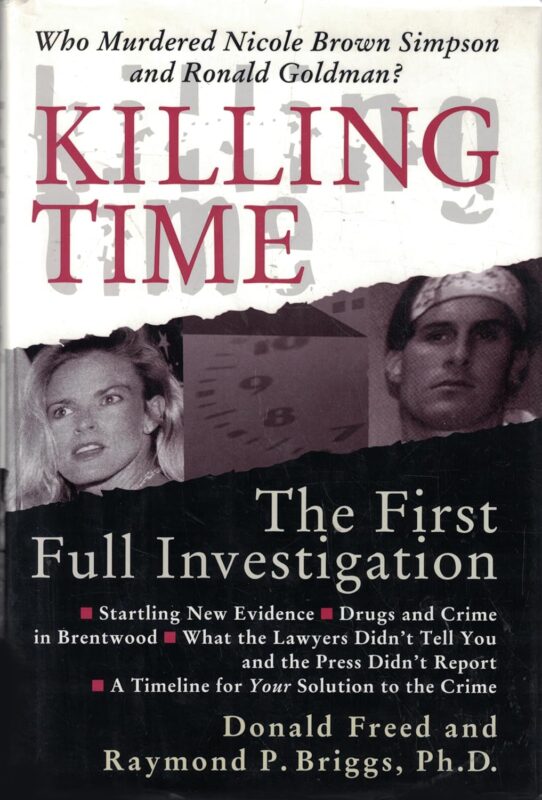
Killing Time: The First Full Investigation into the Unsolved Murders of Nicole Brown Simpson and Ronald Goldman by Donald Freed and Raymond P. Briggs examines the O.J. Simpson case through the disciplined use of timelines, forensic evidence, and reconstructed scenarios that immerse the reader in the unresolved hours of June 12, 1994.
The Trial That Defined an Era
O.J. Simpson’s trial spanned nine months, absorbing the American public in daily televised proceedings. Freed and Briggs reconstruct the prosecution’s attempt to fix Simpson at the crime scene through circumstantial evidence and a theory of domestic rage. They demonstrate how the case rested on critical minutes and how testimony about barking dogs, telephone calls, and shifting lights in Brentwood became decisive markers. Prosecutors argued that Simpson, enraged after a dance recital, armed himself with gloves, a cap, and a knife, and confronted his ex-wife Nicole and her friend Ronald Goldman.
The Power of the Timeline
The authors organize events into precise timelines that track movements and interactions minute by minute. They treat the calls placed by Nicole, her mother, and Goldman as immovable anchors. They show how the limousine driver’s repeated attempts to contact Simpson establish a clock of absence that coincides with the likely murders. They position Kato Kaelin’s account of hearing thumps against testimony from neighbors who reported dog wails, using these details as temporal gates that confine or release different scenarios. Through this structure, the book illustrates how time can serve as both a weapon for prosecution and a shield for defense.
The Prosecution’s Narrative
Freed and Briggs recount the state’s case: Simpson left his estate shortly after 10:00 pm, drove his white Ford Bronco to Bundy Drive, attacked Nicole, and killed Goldman when the waiter arrived with Nicole’s mother’s glasses. The sequence ends with Simpson fleeing, cutting his finger, and returning home in time to be seen by his driver. The prosecution leaned on physical traces—blood drops leading to the Bronco, socks stained with Nicole’s DNA, and the infamous glove recovered by Detective Mark Fuhrman. They sought to connect domestic violence to homicide, presenting Nicole’s 911 call and photographs of her injuries as a blueprint of escalation.
The Defense Counterattack
The defense dismantled confidence in the state’s evidence. Freed and Briggs detail how Barry Scheck and Peter Neufeld scrutinized the LAPD’s handling of blood samples, emphasizing contamination risks and broken chains of custody. They stress how Johnnie Cochran leveraged Fuhrman’s racism, revealed through tapes, to argue evidence planting. The defense reminded jurors that their responsibility was not to construct a counter-narrative but to demand proof beyond reasonable doubt. In this framework, gaps and contradictions in time became central: if Simpson was seen entering his house at 10:55 pm, could he have committed two brutal murders, cleaned up, and staged normalcy?
The Problem of Witnesses
Freed and Briggs present the witnesses as human clocks. Some neighbors testified to silence around 10:20, others described prolonged canine wailing. A passing motorist claimed she saw Simpson’s Bronco at 10:50, yet the prosecution kept her from the stand because her timeline conflicted with their own. Testimony diverged between those who reported seeing nothing unusual outside Nicole’s condominium and those who swore they heard voices or shouting. By juxtaposing these accounts, the book demonstrates how fragile perception becomes under courtroom scrutiny.
Domestic Violence as Motive
The prosecution placed Nicole’s abuse history at the heart of their argument. Police reports from 1985 and 1989, along with Nicole’s desperate 1993 911 call, painted a picture of fear and control. Freed and Briggs reproduce these records and testimony to show how prosecutors framed the murders as the tragic culmination of repeated assaults. The defense countered by highlighting Nicole’s own deposition, in which she stated that the 1989 incident was the only time Simpson struck her. The authors probe this contradiction to show how jurors had to weigh a pattern of abuse against the requirement of direct linkage to murder.
The Role of Technology
The book insists that the computer functioned as the essential investigative tool. By digitizing phone logs and constructing overlapping timelines, Briggs created a form of virtual reality that replays the crime from competing perspectives. This method echoes Kurosawa’s Rashomon, where the same event appears through different testimonies. Freed and Briggs argue that technology has altered modern trials: the Zapruder film, the Pentagon Papers, Nixon’s Watergate tapes, and the Rodney King video all reshaped public consciousness. The Simpson trial entered this lineage with DNA analysis, televised testimony, and digital reconstructions of time.
The Shadow of Detective Fuhrman
The discovery of the bloody glove at Simpson’s Rockingham estate became the hinge of the prosecution’s case. Freed and Briggs focus on Fuhrman’s role, his racial slurs, and his Fifth Amendment silence under questioning. They argue that this single point of evidence, meant to connect Bundy and Rockingham, instead destabilized the prosecution by raising the possibility of fabrication. The glove itself symbolized the trial’s doubleness: evidence of guilt to some, evidence of corruption to others.
Alternative Scenarios
The book ventures beyond the courtroom to consider other possibilities. Some witnesses reported multiple men near the crime scene. Others described suspicious figures fleeing. Freed and Briggs devote chapters to the theory of a second man and to potential links with drug trafficking and organized crime. They explore whether Nicole’s social circle or debts could have drawn violence to her home. These scenarios extend beyond the trial record, inviting the reader to weigh whether Simpson acted alone, acted with another, or was targeted by external forces.
The Open Verdict
Freed and Briggs do not close the case. They insist that contradictions remain embedded in the timelines, that witness testimony collides rather than converges, and that forensic handling failed to secure a definitive account. They leave the reader with the responsibility of judgment, citing Thomas Jefferson’s view of the jury as the anchor of constitutional governance. The book affirms that truth emerges through confrontation with evidence, not submission to authority.
A Study of American Tragedy
The Simpson case becomes more than a legal battle. It exposes the fissures of race, celebrity, gender, and media spectacle in the United States. Freed and Briggs frame O.J. Simpson as a tragic figure in the Du Boisian sense of doubleness: athlete and defendant, icon and pariah, African American hero and suspect in a racially charged trial. Nicole’s death represents the overlooked epidemic of domestic violence against women. The LAPD’s failures echo larger crises of institutional trust in Los Angeles after the Rodney King riots. The trial becomes a mirror that reflects the nation’s contradictions.
Why the Book Endures
The authors offer more than a retelling. They craft a structured inquiry that applies forensic logic to one of the most controversial trials in history. They preserve documents, witness lists, and autopsy reports in appendices to place raw evidence in the hands of the reader. They demonstrate how the mechanics of time—calls, sounds, and sightings—shape the boundary between guilt and innocence. They challenge readers to test each scenario against the clocks of June 12, 1994, and to decide which narrative withstands scrutiny.
The Lasting Legacy
Killing Time asserts that the Simpson case cannot be reduced to a verdict. The acquittal closed the courtroom but left the crime unresolved. Freed and Briggs position the case within a broader American tradition where technology and media transform justice. They show how timelines, like films and recordings before them, destabilize official narratives and open space for independent judgment. The unresolved nature of the murders ensures that the case persists as a subject of debate, scholarship, and cultural memory.
Conclusion
Donald Freed and Raymond P. Briggs deliver a meticulous investigation that restores structural clarity to a case clouded by spectacle. Their work reveals how timelines expose contradictions, how witnesses function as clocks, and how technology reshapes trials. The book demonstrates that unresolved murders do not fade but evolve into enduring mysteries that test the resilience of law, science, and collective conscience.