“Covid-19,” Psychological Operations, and the War for Technocracy
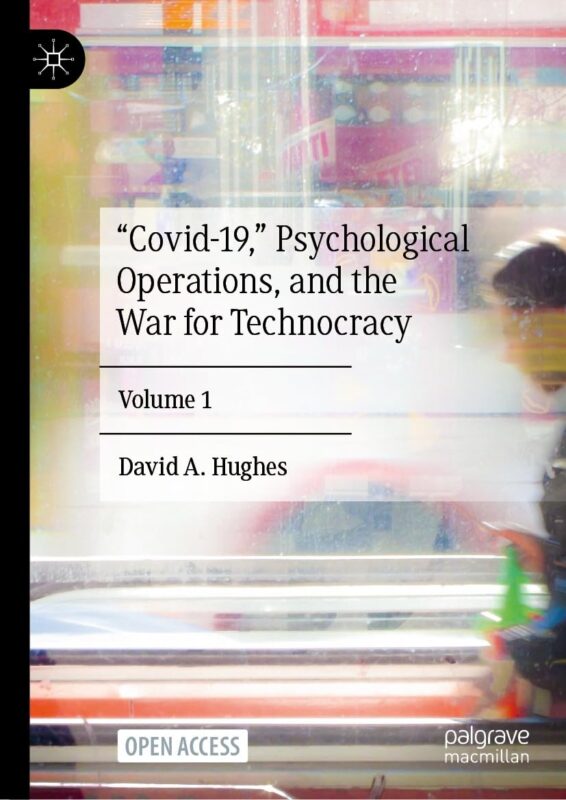
Covid-19, Psychological Operations, and the War for Technocracy by Dr. David A. Hughes traces the emergence of a global system of control that fuses digital surveillance, biotechnology, and psychological warfare into a coherent architecture of governance. Hughes positions the pandemic as the catalytic event in a broader strategy of systemic reorganization. His research situates Covid-19 within a continuum of historical efforts to manage populations through crisis, war, and behavioral conditioning. The book examines how elite institutions leveraged biosecurity to accelerate the transition from liberal democracy to technocracy, a regime defined by algorithmic oversight and data-driven obedience.
The Architecture of Technocracy
Technocracy appears in Hughes’s analysis as a comprehensive mode of power, not a policy trend. He defines it as governance by technical expertise fused with centralized data control. Its logic arises from the integration of information systems, finance, and biopolitics. The technate—an institutional structure of managerial control—emerges from this fusion. Hughes identifies its foundations in early twentieth-century movements such as Technocracy, Inc., led by Howard Scott and M. King Hubbert, who sought to replace monetary exchange with energy accounting. This vision of managed efficiency reemerged through the digital revolution and the rise of global data capitalism.
Hughes shows how twentieth-century thinkers like Bertrand Russell, Aldous Huxley, and Zbigniew Brzezinski articulated a “scientific dictatorship” in which social stability depends on psychological manipulation. Their predictions converge with contemporary systems of biometric surveillance, behavioral nudging, and algorithmic governance. The book demonstrates that the technocratic project relies on a feedback loop between information collection and behavioral control. The Internet of Bodies, central bank digital currencies, and social credit scoring function as convergent instruments of discipline.
From Psychological Warfare to Global Governance
The narrative begins with the claim that the Covid-19 crisis served as the largest psychological operation in recorded history. Hughes presents the pandemic response as an offensive campaign in an undeclared global class war. He argues that transnational elites, facing economic collapse and social unrest in 2019, initiated a coordinated psychological assault designed to disorient populations and justify emergency governance. Lockdowns, mask mandates, and vaccine campaigns appear in his account as calibrated stressors—mechanisms to induce compliance, isolation, and learned helplessness.
The analysis extends the lineage of psychological warfare from World War II propaganda through the Cold War’s behavioral sciences. Hughes traces these methods to the Tavistock Institute, which developed programs of “shock and stress” to manage collective behavior. He details how crisis events generate pliability: disruption of daily routines weakens cognitive defenses, creating openings for new forms of authority. Under this framework, the “Covid-19 operation” becomes a case study in menticide—the systematic destruction of independent thought.
The Global Class War
Hughes situates the pandemic within a long historical arc he calls the “permanent counterrevolution.” Since the nineteenth century, ruling elites have deployed war and economic crisis to suppress social revolution. The Paris Commune of 1871 marks the first instance of international class collaboration against a rising proletariat. Subsequent world wars reinforced this pattern. In Hughes’s argument, modern conflicts function as instruments of social engineering, periodically resetting the structure of power.
The collapse of the Soviet Union dissolved ideological containment, creating the need for new frameworks of control. The “War on Terror” filled that role until its legitimacy eroded. Hughes identifies the transition from counterterrorism to biosecurity as a strategic shift, replacing the external enemy with the biological threat. Under this paradigm, populations internalize surveillance as protection. Emergency powers normalize digital control systems that persist beyond the crisis.
The Economics of Enslavement
The book links financial architecture to psychological manipulation. In 2019, major institutions such as BlackRock and the Bank of England proposed “going direct”—a monetary reset enabling central banks to inject liquidity directly into private accounts. Hughes interprets this as the prototype for central bank digital currencies. The system fuses monetary policy with behavioral regulation. Programmable digital money allows conditional spending, real-time taxation, and targeted penalties. It replaces debt dependency with programmable obedience.
This financial restructuring coincides with a broader collapse of neoliberal capitalism. Hughes argues that global elites viewed technocracy as the only viable mechanism for maintaining control during systemic contraction. The Covid-19 crisis offered the necessary pretext to dismantle small enterprises, consolidate corporate power, and digitize financial relations under surveillance infrastructure. The transition, in his reading, transforms citizens into nodes in a managed economic network.
The Weaponization of Fear
Hughes documents how fear operates as the organizing principle of the new regime. Government communications, media narratives, and statistical distortions construct a permanent atmosphere of threat. Fear dissolves rational deliberation, creating emotional coherence around official directives. The book examines how slogans such as “Stay Home, Save Lives” and visual cues like masks and daily death counts functioned as psychological anchors. Each repetition reinforced the state of emergency.
He shows how fear cascades through social networks, amplifying conformity and silencing dissent. The population becomes both subject and instrument of control, enforcing norms through social shaming and surveillance. This feedback dynamic transforms communities into self-regulating systems of obedience. The process, once stabilized, persists without explicit coercion.
Deception as Method
Hughes analyzes deception as an operational principle rather than a moral failing. He traces its structure through the concept of the “Big Lie.” Totalitarian systems depend on falsehoods so vast that contradiction appears irrational. Within this logic, the reality of the pandemic matters less than the total integration of belief. The performance of safety rituals—testing, masking, vaccination—constitutes the substance of the new faith.
The book examines how information warfare sustains this illusion. Narrative control, algorithmic censorship, and coordinated messaging create a closed epistemic system. Alternative interpretations become pathologized as conspiracy or misinformation. Hughes calls this “weaponized confusion”: a state in which contradictory signals exhaust the capacity for independent judgment. When perception itself becomes unstable, authority achieves near-total cognitive dominance.
Fragmentation and Collective Paranoia
The social consequences of sustained psychological assault form another central theme. Hughes explores how constant exposure to threat narratives generates mass paranoia. The injunction that “anyone can spread it” converts every human interaction into potential danger. He interprets this as a deliberate inversion of social trust. The mechanism isolates individuals, weakens solidarity, and channels aggression toward designated scapegoats.
The division between vaccinated and unvaccinated citizens becomes, in this framework, a functional substitute for wartime enmity. Hughes documents how governments and media promoted moral hierarchies that justified discrimination and social exclusion. This induced self-policing culture stabilizes technocratic governance by redirecting collective frustration toward internal enemies.
The Digital Leviathan
Hughes situates the emerging technocratic order within the IT/Bio/Nano convergence. He traces its technological lineage from the ARPANET’s military origins to contemporary neurotechnology and bioinformatics. The integration of biology and computation forms what he calls the Internet of Bodies—a network linking human physiology to data infrastructure. Vaccination programs, biometric identification, and wearable devices create continuous data extraction from human life.
He argues that this infrastructure enables a new kind of militarization. Control migrates from visible coercion to molecular intervention. Neural interfaces, genetic modification, and nanotechnology promise behavioral regulation at the biological level. The boundaries between surveillance and embodiment collapse, transforming the human being into a managed data platform.
China as Proof of Concept
Hughes presents China as the world’s first fully realized technate. The social credit system, digital payment platforms, and pervasive surveillance illustrate the operational model. He traces Western involvement in building this system through investment flows, technology transfers, and institutional partnerships. The Rockefeller Foundation, the Trilateral Commission, and multinational corporations facilitated its development. The collaboration demonstrates that technocracy operates transnationally, beyond ideological boundaries.
He describes China’s management of the Shanghai lockdowns as a glimpse into the global future: drones broadcasting compliance messages, algorithmic restrictions on movement, and total integration of health data. This system functions efficiently because it merges economic participation with political conformity. Hughes argues that similar frameworks are advancing across Western nations under the language of sustainability, ESG scoring, and digital identity.
Information Warfare and the Reprogramming of Reality
The later chapters describe how technocracy reorganizes human perception. Information warfare, in this context, shapes the architecture of meaning itself. Hughes details the process through which media ecosystems produce synthetic consensus. Algorithms curate attention, filtering reality into predetermined emotional states. The result is a managed consciousness—predictable, measurable, and manipulable.
He extends this analysis to the cognitive level, where exposure to contradictory messaging induces dissociation. Citizens experience mental overload and retreat into compliance as a survival mechanism. The system’s success depends on continuous recalibration of fear and relief, crisis and solution. This rhythmic conditioning sustains the illusion of progress while deepening dependence on the governing apparatus.
The Coming Unrest
Hughes forecasts escalation from psychological to physical confrontation. He foresees conflict emerging as technocratic controls tighten and populations resist integration. The text anticipates an era of “information liquidation,” where dissenting voices are erased from digital existence. He warns that military technologies—graphene interfaces, bio-nanotech, and neural modulation—may extend control inside the human body.
The narrative culminates in a call for revolutionary consciousness. Hughes envisions a bifurcation: either a transition to global socialism grounded in democratic ownership of technology or descent into biodigital slavery. He identifies education, independent media, and community solidarity as countermeasures capable of disrupting technocratic consolidation.
The Intellectual Architecture of Resistance
Throughout the book, Hughes builds a scholarly framework for understanding power in the twenty-first century. He fuses economic history with cognitive science and military theory, mapping how financial systems, information networks, and psychological operations intersect. His argument insists on the agency of the reader. Awareness becomes resistance. Understanding how perception is engineered restores the capacity for choice.
The text demands that readers question the operational grammar of crisis. What happens when emergencies become governance? How does safety transform into control? How does digital convenience evolve into surveillance? Hughes constructs these questions as structural coordinates of his analysis. The answers unfold through documentation, citation, and synthesis rather than speculation.
Conclusion: The War for the Human Mind
The book closes on a decisive claim: the battlefield of World War III is the human mind. Hughes asserts that the future of freedom depends on psychological sovereignty. The technocratic system thrives on data extraction from thought, emotion, and biological process. Resistance begins with reclaiming inner autonomy—the ability to discern, to reason, and to act without engineered influence.
In this vision, the Covid-19 era marks the turning point in human governance. The machinery of control operates through information, not ideology; through health, not war; through participation, not subjugation. Dr. David A. Hughes positions his work as both diagnosis and warning. Technocracy advances through compliance, and insight becomes the first form of defiance.