Space Relations: A Slightly Gothic Interplanetary Tale
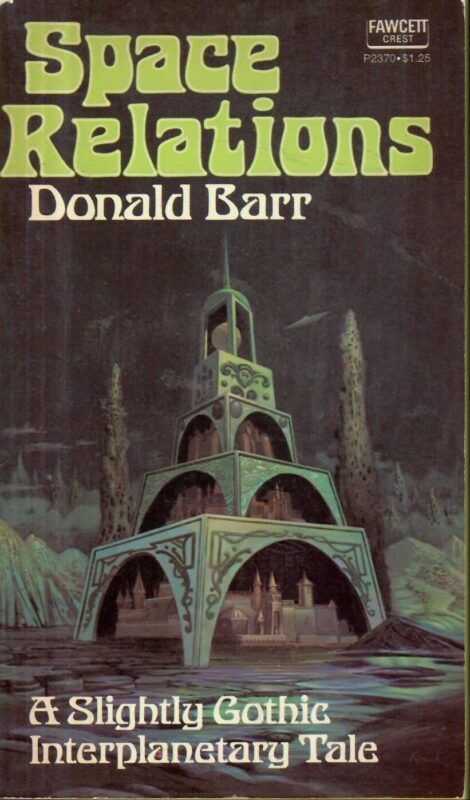
Space Relations: A Slightly Gothic Interplanetary Tale by Donald Barr builds an intricate architecture of erotic power, political decay, and philosophical satire across a colonized galaxy. The novel opens in the bureaucratic sterility of Earth’s future technocracy and extends into the lush, corrupt world of Kossar—a planet ruled by a hereditary aristocracy whose civilization depends on human slavery. Donald Barr’s prose fuses the formal cadence of classical dialogue with the clinical precision of science fiction, creating a world where desire and governance converge into one system of control.
The Political Anatomy of Kossar
Kossar exists as a relic of human feudalism projected into space. The planet’s founders, exiled from Earth centuries earlier, built a society governed by aesthetic cruelty and ritualized servitude. Its ruling council consists of seven figures whose titles evoke decayed nobility: Lord Wynther, Sir Osman Parad, the Count of Lyme, the Master of Orme, General Falkendire, Baron Ewbold, and Lady Morgan Sidney. Their clothing, mannerisms, and dialects recall an aristocracy that sustains its identity through theatrical authority. Each domain reflects a local tyranny. The fens of Treghast, Lady Morgan’s estate, supply slaves to the mines of Blindmarsh. The city of Orme trades in ornamented violence. Kossar’s economy depends on the humiliation of human labor.
The council governs through rhetoric rather than policy. Meetings unfold as performances of irony and menace. They discuss the terms of joining Earth’s Man-Inhabited Planets Treaty Organization, a coalition that promises military protection against the alien Plith Empire. Clause Eighteen of that treaty forbids slavery, threatening the foundation of Kossar’s power. The council debates persuasion, deceit, and reform with a tone of decadent wit. Their deliberation reads as both theater and theology—each lord a priest of domination, each phrase a defense of hierarchy.
The Return of John Craig
John Armbruster Craig, Earth diplomat and former slave of Kossar, returns as envoy to negotiate its entry into the Treaty Organization. His presence embodies the paradox of civilization: the emancipated victim who speaks for his oppressors. Craig’s mission emerges from political necessity. Earth fears the expansionist Plith and seeks Kossar’s alliance to secure interstellar defense. Yet Craig’s personal history transforms diplomacy into psychological confession. Eight years earlier, pirates sold him to Kossar, where he labored in the mines of Treghast under the rule of Lady Morgan. His enslavement left physical scars and moral fissures.
In the novel’s opening sequence, Craig undergoes an exhaustive medical and psychological examination conducted by Dr. Frederic Krause in Bethesda. The procedure, described through a web of wires, electrodes, and probes, turns Craig’s body into a map of control systems. The computer records every reflex as data. Krause’s voice alternates between humor and diagnosis. The examination becomes an interrogation of memory. When Krause tests Craig with a “forty-word” association list—duty, eat, pink, teeth, shame—the results expose an erotic charge between violence and tenderness. The dialogue establishes the novel’s governing equation: the political order of power mirrors the biological order of desire.
The Erotics of Power
Craig’s mind carries the residue of subjugation. His physician senses an unresolved strain between intellect and appetite. Krause accuses him of “binding energy,” a psychic compression that converts trauma into brilliance. Craig’s later achievements in treaty design and poetry arise from this inner distortion. His early poems, written before captivity, celebrate seasonal beauty and human touch. His later “Medusa Sonnets” worship the petrifying ecstasy of domination. Krause identifies the change as pathological; Craig insists it as revelation. The conversation establishes the novel’s tone of philosophical aggression.
Craig’s poetry and diplomacy share the same tension. Both seek order through surrender. The doctor warns that Craig’s brilliance is “a symptom.” Craig replies that he must return to Kossar “for the sake of his health.” He claims unfinished business with Lady Morgan, whose control once destroyed and defined him. His Latin invocation—“Amo ut intellegam,” I love that I may understand—becomes the novel’s moral axis. Love serves as an epistemological act, a method for comprehending evil through submission to its form.
The High Council Convenes
As Craig travels toward Kossar, Barr shifts perspective to the planet’s High Council. The scene unfolds with ceremonial precision. Each ruler enters the chamber adorned in symbolic costume: Wynther’s frock coat like a beetle shell, Falkendire’s decorated uniform, Morgan’s white gown cinched with gold. Their conversation circles Clause Eighteen. The Count of Lyme analyzes its implications: the clause forbids slavery in any member world. The council argues three options—refusal, persuasion, or abolition. Wynther proposes deceit. Lady Morgan rejects moral compromise. She calls slavery the essence of Kossar’s civilization and the true expression of human instinct.
Their dialogue exposes Barr’s method. He constructs political argument as performance. Each speech accumulates irony, historical reference, and erotic suggestion. Morgan’s declaration—“I enjoy being a slaveowner”—announces the theme with stark candor. Her defiance fascinates Craig when he later confronts her. She embodies the attraction of domination, the intelligence that justifies cruelty as art. Through her, Barr dramatizes the collapse of ethics into aesthetics.
The Gothic Mechanism of Civilization
Kossar functions as an organism sustained by ritualized violence. Its cities display grand architecture built by enslaved labor. Its ceremonies reenact conquest. Its technology coexists with archaic manners, creating a world of anachronistic luxury. Barr describes a planet where refinement conceals brutality, and etiquette codifies aggression. The gothic tone arises from this coexistence of elegance and horror. The reader senses a civilization aware of its decay yet incapable of moral revision.
The planet’s history traces back to the Carlyle Society, a faction of authoritarian intellectuals exiled from Earth. Their creed celebrated hierarchy as divine order. Centuries of isolation intensified their ideals into fetish. Kossar’s institutions preserve the gestures of British nobility but drain them of moral substance. The council’s politeness masks paranoia. Beneath its salons lie mines and laboratories of suffering. Barr portrays slavery not as aberration but as structural necessity—a condition that defines consciousness.
The Meeting of Craig and Lady Morgan
Craig’s arrival on Kossar reignites the psychological narrative. His reunion with Lady Morgan operates simultaneously as diplomatic mission and erotic confrontation. She receives him with calculated grace, testing his resolve through mockery and memory. Their conversations unfold as duels. She reminds him of his time in the mines, of the punishments he endured, of the moment he ceased resisting. He answers with irony and restraint, mastering his humiliation through intellect. The tension between them fuels the novel’s energy.
Morgan embodies the intelligence of cruelty. She understands domination as both pleasure and principle. Craig’s presence challenges her certainty, yet she recognizes in him a mirror of her own desire for control. Their dialogue becomes the true negotiation behind the treaty. The signing of documents parallels the seduction of bodies. Through this pairing, Barr fuses politics with metaphysics: every act of governance replicates the erotic rhythm of command and submission.
The Logic of Slavery
Clause Eighteen represents more than law. It symbolizes the possibility of moral reform through external enforcement. Kossar’s rulers see it as existential threat. Craig, its original author, confronts the clause as an accusation. His attempt to reconcile political necessity with personal memory defines the novel’s structure. He argues that Earth needs Kossar’s alliance to resist the Plith, whose insectoid empire consumes planets without sentiment. Lady Morgan counters that Kossar’s system sustains human vitality through hierarchy. Their conflict dissolves into recognition: both civilizations depend on forms of servitude.
Barr refuses sentimental resolution. Kossar’s cruelty persists because it articulates the truth of human desire—the urge to possess and be possessed. Earth’s bureaucratic compassion functions through similar mechanisms of surveillance and control. The treaty that Craig negotiates becomes a moral compromise disguised as progress. The supposed abolition of slavery conceals its redefinition as economic discipline and psychological manipulation. In this fusion of metaphysics and administration, Barr anticipates the bureaucratic dystopias of later science fiction but renders them through the style of gothic melodrama.
The Descent into Moral Equilibrium
Craig’s inner conflict deepens as he realizes his complicity in Kossar’s order. The more he argues for reform, the more he reenacts the logic of mastery. His attraction to Morgan becomes the measure of his self-awareness. Through her cruelty, he perceives the structure of his own civilization. His earlier idealism dissolves into comprehension: freedom exists as a rhetorical form sustained by systems of control.
The final stages of the negotiation reveal the novel’s philosophical climax. Craig does not overthrow slavery; he translates it into diplomacy. The signing of the treaty affirms the permanence of power relations across planets. Morgan remains sovereign of her world, yet bound to Earth’s bureaucratic hierarchy. Craig secures alliance through submission, embodying the paradox that domination survives every reform by adapting its language.
The Aesthetic of Power and the Function of Knowledge
Donald Barr constructs his narrative through precise linguistic symmetry. His prose alternates between the analytical diction of political philosophy and the sensual imagery of gothic romance. Dialogue dominates the structure, reducing action to psychological revelation. Every conversation advances through logical inversion and syntactic compression. Barr’s characters speak as instruments of intellect rather than as emotional entities. The effect is theatrical and cerebral.
Knowledge in this novel operates as seduction. Craig seeks understanding through proximity to danger. His education on Kossar transforms brutality into philosophy. Barr defines this transformation as the essential process of civilization—the conversion of pain into structure. The novel’s title describes this relation: space relations are the cosmic scale of human relations, and the gothic tone arises from the persistence of cruelty within rational order.
The Legacy of a Gothic Intellect
The book concludes with an atmosphere of containment. Craig departs neither redeemed nor condemned. Kossar joins the treaty, yet its essence remains unchanged. Lady Morgan continues her rule, her intelligence untouched by moral reform. Earth receives the alliance it needs, securing temporary defense against the Plith. Beneath political success lies the recognition that civilization perpetuates its own corruption as a condition of stability.
Barr’s fiction achieves its authority through structural clarity. Every sentence advances the geometry of moral decay. The novel belongs to a lineage of speculative works that treat governance as erotic enterprise and philosophy as ritual. Its satire reaches beyond science fiction into theology and psychology. Space Relations defines a world where hierarchy is the grammar of existence, and understanding requires participation in the system one studies. The gothic becomes the language of modern intelligence—elegant, cruel, and exact.