Did the Phoenicians Discover America
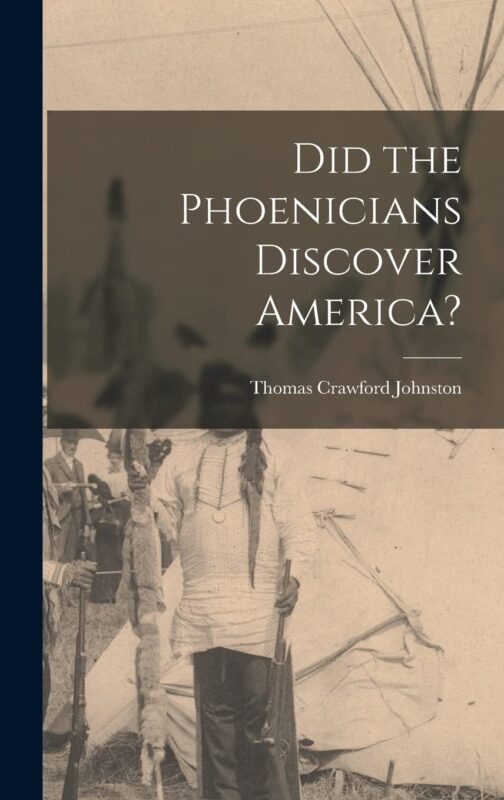
Did the Phoenicians Discover America by Thomas Crawford Johnston examines a thesis that connects the civilizations of the Eastern Mediterranean with those of ancient America. Johnston assembles a structure of ethnological, linguistic, and archaeological evidence to argue that Phoenician navigators reached the American continent millennia before the voyages of the Norse or the Spanish. His study moves from the origins of the Phoenician people in the Persian Gulf to their maritime expansion across the Mediterranean and into the Atlantic, tracing cultural parallels that suggest a transoceanic link between the Old and New Worlds.
Origins of the Phoenician Migration
Johnston begins in the highlands of Kurdistan, where early Semitic tribes formed the nucleus of what became the Phoenician race. From these uplands near the Tigris and Euphrates, the tribes migrated southward into Mesopotamia and later to the shores of the Persian Gulf. There they established settlements on the islands of Tylos and Arados—known today as the Bahrein Islands—whose names would later reappear as Tyre and Aradus in the Mediterranean. Johnston links these sites through linguistic continuity and architectural remains, asserting that the Persian Gulf served as the first maritime school of the Phoenicians. Their exposure to the Indian Ocean trade created a seafaring culture capable of navigating immense distances. The discovery of teak-like timber on the Bahrein Islands, their cotton plantations, and pearl fisheries formed the foundation of an industrial civilization that specialized in textiles, dyes, and maritime commerce.
The Hyksos Legacy and the Egyptian Connection
The book positions the Hyksos, or Shepherd Kings, as a pivotal intermediary race. Johnston reconstructs their invasion of Egypt around 2300 BCE and their long occupation of the Nile valley as a process that transformed a pastoral people into administrators, engineers, and artisans. Their later expulsion by the Theban dynasties dispersed a trained population into Palestine and Syria, where they merged with their Phoenician kin. Johnston interprets this amalgamation as the genesis of the classical Phoenician state—a hybrid power that combined Mesopotamian, Egyptian, and Semitic elements into a commercial and intellectual engine. The union of Hyksos technique with Phoenician enterprise produced an urban society skilled in metallurgy, weaving, shipbuilding, and mathematics. From this convergence arose the maritime cities of Sidon and Tyre, whose fleets extended the world’s first organized trade network.
The Sea as Civilization’s Engine
The Phoenicians’ power derived from their mastery of navigation. Johnston reconstructs their early voyages using references from Herodotus, Strabo, and Pliny. Their trade routes connected the Nile with the Euphrates, traversed the Red Sea, and extended through the Mediterranean to the Atlantic. He examines how their settlements—Gades in Spain, Carthage in North Africa, and Cadiz on the Iberian coast—formed stepping stones toward the open ocean. The author argues that their practice of founding island emporiums near the mainland, perfected at Bahrein and repeated at Tyre and Sidon, shaped their approach to colonization. The murex fisheries that produced Tyrian purple provided both the economic motive and the maritime technology for sustained oceanic exploration.
The Compass and Astral Navigation
Johnston attributes the invention of the compass to Phoenician ingenuity, rejecting Chinese priority. He describes an early magnetic instrument linked to the Aztec Calendar Stone, which he interprets as a monument encoding the same cosmological principles that guided Mediterranean navigation. By aligning the calendar’s symbolic orientation with the discovery of the Pole Star and the Phoenician Bactellium, Johnston constructs a chain of evidence that places the technological origin of direction-finding in the Eastern Mediterranean. He argues that the precision of Aztec astronomical systems, the alignment of their temples, and their understanding of the cardinal points are survivals of this ancient science transmitted across the Pacific.
The Commercial Alliance of Solomon and Hiram
A major section of the book reconstructs the partnership between King Solomon of Israel and Hiram of Tyre. Johnston interprets the alliance described in the Hebrew Scriptures as a historical record of joint maritime enterprise. From the port of Eziongeber on the Red Sea, their combined fleet sailed to Ophir, a region Johnston locates on the American mainland. He infers this location from the nature of the cargo—gold, silver, ivory, and exotic woods—and from the duration of the voyages. The cooperation between Israelite administrators and Phoenician mariners forms, in his view, the historical bridge between Eastern and Western civilizations. The expedition’s products mirror those of Central America, where precious metals, mahogany, and ornamental stone abounded.
Ophir and the American Mainland
Johnston’s identification of Ophir anchors his thesis. He asserts that the land described in the Biblical texts corresponds to territories on the Pacific slopes of the American continent. The duration of Solomon’s voyages—three years—fits the distance from the Red Sea to the western shores of Mexico and Central America when calculated with the prevailing trade winds. He points to traces of Semitic architecture, language, and religious symbolism among the Toltecs and early Aztecs as evidence of this contact. The use of similar iconography in temples, the resemblance of mythic flood narratives, and the appearance of Phoenician script-like markings on American relics build his case that the migrants from the Eastern Mediterranean colonized parts of the New World long before recorded European exploration.
The Cultural Bridge of the Pacific
The argument extends through the Polynesian archipelagos. Johnston examines Samoan and Tahitian traditions describing gods and ancestors who arrived from the east in vessels of fire and light. He identifies these myths as recollections of Phoenician and Hebrew sailors who, driven by monsoon currents, crossed the Pacific. The presence of related religious symbols—altars, sacrificial rites, and the use of sacred fire—corresponds to Mediterranean ritual forms. He interprets linguistic traces in Polynesian dialects as survivals of Semitic roots, suggesting a continuous diffusion of culture from Syria through Arabia and India into the Pacific world.
The Aztec Problem and the Unity of Civilization
In addressing the origins of American civilization, Johnston approaches the Aztec question through the lens of racial unity. He argues that the intellectual and artistic forms of the Aztec, Maya, and Inca societies derive from a shared ancestral matrix extending back to the Eastern Mediterranean. The pyramid temples of Teotihuacan, the hieroglyphic script of the Maya, and the metallurgical expertise of the Andean peoples embody techniques and cosmologies known to Phoenician craftsmen. Johnston reads these parallels as the structural memory of a single civilizing movement that radiated westward from the Levant. The Aztec myths of Quetzalcoatl and the white-bearded visitors arriving from the sea correspond to the historic arrival of Phoenician navigators who transmitted astronomy, agriculture, and metallurgy to the native populations.
Material Parallels Between East and West
Johnston devotes a comparative section to the economic and industrial correspondences between Eastern Mediterranean and American societies. He lists their shared practices: the weaving of wool and cotton, the manufacture of glass and dyes, the extraction and working of precious metals, the use of pearl fisheries, and the complex regulation of trade. He observes that the Aztecs possessed tanning, tattooing, and gymnastic traditions similar to those of Phoenicia. Both regions developed elaborate laws of property, priestly hierarchies, and systems of tribute. The coincidence of these institutional features, he contends, cannot be accidental. They reveal the transplantation of a maritime commercial civilization to the Western Hemisphere.
Religion and Symbolic Continuity
Religious architecture and symbolism form another axis of Johnston’s study. The Phoenician Baal and the Mexican sun god share attributes of solar worship expressed through monumental stone construction. Temples in Central America display columnar forms, serpent motifs, and orientation to solstitial rising points identical to those of the Levantine sanctuaries. Johnston interprets these architectural parallels as physical proof of transmitted theology. He argues that the Phoenician fusion of Egyptian solar rites with Babylonian astronomy found new expression among the American priesthoods, producing the intricate calendar systems of the Aztecs and Mayas.
The Scientific Mind of the Phoenicians
Throughout the work, Johnston frames the Phoenicians as the intellectual engineers of antiquity. They measured the heavens, mapped coasts, and codified commercial law. Their mastery of magnetism, metal alloys, and color chemistry positioned them to shape any civilization they touched. By transferring their methods to foreign shores, they created the first global network of material exchange. Johnston extends this vision to the Americas, portraying the ancient New World as an extension of Phoenician innovation rather than an isolated cradle of development.
The Argument of Continuity
The author structures his conclusion as a chain of correspondences. The migration from Kurdistan to the Persian Gulf created the maritime habit. The Hyksos conquest of Egypt produced the technical base. The alliance of Solomon and Hiram provided the logistical means for transoceanic voyages. The physical evidence in Central America—the arts, languages, and myths—preserves the historical echo of those voyages. Johnston declares that these converging lines form an unbroken narrative of cultural transmission that connects the ancient East to the far West.
The Author’s Intellectual Lineage
Johnston situates his inquiry within the tradition of nineteenth-century scholarship represented by Heeren and George Rawlinson. He uses their chronological frameworks but extends their implications beyond the Mediterranean. The book’s foreword by Oliphant Smeaton praises Johnston’s methodical accumulation of facts and his resistance to speculation. Smeaton characterizes the study as a geographic and ethnologic contribution that redefines the understanding of early human movement. Johnston’s meticulous reconstruction of trade routes and cultural artifacts transforms conjecture into structured argument.
The Vision of a Unified Human Past
In the final synthesis, Johnston affirms that human civilization progresses through contact and migration. The Phoenician voyages across the Pacific become the missing link that explains the sudden appearance of advanced societies in the Americas. The diffusion of agricultural knowledge, textile production, metallurgy, and celestial science reflects the dynamism of a people who carried their institutions wherever the sea permitted. The author treats the transoceanic journey not as a legend but as a consequence of maritime capability, geographical opportunity, and commercial intent.
Continuing Significance
Did the Phoenicians Discover America frames a historical paradigm that binds geography to anthropology. Its relevance persists in discussions of early navigation, cross-cultural transmission, and the global scope of ancient commerce. Johnston’s synthesis positions the Phoenicians as progenitors of the maritime world system, extending their influence from the Euphrates to the Pacific. The book invites reconsideration of the origins of American civilization as an outcome of Mediterranean enterprise. Through an architecture of detailed historical reconstruction, it restores to ancient seafaring its full creative power in shaping the human world.