In Search of the Phoenicians
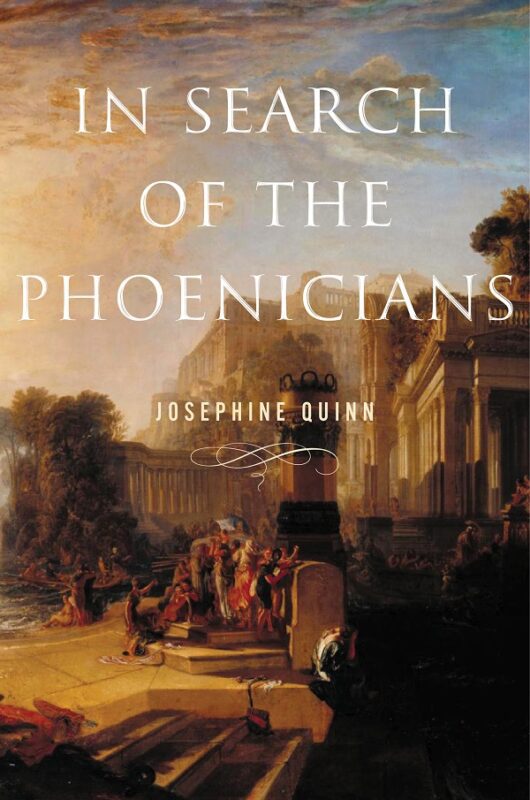
In Search of the Phoenicians by Josephine Quinn reconstructs the ancient Mediterranean through the lives, cities, and myths of those later called Phoenicians. Quinn anchors her analysis in material, linguistic, and textual evidence to show how communities along the Levantine coast—Tyre, Sidon, Byblos, Arados, and Beirut—operated as autonomous polities whose collective identity emerged only in later imaginations. The book tracks how these seafaring urban societies created vast networks of exchange across the Mediterranean and how later historians, imperial powers, and national movements turned that activity into the idea of a single people.
The Origins of the Phoenician Label
The word “Phoenician” comes from the Greek Phoinikes, a descriptive label that referred to the purple dye extracted from murex shells, a key commodity in Levantine trade. Greek authors such as Homer, Herodotus, and Strabo used the term to describe merchants and navigators who connected the Aegean with the Near East. No inscription from Tyre, Sidon, or Byblos identifies an individual as “Phoenician.” Inscriptions record names, families, dedications, and cities. This absence defines the framework of Quinn’s argument: the category originated as a Greek construct that condensed multiple local traditions into one term. By tracing how that word circulated, Quinn situates the emergence of the Phoenicians as a historiographical rather than ethnic event.
City Networks and Maritime Enterprise
Quinn places the rise of the Levantine ports after the Late Bronze Age collapse around 1200 BCE. The fall of Mycenaean, Hittite, and Kassite powers opened maritime routes across the eastern Mediterranean. Merchants from Tyre and Sidon transported cedar, glass, and fine metalwork in exchange for silver, tin, and copper from Cyprus, Sardinia, and Iberia. They refined navigation, transmitted the alphabetic script that simplified trade records, and established new urban foundations on distant shores. Carthage, founded according to legend by the Tyrian princess Elissa—Dido—became the most powerful of these colonies. Polybius described Carthage as the wealthiest city of its time. Quinn builds this economic geography from archaeological and textual data to show a maritime world defined by commerce and local autonomy.
Civic and Familial Identity
Across thousands of surviving Phoenician inscriptions, individuals identify themselves through kinship or place: “son of Hiram, of Tyre” or “daughter of Abdashtart, of Byblos.” This linguistic pattern demonstrates a civic and genealogical orientation rather than ethnic consciousness. Quinn analyzes how these naming practices operated as systems of affiliation that bound people to family, temple, and city. The focus on household and lineage shaped social responsibility, legal standing, and trade partnerships. The city, not the collective nation, structured identity and memory.
Religious Cohesion and Divergence
The cults of Baal Hammon, Astarte, and Melqart linked Phoenician-speaking populations through shared ritual vocabulary and artistic motifs. Quinn examines votive stelae, tophet sanctuaries, and inscriptions from Carthage, Motya, and Sulcis to trace how ritual practice circulated across colonies. The cult of Melqart, patron of Tyre, extended to Gades and Ebusus, providing symbolic continuity across migration routes. Baal Hammon’s worship at Carthage, especially through child dedication and sacrifice, defined a distinctive western community. These networks show a pattern of religious mobility and adaptation. They reveal communication between ports without establishing a single priestly or cultural center.
The Material Grammar of Exchange
Phoenician art, coinage, and architecture reveal interregional conversation rather than uniform style. Quinn surveys silver coinage from Byblos, Sidon, and Tyre alongside the “Siculo-Punic” coins of western colonies. The imagery—palm trees, ships, lions, and gods—forms a visual lexicon that evolved through contact with Greek and Egyptian models. Sculptural fragments from Sidon’s necropolis, such as the “Lycian sarcophagus” and anthropoid coffins, combine Egyptian iconography with local techniques. These artifacts show aesthetic circulation that paralleled trade. Quinn interprets them as material evidence for an open, adaptive culture grounded in maritime experience.
The Carthaginian Ascendancy
Carthage emerges in the fifth century BCE as the dominant power of this maritime system. Quinn identifies the palm tree (phoinix in Greek) on Carthaginian coinage as the first explicit visual statement of Phoenician identity. The symbol served political ambition rather than ethnic awareness. Carthage integrated colonies in Sardinia, Sicily, and North Africa into an organized commercial and military sphere. Under Hamilcar and Hannibal Barca, it contested Roman expansion until its destruction in 146 BCE. Quinn reads Carthage’s empire as a late, pragmatic consolidation of earlier trading practices—a network that retroactively inspired the notion of a Phoenician world.
Greek and Roman Constructions of the Phoenicians
Greek authors portrayed Phoenicians as skilled mariners and inventors, assigning them the alphabet, glassmaking, and navigation by the stars. Roman writers incorporated them into imperial genealogy. Virgil’s Aeneid opens with Juno’s beloved city, Carthage, “a city ancient, held by Tyrian settlers.” The Latin literary tradition transformed the Phoenicians into a dramatic symbol of wealth and fatal ambition. Quinn traces how this image shaped European scholarship from Renaissance humanism through Enlightenment antiquarianism. The Phoenicians became the emblem of commerce and cosmopolitanism.
The Transformation under Empire
In the Hellenistic and Roman periods, the Levantine cities continued to thrive, yet their inscriptions adopt Greek and Latin forms. Coinage under Roman rule in Tyre, Sidon, and Byblos bears imperial portraits alongside local deities. Quinn identifies this bilingualism as cultural strategy rather than assimilation. The first recorded person to call himself a “Phoenician” was Heliodorus of Emesa, author of the Greek romance Aethiopica in the third or fourth century CE. His claim demonstrates how the term had by then become a literary identity within the Greco-Roman world.
The Modern Reinvention of the Phoenicians
Quinn moves from antiquity to modern nationalism. In the nineteenth and twentieth centuries, Lebanese intellectuals and politicians revived the Phoenicians as ancestors of the modern nation. The Maronite historian Tannus al-Shidyaq described the “Phoenician cities of Lebanon” in 1859. During the French Mandate after World War I, figures such as Charles Corm and Michel Chiha linked Lebanese identity to maritime heritage. They presented Lebanon as a Mediterranean country distinct from Arab culture. The journal La Revue Phénicienne in 1919 articulated a vision of Lebanon as “the first civic state” descending from Tyre and Sidon. French authorities supported this imagery through coinage, museums, and education. Coins under the Mandate bore a Phoenician ship and the cedar of Lebanon, asserting historical continuity between ancient navigation and modern commerce.
Nationhood and Historical Invention
Quinn situates these movements within theories of nationalism articulated by Ernest Renan and later scholars. A nation forms through shared memory and collective will, not through biological descent. Lebanese “New Phoenicianism” used the language of ancestry to unify diverse communities under a secular, Mediterranean narrative. In Tunisia, after independence in 1956, President Habib Bourguiba employed a similar strategy. He built his palace at Carthage and placed a Phoenician ship on the national coat of arms beside a lion and scales of justice. The state hosted archaeological festivals and UNESCO campaigns under the slogan “Save Carthage.” The Phoenician past supplied a vocabulary of prestige, maritime power, and continuity that framed postcolonial identity.
Archaeology and the Production of Memory
Quinn demonstrates how archaeology reinforced these political imaginations. Excavations at Tyre, Sidon, and Carthage focused on monumental remains that supported narratives of national grandeur. Museums in Beirut and Tunis curated Phoenician artifacts as symbols of origin. Maps, coins, and educational texts presented the Phoenicians as founders of civilization and inventors of writing. The process mirrored European colonial scholarship that tied modern nations to ancient prototypes. The result was a durable myth in which a network of port cities became a singular people.
The Structure of the Book
The work unfolds in three sections. Phantom Phoenicians dismantles the ethnic premise by analyzing linguistic and historical evidence. Many Worlds explores the cultural, religious, and economic dynamics that shaped the Levantine and western Mediterranean networks. Imperial Identities traces the reinterpretation of Phoenician heritage from the Roman era to modern nationalism. Quinn arranges these sections to move from deconstruction to reconstruction, replacing the idea of a nation with a study of interaction, adaptation, and memory.
Language, Sources, and Evidence
The research integrates more than ten thousand inscriptions, extensive coin catalogues, and archaeological records from the Levant, North Africa, and the western Mediterranean. Quinn employs comparative analysis across Greek, Latin, and Semitic sources. She draws on the Kanaanäische und Aramäische Inschriften corpus, the Corpus Inscriptionum Latinarum, and regional excavation reports. This evidentiary precision anchors the argument that identity in the ancient Mediterranean operated through language, ritual, and trade rather than lineage.
Identity as Historical Process
Quinn defines identity as a practice that forms through context and repetition. In the Phoenician case, identity resided in action—the sailing of ships, the building of temples, the minting of coins—rather than in mythic unity. The book portrays a dynamic Mediterranean where people moved between cultures, translated gods, and repurposed traditions. The Phoenicians existed through connectivity, not boundaries. This framework gives historical agency to merchants, artisans, and migrants who shaped the economic and cultural fabric of the ancient world.
The Persistence of the Phoenician Idea
From the Renaissance onward, European antiquarians sought ancient origins for their own nations. In the seventeenth century, Aylett Sammes published Britannia Antiqua Illustrata with maps linking Britain to Phoenician traders. In the nineteenth century, Irish scholars proposed that the Irish language descended from Phoenician and that the Phoenicians had settled on their shores. Quinn connects these ideas to colonial identity formation in Ireland, where writers compared the Irish under British rule to the conquered Carthaginians of Virgil’s Aeneid. Such associations shaped modern cultural memory across Europe.
Intellectual Continuity and Historical Responsibility
The narrative ends by returning to the problem of historical imagination. The Phoenicians endure as symbols because they embody mobility, innovation, and exchange. Their story illustrates how communities create coherence through storytelling. Quinn concludes that the task of history is to trace those stories, recognizing how names generate realities. The Phoenicians exist in the world’s archives as a dialogue between description and belief. Their legacy survives in languages, artifacts, and the continuing impulse to locate origins in movement.
Historical Precision and Structural Insight
Quinn’s method unites classical philology, archaeology, and political history. Her precision in tracing inscriptions and her attention to modern reception create a continuous line from Tyre’s harbor walls to the speeches of twentieth-century Lebanese politicians. The argument unfolds through cumulative detail: ships carved on coins, sanctuaries dedicated to Melqart, colonial charters, and nationalist manifestos. Through these sources, Quinn restores historical depth to Mediterranean networks that shaped the ancient and modern world alike.
Enduring Significance
In Search of the Phoenicians defines a pattern of human organization rooted in exchange, adaptation, and the circulation of memory. The book speaks to historians, archaeologists, and readers interested in how communities define themselves across time. Quinn transforms the Phoenicians from a static label into a model of historical interconnection. The cities of Tyre, Sidon, and Carthage emerge as agents of movement whose influence extended from the Levant to the Atlantic. Their story demonstrates how people construct belonging through commerce, language, and belief—and how later generations transform those traces into nations.
