Original Sin: Ritual Child Rape & The Church
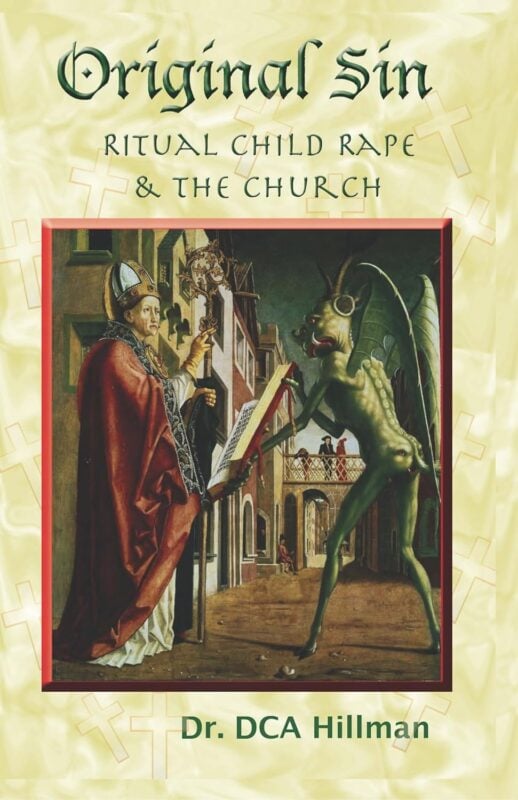
Original Sin by David Hillman examines the role of ritual child abuse in early Christianity as a deliberate strategy to erase pagan influence, reshape sexual norms, and consolidate ecclesiastical authority. The book traces how the institutional Church constructed its theological identity through a series of strategic cultural erasures and redefinitions, placing ritual sodomy, doctrinal exclusivity, and anti-feminine ideology at the core of Christian orthodoxy.
Sexual Power as Political Weapon
Early Church leaders identified sexual energy as the primary threat to their authority. Pagan cultures honored desire as sacred, aligned with divine forces such as Aphrodite and Dionysus. Their rituals centered on ecstasy, embodied revelation, and the sanctity of erotic power. In contrast, Christian priests engineered a theological system that criminalized sexual pleasure, reframed puberty as a fall from grace, and assigned moral decay to female beauty. They taught that women facilitated demonic corruption through sexual allure and that true holiness required the suppression of desire.
This doctrine provided justification for the sexual violation of boys during initiation. Ritual sodomy served two strategic functions: it separated young males from maternal influence and inoculated them against attraction to women. It also created a shared secret that bound initiates to the priesthood. Within these closed systems, abuse was reframed as spiritual protection. Priests taught that ritual rape guarded the soul from the temptations of pagan femininity, redirecting allegiance toward a male-centered ecclesiastical hierarchy.
Destruction of the Feminine Oracle
Pagan societies placed political and religious authority in the hands of adolescent priestesses. Known as oracles, these young women served as the voices of gods. Trained in geometry, astronomy, and pharmacology, they administered justice, advised monarchs, and mediated divine messages through ritual performance and psychoactive substances. Their bodies and voices were conduits of cosmic truth.
The Christian Church dismantled this system by attacking its foundational premises. It banned drug use in religious contexts, classified oracular rites as demonic, and used rape to disqualify young boys from participating in oracular cults. This ensured that converts could never become mediums for rival deities. Through these mechanisms, Christian priests eliminated the public authority of women and delegitimized the experience of divine possession outside Church doctrine.
Erasure of the Oracular Cosmos
Ancient Mediterranean religion viewed the cosmos as a dynamic system governed by immortal principles. Deities like Night, Fate, and Nemesis embodied natural forces and provided ethical structure. Priestesses interpreted these forces through trance states, guided by venom-derived sacraments and performed in landscapes designed to amplify spiritual resonance. These rituals upheld communal justice and often restrained the ambitions of tyrants.
The Church replaced this model with a single masculine deity embodied in a historical man. It prohibited experiential engagement with divinity and substituted hierarchical instruction for visionary access. Doctrine became the sole vehicle of truth. The conversion experience required not illumination but submission. Mystery gave way to creed. Where oracles taught personal reckoning, the Church imposed obedience.
Monopoly on Sacramental Authority
To secure its dominance, the Church criminalized alternative sacramental systems. Pagan rituals often employed psychotropic wine to invoke divine presence. These ceremonies grounded the worshipper in natural cycles of death and renewal. Christian leaders condemned this sacramental ecology as heresy and legislated against it. They seized the assets of non-Christian cults under the guise of moral reform.
Church sacraments eliminated chemical intermediaries and relied on symbolic rituals overseen by ordained clergy. The Eucharist replaced drug-induced ecstasy with metaphysical doctrine. Faith substituted for visionary experience. By outlawing drug-based rites and sanctifying non-erotic virginity, the Church destroyed the bodily foundation of spiritual knowledge and created a doctrine-centered orthodoxy.
Reconstruction of the Child
Church authorities redefined the developmental arc of youth to align with their ritual purposes. In the pagan world, adolescence marked the emergence of sacred potential. Puberty signified readiness to receive divine inspiration. Young girls served as priestesses; young boys entered civic life through performance and service.
Christian doctrine reversed this arc. Puberty signaled contamination, a fall into lust, a danger to the soul. Priests taught that uncorrupted boys must be cleansed of sexual potential before desire awakened. Ritual sodomy was presented as preventive purification. This inversion placed children’s bodies at the center of Christian initiation, not as symbols of purity but as sites of conquest.
By instilling shame, pain, and secrecy at the moment of sexual awakening, the Church severed the child’s bond to natural maturation. It redirected emotional allegiance from maternal nourishment to clerical dominance. In this structure, the priest became both father and god. The child’s psyche was grafted into the institutional body of the Church.
Suppression of Maternal Justice
The early Church neutralized female political power by severing the link between motherhood and moral authority. In pagan cosmology, divine mothers like Night and Aphrodite embodied justice, protection, and fertility. Their priestesses wielded real power through oracles, legal pronouncements, and armed enforcement. Orders like the Wolves and Medusae trained girls in pharmacology and weaponry to defend sacred law.
Christian theology inverted these associations. It reclassified motherhood as subservience and feminine power as sin. Church fathers taught that pregnancy, menstruation, and erotic attraction were signs of spiritual corruption. They cast the nurturing female as Eve—originator of sin—and exiled her from public life.
This ideological shift allowed the Church to undermine the legal protections previously enforced by maternal cults. Oracular decrees that had upheld family integrity and punished abuse were discarded. Justice became the domain of male bishops and councils. Without the protective framework of feminine divinity, children lost their political defenders.
Fabrication of the Whore and the Homosexual
Church leaders created the modern categories of sexual deviance by assigning moral pathology to behaviors previously embedded in sacred practice. Pagan cults embraced bisexuality, cross-gender expression, and ritual sex as integral to spiritual transformation. Their ceremonies taught that erotic experience could unlock divine awareness.
The Church systematized opposition to these practices. It constructed the concept of the homosexual as a person defined by sin. It classified sexually expressive women as whores. These labels were not observations—they were inventions designed to isolate, control, and convert. By criminalizing the embodied identities of its rivals, the Church monopolized the language of morality and reshaped cultural memory.
Political Ascendancy Through Sexual Control
Hillman argues that Christian doctrine advanced not through superior theology but through strategic social engineering. Priests used sexual trauma to manufacture exclusivity, loyalty, and secrecy. They framed these violations as sacred rites that separated the elect from the damned.
This model generated a culture of fear, dependence, and obedience. Converts were stripped of their cultural frameworks and recast in the image of Church doctrine. The enforcement of celibacy, the eradication of pagan symbols, and the imposition of doctrinal purity created a spiritual monopoly aligned with imperial power.
Within this system, ritual abuse functioned as both a rite of passage and a mechanism of control. It forged a psychological break with the past and installed the Church as the sole arbiter of truth. The result was a civilization structured around denial, repression, and enforced amnesia.
A System Built on Erasure
Original Sin documents the convergence of theology, violence, and politics in the formation of early Christianity. Hillman details the methods by which the Church extinguished rival spiritual systems and instituted a regime of bodily control. He presents ritual child abuse not as an anomaly but as a deliberate act of cultural reprogramming. The suppression of feminine authority, the destruction of ecstatic ritual, and the redefinition of sex all served a single goal: the consolidation of priestly power.
