On Tyranny: Twenty Lessons from the Twentieth Century
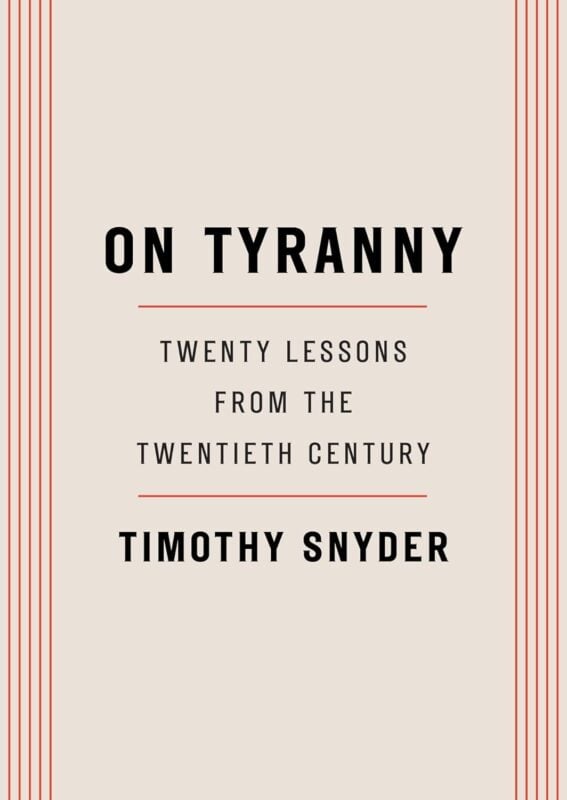
On Tyranny by Timothy Snyder offers twenty actionable strategies for recognizing and resisting authoritarian rule. Drawing on the collapse of democracies in 20th-century Europe, Snyder maps a path for civic courage grounded in historical awareness, ethical responsibility, and individual action. The book merges urgent political instruction with moral inquiry, rooted in a historian’s precise, narrative logic.
Tyranny as Process
Tyranny does not erupt; it accretes. Snyder opens with the premise that authoritarianism gains power not through immediate seizure but through gradual acquiescence. Individuals obey in advance. They anticipate repression and adjust their behaviors before coercion demands it. In Germany, Austria, and Czechoslovakia, citizens aligned themselves with new powers before those powers issued orders. In doing so, they revealed the scope of potential control and widened the corridor for authoritarian acceleration. Tyranny begins when a population teaches its leaders what they can get away with.
Institutional Vigilance
Institutions sustain democratic continuity, but they do not animate themselves. Snyder argues that institutions only function when individuals uphold their principles through action. Courts, media, electoral commissions, and unions depend on people choosing to participate, protect, and push back. After Hitler’s appointment in 1933, German Jews underestimated the capacity of institutions to crumble under pressure. The editorial optimism of their own press betrayed a belief that government norms would hold. Within a year, those norms vanished.
Democracy Dismantled from Within
Elected parties often erase democracy. Snyder emphasizes that the most consequential democratic collapses began with elections. The Nazis used their electoral victory in 1932 to introduce legal changes, eliminate opposition, and instill one-party rule. The Czech Communists, after winning in 1946, did the same. People who assumed another election would follow forfeited their last chance to resist. Voting is not a ritual; it is a threshold. Its significance hinges on the assumption that it recurs.
Symbols Shape Action
Slogans, emblems, and visual codes define the cultural prelude to repression. Snyder stresses the physical world’s symbolic weight. Removing or confronting hate signs—graffiti, banners, armbands—prevents the normalization of violence. When Austrians humiliated Jews in public after Hitler’s annexation, they did so not under orders, but under a new code of public legitimacy. Watching becomes participation. Ignoring signs of exclusion accelerates their conversion into systems of persecution.
Ethics Within Professions
Under tyranny, professions become instruments. Judges sign off on show trials. Doctors perform experiments. Civil servants draft deportation lists. Businessmen calculate profit margins from slave labor. Snyder profiles individuals who justified atrocities through professional roles, insisting that lawyers and physicians had the power to say no. The ethical guardrails of professions do not collapse; they are surrendered.
Paramilitary Convergence
Authoritarian leaders rely on semi-legal violence. Snyder details how Nazi storm troopers and SS units began as unofficial groups, gained uniforms, and integrated with state forces. As boundaries between legal authority and personal allegiance dissolve, paramilitary actors change the rules. When a campaign crowd expels dissenters at the candidate’s behest, and private security enforces ideological conformity, democratic space contracts.
Armed Conscience
Carrying a weapon demands reflection. Snyder recounts how ordinary German police—not elite SS units—executed mass killings. They followed orders without coercion. In rare cases, those who refused were not punished. The lesson: refusal is possible. Uniformed service does not absolve responsibility; it heightens the need for moral clarity. Tyranny exploits obedience but relies on conformity.
Power of Example
One figure standing firm disrupts consensus. Snyder elevates Rosa Parks and Winston Churchill as archetypes of civic courage. When Churchill rejected appeasement and committed Britain to resist Hitler, he altered world history. When a young Polish woman named Teresa Prekerowa repeatedly entered the Warsaw ghetto to save Jews, she affirmed an ethical order that the law no longer protected. Visibility matters. Resistance begins with presence.
Guarding Language
Tyranny thrives in linguistic erosion. Snyder examines how authoritarian regimes redefine vocabulary. In Nazi Germany, "the people" meant the racially pure. Political engagement was war. Criticism became treason. Television reduces nuance to image flow, erasing context. Internet echo chambers replicate the same effect. Snyder urges readers to read books—novels, history, political theory—to reestablish cognitive independence and critical perspective.
Truth and Freedom
Truth enables liberty. Snyder warns that when fact loses meaning, critique collapses. Authoritarians deploy lies with rhythm. Trump’s campaign, he writes, turned factual distortion into ritual. Slogans replaced argument. Shamanistic incantation—“Build that wall,” “Lock her up”—displaced substance with affirmation. Magical thinking blurred contradiction. Post-truth conditions do not soften democracy; they suffocate it.
Investigative Citizenship
A functioning democracy requires an informed public. Snyder calls for direct engagement with investigative journalism. Trust builds through long-form reporting, factual verification, and transparent sourcing. Social media recirculates spectacle. Investigative work uncovers structure. Journalists risk their freedom, and often their lives, to reveal hidden mechanisms of power. Supporting them is a civic imperative.
Interpersonal Solidarity
Eye contact is politics. Small talk affirms community. Snyder describes how people under Stalinism or Nazism remembered a handshake, a glance, a greeting—those who still saw them as human. In cultures of denunciation, trust anchors survival. People escape when others choose to help. Tyranny isolates. Recognition resists.
Embodied Resistance
Action occurs in physical space. Snyder explains how effective movements—from Poland’s Solidarity to civil rights marches—require bodies in unfamiliar places. Civic courage grows from connection. Friends forged in protest become the infrastructure of resistance. Shared risk cements solidarity. Digital outrage without material commitment remains inert.
Private Life as a Fortress
Privacy limits power. Tyranny expands by collapsing the boundary between public and private. Snyder outlines how regimes exploit digital surveillance, leak communications, and expose personal data to shame or control. He urges readers to scrub malware, use secure communications, and talk in person. Legal trouble, financial dependency, or emotional vulnerability becomes leverage for coercion.
Support Structures
Organizations, even apolitical ones, defend freedom. Snyder encourages active participation in associations—charities, unions, clubs. Such groups cultivate trust, decentralize power, and model mutual responsibility. Totalitarian systems absorb or destroy independent institutions. A society with vibrant civil life diffuses control and cultivates citizenship.
Global Learning
Democratic erosion follows patterns. Snyder observes that those who understood Trump’s campaign most clearly were eastern Europeans. Having faced Russian disinformation, manipulated media, and electoral interference, they recognized the tactics. Snyder insists on the necessity of passports, foreign friends, and international awareness. Problems replicated across borders require shared insight.
Rhetoric of Emergency
Tyrants exploit crisis. Snyder explains how Carl Schmitt, Nazi theorist, defined sovereignty as the power to declare an exception. When leaders call for permanent emergencies, they erase legal boundaries. Words like “extremism,” “terrorism,” and “patriotism” often function as pretexts. They reshape rules under the guise of necessity. Snyder urges vigilance against rhetorical escalation.
Preparedness for Shock
Disaster accelerates consolidation. After the Reichstag fire, Hitler moved swiftly to suspend rights and centralize power. Snyder notes that the cause of the fire mattered less than its function. Leaders who predict catastrophe and promise salvation often seek unchecked authority. The moment of panic demands clarity. Democracy depends on calm.
Final Courage
The last of Snyder’s lessons returns responsibility to the reader. “If none of us is prepared to die for freedom,” he writes, “then all of us will die under tyranny.” The defense of liberty does not begin with policies or slogans. It begins with individual resolve. History instructs. It does not guarantee. The burden is shared, but the decision is personal.
