Sapiens: A Brief History of Humankind
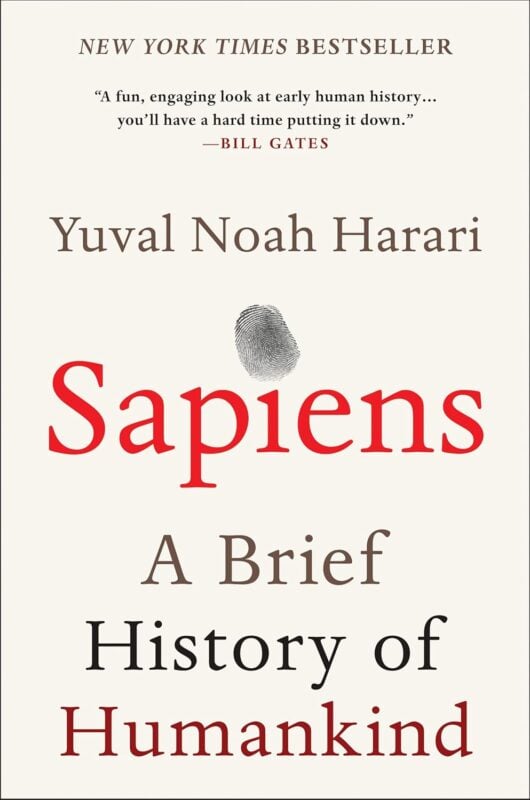
Sapiens: A Brief History of Humankind by Yuval Noah Harari opens with a foundational premise: Homo sapiens rose to global dominance through cognitive adaptability, collective mythmaking, and the compounding power of culture. Harari traces this ascent from the emergence of Homo sapiens in East Africa to their modern geopolitical and technological influence. He identifies three pivotal revolutions—the Cognitive, Agricultural, and Scientific—that defined the human trajectory.
The Cognitive Leap
Roughly 70,000 years ago, Homo sapiens developed the capacity for shared fictions. This shift allowed large groups to coordinate beyond kinship ties. Language, previously limited to immediate, observable realities, expanded to include myths, gods, nations, and laws. With this transformation, humans formed tribes not around biological necessity, but belief systems. Social structures scaled. Cooperation extended across thousands. The abstraction of shared imagined realities enabled cities, armies, and commerce.
Why did this capacity emerge in Homo sapiens rather than other hominins? Harari does not speculate genetically; instead, he tracks behavioral consequences. Sapiens displaced Neanderthals and Denisovans with startling speed. This displacement followed a consistent pattern. Within a few millennia of Sapiens arriving in new ecosystems, megafauna vanished, indigenous hominins disappeared, and ecosystems reshaped. Harari attributes this success to the Sapiens' unique ability to innovate socially, not merely biologically.
The Illusion of Objective Order
Harari argues that human cooperation hinges on belief in collective fictions. Nations, corporations, religions, and legal systems exist because humans act as though they do. These fictions lack material presence yet hold more authority over human behavior than natural forces. Peugeot SA exists only in legal codes and collective trust, yet it produces vehicles, employs workers, and influences markets.
Religious narratives shaped early empires. Legal fictions shaped capitalism. Harari explains that imagined orders enable flexibility. As humans change the stories they believe, they redefine institutions and reshape behaviors. This mutability outpaces biological evolution, giving cultural evolution an accelerating edge.
Agriculture as a Trap
Around 12,000 years ago, Homo sapiens began domesticating plants and animals. Harari frames the Agricultural Revolution not as progress, but entrapment. Farming increased food production, which sustained larger populations, but also introduced hierarchy, labor division, and chronic warfare. Wheat domesticated humans as much as humans domesticated wheat.
Settled life demanded protection of surplus, incentivizing the emergence of kingship, tax systems, and militarized governance. The shift from foraging to farming reduced dietary variety and increased disease exposure. Harari emphasizes the irony: in seeking security and abundance, humans subjected themselves to monotonous work, rising inequality, and dependence on centralized authority.
The Consolidation of Power
Empires extended the logic of imagined order across regions. Harari identifies money, empire, and religion as the three unifiers of humankind. Money enabled trust across strangers through the abstract language of currency. Empires imposed political unity through force and infrastructure. Religions enforced moral consensus through shared belief in divine law.
Each of these forces rested on shared myths. Harari examines how imperial visionaries—from Cyrus the Great to Ashoka—wielded religion and coinage to stabilize and expand power. Commerce spread ideas as effectively as armies. Cross-cultural exchange accelerated, especially along trade routes like the Silk Road.
Science and the Ascendancy of Ignorance
The Scientific Revolution began when humans admitted ignorance. Harari dates this transformation to the 16th century, when thinkers shifted from relying on revelation to seeking empirical evidence. By acknowledging what they did not know, humans launched an exponential pursuit of discovery. This intellectual humility catalyzed technological and industrial revolutions.
Harari shows how science intertwined with empire. European powers funded expeditions that mapped the globe not for knowledge alone, but for domination. Science justified conquest. It also enabled it. Advances in navigation, metallurgy, and biology armed colonizers with strategic advantages over indigenous populations.
Capitalism and the Power of Credit
The rise of capitalism restructured societies around growth. Harari defines capitalism as a system built on faith in future profit. Credit, the lifeblood of capitalism, depends on trust in economic expansion. If lenders believe tomorrow’s economy will grow, they invest today. This belief spurred the rise of banks, joint-stock companies, and colonial enterprises.
Harari traces how capitalism funded the slave trade, underwrote imperialism, and produced both material abundance and systemic exploitation. He underscores capitalism’s unique resilience: it adapts by commodifying change. Innovations become products. Disruptions become markets.
The Industrial Transformation
The Industrial Revolution reshaped human labor, family structures, and relationships with time. Machines replaced muscle. Cities expanded rapidly. The state and market supplanted the family and community as providers of welfare and identity. Harari analyzes how nationalism and mass education filled the emotional and social voids left by mechanization.
Factory life altered rhythms of existence. Clocks replaced seasons. Productivity became virtue. Harari shows how capitalism, science, and empire converged in the modern state, which enforces education, conscription, taxation, and surveillance to maintain order.
Happiness and the Human Condition
Harari challenges the assumption that modern humans live happier lives. Despite technological progress, he argues that human satisfaction remains elusive. Psychological studies show rising incomes have diminishing effects on happiness. Subjective well-being depends more on expectations, social comparisons, and internal narratives than material conditions.
He explores Buddhism’s insight that suffering arises from craving and mental agitation. Where capitalism sells happiness through consumption, Buddhism advises detachment. Harari does not resolve this tension but frames it as central to the human experience.
The Future of Homo Sapiens
Harari closes with a stark provocation: Homo sapiens may soon engineer its own successors. Biotechnology and artificial intelligence could produce beings with greater capabilities and different values. Evolution by natural selection gave way to intelligent design, first through breeding, now through code and genes.
He warns that the species that conquered the planet through shared myths may now create realities beyond collective control. The trajectory from fire to fission, from spearheads to superintelligence, builds toward a future in which Homo sapiens ceases to be the dominant force, or even the definitional human.
History does not move toward justice or freedom, Harari insists. It flows through complexity and contingency. Understanding our past equips us to face futures we cannot yet imagine but are already building.
