Gods of the Bible: A New Interpretation of the Bible Reveals the Oldest Secret in History
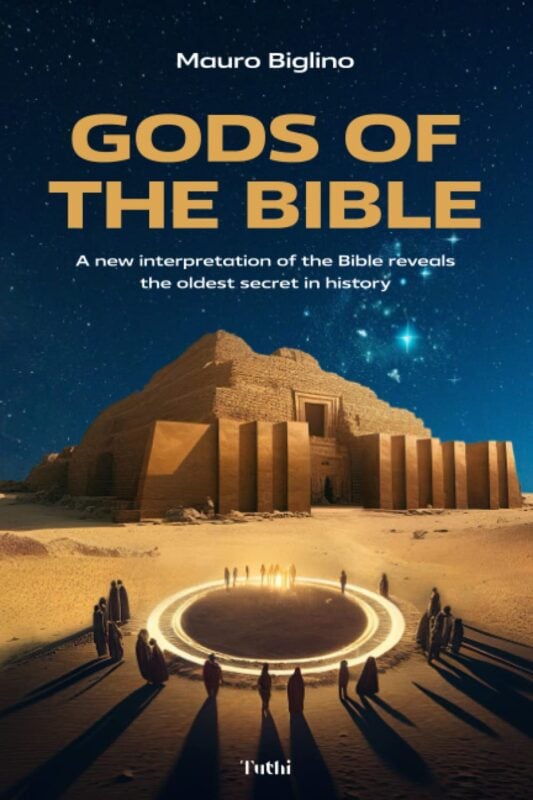
Gods of the Bible: A New Interpretation by Mauro Biglino reframes the Bible as a historical document chronicling interactions between humans and advanced non-human entities. Drawing on his experience as a Vatican-approved Bible translator, Biglino presents a methodical linguistic analysis that unearths alternative meanings hidden beneath millennia of theological overlayering. He contends that many biblical episodes, when read literally and free from doctrinal filters, depict technologically advanced beings engaging directly with ancient human societies.
Revisiting the Elohim
Biglino anchors his thesis in the Hebrew term “Elohim,” traditionally translated as “God.” He demonstrates that this word appears with plural verbs and grammatical forms in multiple passages, signifying a group of beings rather than a singular divine entity. The biblical narrative frequently presents these Elohim as interacting, debating, commanding, and even engaging in territorial negotiations. In Genesis, the “sons of the Elohim” choose human wives, suggesting biological compatibility rather than metaphorical intent. In Exodus, Moses demands a name from the Elohim speaking to him, implying uncertainty about the speaker’s identity and reinforcing the notion of multiple possible interlocutors.
The text also records explicit references to regional Elohim—Yahweh is described not as the universal creator, but as the Elohim “of Abraham, Isaac, and Jacob.” When Jacob and Laban make a covenant in Genesis 31, they invoke the Elohim of both their lineages. This invocation affirms the presence of separate, regionally acknowledged powers rather than a singular, omnipresent deity.
Technology and Misidentification
Biglino advances the hypothesis that early humans encountered advanced visitors whose technologies appeared miraculous. The cargo cult phenomenon illustrates how modern humans mythologized technologically superior outsiders. Islanders during WWII, exposed to military aircraft and radios, constructed ritual runways and worshipped departing soldiers. Biglino posits a similar pattern: ancient people, overwhelmed by aerial phenomena, structured religious systems around misunderstood experiences with superior beings.
This explanatory model transforms traditional divine acts into technological demonstrations. Fire descending from heaven, voices from clouds, and divine transport vehicles mirror modern descriptions of aerial phenomena. Yahweh’s requests—detailed inventories of livestock, metals, and virgins—align more with material desires than spiritual metaphors. These demands are not portrayed as allegorical. The biblical text frames them as logistical outcomes of military campaigns, further grounding the Elohim as embodied agents operating under practical imperatives.
Textual Layers and Translation Bias
Biglino dissects the textual instability of the Bible. He catalogues discrepancies among Jewish, Catholic, Protestant, Samaritan, and Coptic canons. He identifies thousands of variations across source manuscripts such as the Masoretic Text, the Septuagint, and the Samaritan Torah. These divergences reveal ongoing editorial intervention and divergent theological agendas. He emphasizes that vocalization—the addition of vowels to the originally consonant-only Hebrew—occurred centuries after the texts were written, introducing interpretative layers that reshaped meaning.
His critique targets systematic translation errors. Terms like “olam” and “kavod” are routinely rendered as “eternity” and “glory,” despite older lexical definitions suggesting temporal finitude and physical substance. He identifies “ruach,” often translated as “spirit,” as referring more plausibly to wind or breath. These mistranslations serve theological aims, aligning the text with monotheistic dogma by masking its more tangible and pluralistic origins.
Yahweh as a Character
In Biglino’s reconstruction, Yahweh emerges not as a universal, immaterial creator, but as a regional commander among the Elohim. He behaves with emotion, anger, and favoritism. He demands loyalty, punishes disobedience, and enforces legal codes through direct intervention. He claims exclusive rights over territory and people. Biglino highlights Yahweh’s repeated efforts to assert dominance over rival Elohim and secure Israelite allegiance through both promises and threats. This Yahweh does not function as an abstract moral ideal, but as a governing figure managing a political and military enterprise.
The narrative structure of the Bible supports this reading. In the Ten Commandments, Yahweh begins by stating his exclusivity over Israel, not over the cosmos. The command “You shall have no other Elohim before me” presupposes the existence of alternatives. This is not a metaphysical claim about monotheism. It is a geopolitical assertion of allegiance.
Ancient Narratives as Historical Memory
Biglino urges readers to treat biblical accounts as distorted but traceable memories of actual events. He parallels Schliemann’s discovery of Troy by following Homer’s epic literally. The Iliad, once dismissed as mythology, led to the unearthing of a real city. By applying the same method to the Bible—reading it as a document of historical memory rather than theological allegory—Biglino seeks to uncover traces of ancient contact with technologically advanced beings.
He situates his work within a broader intellectual shift. Academic interest in Unidentified Aerial Phenomena (UAPs) has accelerated, with institutions like NASA and Harvard launching formal investigations. These efforts validate the plausibility of ancient extraterrestrial contact. Biglino sees the Bible not as a spiritual code but as a cultural artifact encoded with misunderstood records of such contact.
Methodology of Literalism
To clarify his approach, Biglino outlines a methodological stance: interpret the text literally unless constrained by linguistic necessity. Avoid imposing theological concepts. Translate from the oldest available Hebrew texts, using only consonantal readings where possible. Present alternative translations when vocabulary supports divergent meanings. Preserve grammatical ambiguity instead of resolving it through doctrinal interpretation. This method exposes the infrastructure of belief systems as historically contingent, not divinely revealed.
Literalism reveals that many actions attributed to Yahweh reflect situational judgments rather than universal principles. His interventions respond to local disputes, logistical needs, and political challenges. He deploys violence not as a last resort but as a strategic imperative. He negotiates with other powers. He demands tangible tribute.
Cultural Ramifications
Biglino traces the evolution of Yahweh from a tribal Elohim into the monotheistic God through editorial selection, reinterpretation, and exclusion of competing narratives. This transformation supported the consolidation of religious authority. Over centuries, theological interpreters redefined the text’s original pragmatism as moral absolutism. This process masked the plurality of the ancient world behind a singular metaphysical framework. The transformation of Yahweh into God required erasing the other Elohim or rendering them demons, angels, or metaphors.
This interpretive shift underpins the authority of modern religious institutions. It validates doctrine, justifies hierarchy, and sustains ritual. By challenging the translation and interpretation scaffolding, Biglino exposes the fragility of this foundation. His work invites readers to interrogate inherited beliefs and reassess the sources of religious knowledge.
The Stakes of Interpretation
Gods of the Bible reframes the sacred as historical, the divine as technological, and the theological as editorial. Biglino’s work strips away metaphysical assumptions and invites empirical inquiry. He does not offer answers to existential questions. He demands a revision of the questions themselves. Who were the Elohim? What technologies did they possess? How did ancient people understand these encounters? What mechanisms transformed memory into theology?
These questions do not seek symbolic truth. They seek historical clarity. Biglino’s proposition turns scripture into testimony, metaphor into record, belief into artifact. His method asks readers to suspend assumptions and trace the line between description and invention. By doing so, he constructs a framework in which the Bible functions not as a spiritual guide but as an archival source for forgotten histories. The result is a provocative, meticulously argued, and structurally coherent reexamination of one of the most influential texts in human history.
