The Spectacle of the False-Flag: Parapolitics from JFK to Watergate
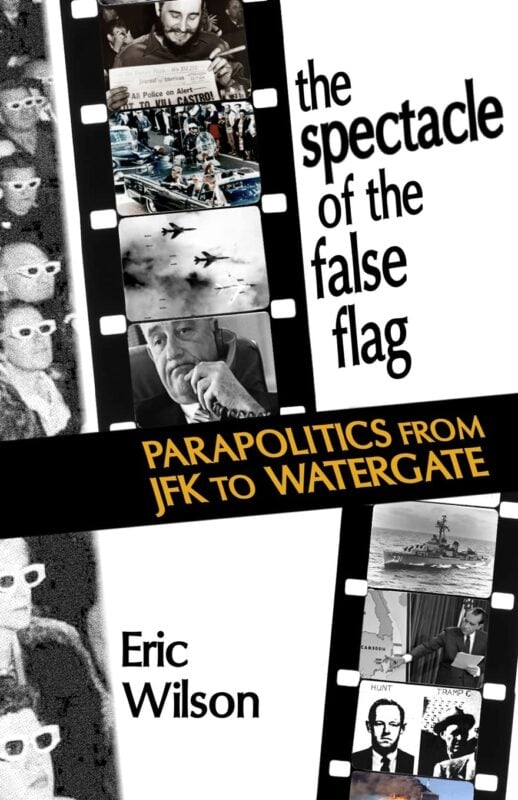
The Spectacle of the False Flag: Parapolitics from JFK to Watergate by Eric Wilson studies how the modern state operates through hidden systems of control expressed as public crises. Wilson, a criminologist at Monash University, examines how intelligence agencies, military hierarchies, and organized crime form a concealed structure of governance that produces its own legitimacy through spectacle. His analysis moves from the assassination of John F. Kennedy to the Gulf of Tonkin incident and the Watergate scandal, describing how these moments functioned as orchestrated demonstrations of power rather than spontaneous breakdowns.
The Structure of Spectacular Power
Wilson builds on Guy Debord’s analysis of the spectacle as the primary mode of political life in late capitalism. He describes a social order where governance depends on images that organize perception. Media institutions and state agencies convert events into visual narratives that maintain obedience and suppress inquiry. Power consolidates through exposure rather than secrecy; the display of crisis serves as evidence of control.
In this framework, the spectacle operates as a machinery of governance. It absorbs events into a continuous stream of representation. News, film, and official commentary shape a field of vision that eliminates direct experience of political reality. Wilson describes this as the conversion of politics into theater, where representation substitutes for participation and performance replaces accountability.
Criminal Sovereignty
Wilson identifies a condition he names “criminal sovereignty,” a structural fusion of legal authority and covert violence. State agencies act through clandestine channels that resemble organized crime in method and discipline. Intelligence networks manage illegal operations as instruments of national policy. Legal boundaries dissolve when the pursuit of security requires a permanent exception.
This fusion transforms the state into a dual organism. One branch operates through visible institutions of law and election. The other functions through covert systems that conduct surveillance, manipulation, and assassination. Wilson uses Carl Schmitt’s concept of the “state of exception” to describe how emergency powers become routine instruments of rule. Law remains intact as appearance, while real authority resides in the secret sphere.
Deep Events and the Administration of Perception
Wilson applies Peter Dale Scott’s term “deep event” to describe critical episodes that reorganize political consent through controlled revelation. He treats these events as administrative operations designed to shape belief. Each event combines violence, narrative, and media circulation. It creates an appearance of disruption that masks the continuity of power.
The assassination of Kennedy, the Gulf of Tonkin incident, and Watergate mark stages in the institutionalization of this practice. Together they demonstrate how modern governance produces crisis as a regular function. Each episode generates a new alignment between secrecy and legitimacy. The state performs its own exposure to sustain public confidence in its visibility.
The Kennedy Assassination
Wilson’s analysis of Dallas identifies a network of military planners, intelligence officers, and criminal intermediaries whose interests converged around regime change. He examines the roles of General Lyman Lemnitzer, Edward Lansdale, and CIA figures such as Tracy Barnes and David Atlee Phillips. Their activities intersected with anti-Castro operations and Mafia channels in New Orleans and Miami.
He reads Dealey Plaza as a deliberate construction of visibility. The public location, the cameras, and the sequence of images form a tableau of power and mortality. The assassination dramatizes control through apparent chaos. The subsequent investigation extends the performance by translating mystery into bureaucratic order. The Warren Commission’s report does not clarify events; it produces a stable narrative that anchors national memory.
The Gulf of Tonkin
Wilson treats the Gulf of Tonkin as a second phase in the development of parapolitical governance. Reports of North Vietnamese attacks on U.S. naval vessels in August 1964 provided the Johnson administration with justification for open war. Subsequent evidence exposed the fabrication of the incident, yet the deception achieved its purpose.
He details how intelligence manipulation, naval command procedures, and congressional authorization converged in a single act of political design. The Tonkin Resolution institutionalized executive war powers, transforming an image of aggression into a permanent authorization for conflict. The episode demonstrates how staged information creates legislative consent.
Watergate and the Circular Spectacle
In Wilson’s reading, Watergate represents the culmination of the parapolitical cycle. The scandal unites revelation and concealment in a single process. Media exposure, congressional investigation, and presidential downfall unfold within a system that protects itself through performance. The appearance of accountability becomes the mechanism of preservation.
He maps the connections between the White House, the CIA, and naval intelligence. The Moorer–Radford affair and the actions of Deep Throat (Mark Felt) reveal intra-agency rivalries within the security bureaucracy. The same networks that enabled covert operations now regulate the boundaries of disclosure. The spectacle sustains its own continuity by dramatizing reform.
The Parapolitical State
Wilson describes the United States during the Cold War as a dual configuration of public and deep institutions. The visible government operates through elections and lawmaking; the deep apparatus governs through secrecy and manipulation. This configuration does not form a hidden conspiracy but an organized mode of administration. Intelligence agencies, defense contractors, and criminal intermediaries coordinate policy through informal channels that bypass constitutional oversight.
He emphasizes how this arrangement depends on continual production of uncertainty. Crises, leaks, and exposures create movement within the system and maintain its legitimacy. The parapolitical state renews itself through controlled instability.
Media as Instrument of Order
Wilson examines how media systems convert clandestine operations into coherent stories. The spectacle requires narrative control to sustain collective belief. Journalists, film studios, and broadcasters serve as intermediaries between state secrecy and public perception. The circulation of images creates a shared field of interpretation that limits possible understanding.
He studies the photographic and televised representations of the Kennedy assassination, the Navy communications surrounding the Tonkin incident, and the televised Watergate hearings. In each instance, visibility becomes containment. The public witnesses the event only through its managed reproduction.
The Aesthetics of Power
Wilson frames governance as an aesthetic process. Power designs its appearance through images, symbols, and temporal rhythm. The repetition of crisis creates a recognizable form. Each episode—assassination, attack, scandal—follows the same pattern: emergence, investigation, revelation, resolution. The pattern itself becomes the guarantee of order.
He draws from the Situationist practice of détournement to explain how authority reuses elements of dissent. Symbols of resistance are reabsorbed into official culture. The visual vocabulary of protest becomes decoration for the same system it opposes. This dynamic secures the spectacle against external challenge.
From Industrial Secrecy to Cyber Control
Wilson extends his study into the digital age. He describes how post–Cold War globalization and networked technology integrate surveillance, finance, and information into a single operational field. The transition from industrial capitalism to cyber capitalism expands the scope of parapolitical control. Data replaces ideology as the medium of power.
He outlines how the techniques of disinformation, simulation, and crisis management evolve into digital operations: online propaganda, cyberattacks, and algorithmic censorship. These tools continue the same logic of managed visibility that defined the earlier era. The spectacle migrates from television screens to digital interfaces, but its function remains constant—the regulation of perception through designed images.
Conspiracy as Administrative Practice
Wilson defines conspiracy as a structural feature of political organization. Clandestine coordination among elites, security services, and private actors functions as a mode of policy execution. He rejects the idea of conspiracy as aberration. It operates as technique, integrated into the ordinary conduct of government.
This conception anchors his call for a new criminology focused on the state itself. The study of law enforcement, corruption, and crime must include the operations of sovereignty that generate illegality. Criminality does not exist outside the state; it forms within its procedures.
Toward a Criminology of Visibility
Wilson proposes a discipline of radical criminology that investigates how secrecy organizes law. He argues for an analysis of the mechanisms that render violence legitimate and that transform deception into policy. This criminology examines power through its images, documents, and performances. It treats exposure as material evidence, not as moral revelation.
Through this lens, the study of parapolitics becomes an inquiry into the manufacture of appearance. Law functions through visibility, and visibility depends on concealment. The relationship between what can be shown and what must remain hidden defines the structure of authority.
Continuing Resonance
Wilson’s synthesis connects Cold War parapolitics to contemporary forms of mediated control. His framework clarifies how modern states maintain cohesion through continuous crisis and how citizens experience authority through spectacle. The patterns he documents persist across digital warfare, mass surveillance, and media-driven conflict.
His combination of historical investigation and theoretical precision gives his work lasting significance. He describes systems of coordination rather than myths of omnipotence. He names institutions, identifies procedures, and reconstructs the mechanisms by which representation becomes power. Through this analysis, he exposes the choreography that binds secrecy, violence, and communication within the architecture of modern sovereignty.
