SJWs Always Double Down: Anticipating the Thought Police (The Laws of Social Justice Book 2)
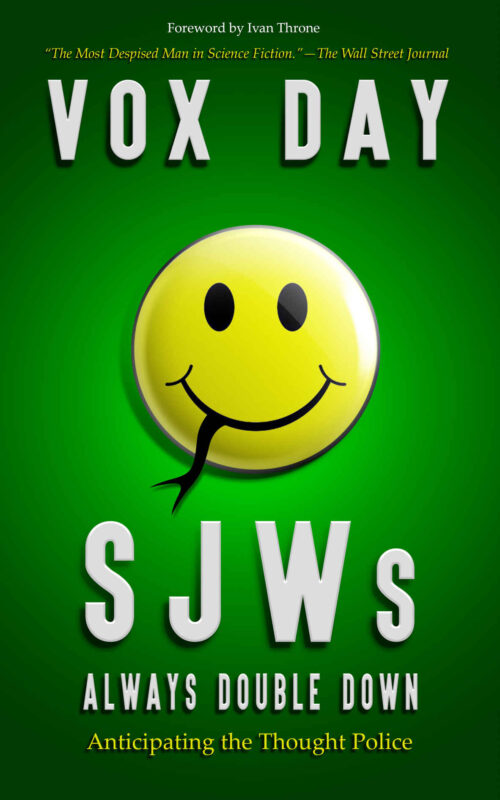
SJWs Always Double Down: Anticipating the Thought Police by Vox Day scrutinizes the rise, methods, and cultural impact of Social Justice Warriors, dissecting their tactics and strategic consequences for institutions and society. Vox Day asserts that SJWs shape the trajectory of Western culture through a relentless push for radical equality, employing a unique set of psychological drives, rhetorical devices, and organizational behaviors that both define and fuel their ongoing influence.
The Cultural War Unfolds
Vox Day situates the reader within a dynamic cultural conflict, casting the activities of SJWs as an escalating campaign that impacts corporations, social networks, open source communities, media, and political institutions. He declares the boundaries of this conflict absolute, erasing the possibility of neutral ground. The SJW movement, he explains, derives its energy from the pursuit of social justice as a moral imperative, enlisting adherents in a secular crusade that manifests as both organizational activism and cultural confrontation.
Institutions undergo rapid transformation when SJWs penetrate key decision-making nodes—human resources, compliance, diversity councils—triggering what the author terms “convergence.” He describes convergence as a systematic reorientation of the institution’s mission toward the primacy of social justice, supplanting service to clients, customers, or stakeholders. As this shift occurs, organizational priorities mutate. Business objectives yield to the enforcement of ideological orthodoxy. Decision-making calcifies around diversity and inclusion mandates, and dissenters experience marginalization, investigation, or termination.
Understanding SJW Mindset and Motivation
The book interrogates the psychological underpinnings that drive SJW behavior. Vox Day posits that the core of SJW motivation lies in a distinct set of socio-sexual dynamics—status-seeking, emotional projection, and a compulsion to moralize. These impulses generate a predictable pattern of behavior, which the author crystallizes into a set of “laws.” SJWs exhibit compulsive escalation: when confronted or opposed, they double their efforts, intensifying campaigns regardless of setbacks or failures. This reflexive doubling down, Day argues, results not from strategy but from inherent psychological structure.
Language plays a critical role in this ecosystem. SJWs, according to Day, manipulate definitions, deploy neologisms, and rapidly mutate linguistic norms to maintain strategic advantage. The “Narrative,” a fluid set of ideological talking points, serves as a compass and shield. Adherents coordinate attacks, justify purges, and reinterpret events in real time, ensuring consistency with prevailing ideological trends. Day maintains that the elasticity of this narrative sustains the movement, even as it provokes confusion or resistance from outsiders.
Convergence and Organizational Collapse
Day documents the process of convergence as a sequence of organizational events. Initial entry points often appear innocuous—diversity initiatives, sensitivity training, or revised hiring practices. As SJWs secure influence, internal culture shifts. Performance metrics lose primacy to ideological compliance. The author recounts scenarios in which companies endure internal investigations, ritualized apologies, and the installation of oversight bodies intended to enforce social justice dogma.
These interventions create cascading effects. Internal discipline becomes weaponized. Employees, fearful of reprisal, self-censor or resign. Senior leadership, confronted with accusations or media attention, capitulates to demands. Over time, original organizational purposes erode. Day contends that this realignment destroys institutional value, causing a fatal disconnect between market needs and internal priorities. When the organization’s raison d’être collapses under the weight of activism, the inevitable result is commercial or structural failure.
Case Studies in Corporate and Social Transformation
The book presents an array of case studies to ground its argument. Vox Day analyzes corporate incidents where employees undergo lengthy HR investigations for perceived offenses, culminating in mandatory diversity training and public contrition. He details the firing of prominent figures in technology, journalism, and entertainment, showing the pattern of accusation, ostracism, and organizational overreaction. Through these examples, he claims to reveal the internal logic and emotional intensity driving each escalation.
Day explores the influence of SJWs in the open source software community, noting how the introduction of “Safety Councils” and “Diversity Assurance Teams” alters project dynamics. These changes, he argues, disincentivize meritocratic collaboration, channel resources into bureaucratic oversight, and stifle innovation. The resulting dysfunction, according to Day, weakens projects and damages reputations.
The Narrative as Strategic Weapon
At the heart of SJW power lies the management of the narrative. The book demonstrates how SJWs deploy shifting rhetorical frameworks to maintain internal solidarity and external pressure. Narratives shift quickly, adapting to changing circumstances, and those who fall out of step with new priorities become immediate targets.
Vox Day introduces the idea of “projection” as a central tactic. He contends that SJWs attribute their own aggressive impulses to opponents, accusing dissenters of the very behaviors or motivations they themselves exhibit. This projection, he asserts, provides cover for otherwise indefensible conduct and enables the social shaming necessary to maintain ideological discipline.
The author tracks these rhetorical dynamics through examples from media, academia, and online discourse, highlighting episodes in which public figures are accused of bigotry, harassment, or ideological deviation. The stakes of narrative control escalate as major platforms introduce content moderation regimes and political campaigns leverage moral outrage.
The Backlash and 2016’s Turning Point
The book situates 2016 as a watershed in the cultural war. Day chronicles the rise of populist political movements, the election of Donald Trump, and the Brexit vote as evidence of mass resistance to the perceived encroachment of social justice ideology. These events, he maintains, demonstrate a rejection of convergence and a reassertion of traditional values, even as they intensify SJW mobilization.
He describes the aftermath of these events as a period of shock and retrenchment within SJW circles. Despite electoral setbacks, social justice activists and aligned institutions accelerate their efforts, deploying new narratives and consolidating their hold over key cultural and organizational assets. The cyclical nature of doubling down emerges as a central dynamic, sustaining conflict and ensuring its escalation.
Defensive Strategies and Countermeasures
Vox Day proposes a range of defensive strategies for individuals and organizations under pressure from convergence. He urges clarity and firmness in the face of accusations, warning against apologies or concessions that cede narrative ground. Detailed documentation, rigorous attention to process, and an understanding of the psychological dynamics at play constitute critical tools for self-preservation.
The author advocates for the formation of new organizations designed to resist convergence. These entities maintain clear missions, minimize bureaucratic capture, and cultivate resilient cultures. Day emphasizes the importance of strong boundaries, explicit organizational values, and the exclusion of ambiguous diversity initiatives that can serve as entry points for activism.
He underscores the necessity of anticipating escalation. Recognizing the inevitability of doubling down, effective countermeasures require both preemptive action and decisive resistance when challenged. In this context, awareness of the specific tactics, language, and signaling employed by SJWs provides a practical advantage.
Socio-Sexual Dynamics and Ideological Structure
The book delves into the evolutionary and psychological foundations of SJW behavior. Day attributes much of the movement’s cohesion and intensity to a distinct socio-sexual hierarchy, where status anxieties, resentment, and the drive for recognition shape individual and group action. He situates social justice ideology as a surrogate religion, complete with its own moral code, heresies, and rituals of confession and absolution.
This analysis underpins his account of organizational conflict. Rituals of confession, compelled apologies, and ceremonial training sessions serve as mechanisms of social control, reinforcing group identity and policing boundaries. Dissent, even in trivial matters, triggers disproportionate retribution, as the maintenance of internal purity takes precedence over compromise or dialogue.
Impact on Western Civilization and Culture
Vox Day frames the stakes in civilizational terms. He identifies social justice activism as fundamentally opposed to the values of Western civilization, which he defines through reference to truth, beauty, and divine order. The SJW movement, in his account, inverts this hierarchy, placing ideology, identity, and mutable group priorities above transcendental values. The resulting conflict, he asserts, shapes political, social, and institutional outcomes across generations.
He describes the relentless advance of SJW influence as both methodical and destructive. By occupying strategic positions, enforcing conformity, and punishing dissent, SJWs erode the cultural and organizational foundations of Western society. This pattern emerges not from a conspiracy but from the convergence of psychological drives, ideological fervor, and opportunistic institutional behavior.
Practical Implications and the Path Forward
The book concludes by urging readers to recognize the reality and scope of the cultural war. Vox Day insists on the impossibility of neutrality, urging individuals to prepare for conflict by cultivating awareness, strategic clarity, and organizational independence. He describes victory not as a matter of compromise but of persistence, vigilance, and the construction of alternative structures.
He provides checklists and practical guidelines for defending against convergence, from scrutinizing HR policies to monitoring changes in organizational rhetoric. He points to the emergence of SJW-free organizations as a sign of cultural renewal, advocating for disciplined resistance and the maintenance of traditional values in the face of ideological aggression.
Throughout, Vox Day draws a direct link between the fate of organizations and their willingness to defend against convergence. The long-term survival of institutions, he argues, depends on their capacity to resist infiltration, sustain coherent missions, and cultivate leaders equipped to anticipate and counteract SJW tactics.
SEO-Optimized Focus: Why SJWs Always Double Down Remains Relevant
SJWs Always Double Down: Anticipating the Thought Police delivers a provocative analysis for readers searching for insight into the tactics of social justice activism, the risks of organizational convergence, and the mechanics of the ongoing cultural war. By examining the specific methods, psychological foundations, and real-world consequences of SJW influence, Vox Day positions his work as an indispensable guide for professionals, organizational leaders, and anyone concerned with defending the integrity of Western values.
Search queries related to "SJWs in corporations," "how to resist social justice activism at work," "Vox Day book summary," "what is convergence in business culture," and "cultural war strategies for organizations" find comprehensive treatment in this book. Readers seeking a deep dive into the processes and consequences of convergence, or looking for step-by-step strategies to identify and repel SJW influence, receive direct and detailed answers.
For organizations facing internal pressure to adopt radical social justice mandates, the book provides a framework for diagnosis, prevention, and recovery. For individuals navigating professional environments fraught with ideological tension, the book offers both psychological insight and actionable guidance.
The persistence and escalation of SJW tactics, described through the principle of doubling down, underscore the enduring urgency of these themes. As companies, universities, and communities continue to experience the impact of convergence, SJWs Always Double Down equips readers with the analytical tools and defensive strategies necessary to recognize, anticipate, and counteract the evolving dynamics of social justice activism. The cultural war, as Vox Day narrates it, shapes both public discourse and private life, defining the future of institutions, organizations, and societies for decades to come.
