Jordanetics: A Journey Into the Mind of Humanity’s Greatest Thinker
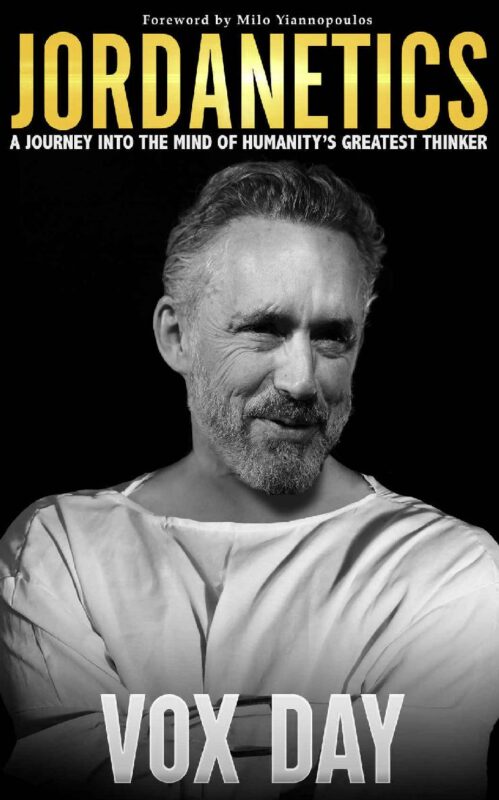
Jordanetics: A Journey Into the Mind of Humanity’s Greatest Thinker by Vox Day delivers a categorical dismantling of Jordan B. Peterson’s intellectual credibility, moral authority, and spiritual posture. Framed as a forensic exposé, the book traces a complex lattice of rhetorical deceit, psychological fragility, and philosophical subversion embedded within Peterson’s public persona and body of work.
Authority and Inversion
Peterson constructs influence by layering abstraction atop ambiguity. His authority arises not from clarity, but from mystique. He leverages symbolic language to erect a scaffolding of reverence around archetypes, while concealing the underlying incoherence of his prescriptions. The book identifies a recurrent strategy: displace precise meaning with mythological metaphor, then tether behavioral directives to cosmic implications. Through this process, Peterson repositions himself as a transcendent intermediary between chaos and order.
The text dissects this rhetorical mechanism. When Peterson invokes Jungian archetypes, he does not transmit inherited wisdom. He distorts the archetypes to invert Christian theological order. He recasts the Logos as a psychological function rather than divine truth. He portrays the Christ figure not as a Savior but as a tragic sufferer in a nihilistic world. This inversion permeates his self-help advice, which redirects spiritual hunger toward psychological management.
The Machine of Manufactured Depth
Peterson presents language as a puzzle rather than a pathway. He obfuscates rather than illuminates. His formulations defer clarity with qualifying phrases, recursive metaphors, and semantic hedging. “It’s something like that,” “roughly speaking,” and “you might say” function not as concessions to complexity but as tools of deliberate evasion. Readers confront a text that demands constant decoding. This demand creates the illusion of profundity and masks the vacuity of his claims.
The book identifies this evasion as the core of Peterson’s mass appeal. His audience mistakes linguistic complexity for conceptual depth. But the harder they search for meaning within his phrases, the more captive they become to his persona. This mechanism mirrors cultic initiation rituals that bind followers by wrapping simple commands in elaborate spiritual significance. By cloaking banality in mysticism, Peterson manufactures dependence.
The Lie of Neutrality
Peterson positions himself as a neutral observer of ideological extremes. He appeals to young men disillusioned with cultural decay and portrays himself as their intellectual father figure. He claims no political allegiance and asserts detachment from tribal passions. This self-positioning creates a framework of trust. The reader, believing they encounter a Socratic mentor, lowers intellectual defenses.
Jordanetics dismantles that illusion. Peterson’s neutrality conceals a pattern of ideological appeasement. In high-stakes moments, he abandons principle in favor of compliance. He withdraws from conflict by redefining terms, revising earlier statements, or retreating into abstraction. When pressed on controversial affiliations, such as his relationship with Faith Goldy or his commentary on Brett Kavanaugh, Peterson reframes the issue rather than confront it.
These evasions are not random. They reflect a strategic submission to institutional power. Peterson refuses to challenge the core dogmas of modern liberalism. He does not confront the architecture of globalism, identity politics, or institutional corruption. Instead, he redirects attention to personal discipline, spiritual suffering, and psychological resilience. He offers catharsis, not confrontation.
Statistical Illiteracy as Shield
Peterson invokes data to reinforce rhetorical authority but often misrepresents it. The book provides multiple examples, including his inflated claims regarding Jewish IQ and elite representation. Peterson attributes Jewish success solely to intelligence, denying structural, cultural, or networked influence. He cites discredited studies without context and miscalculates distribution percentages by orders of magnitude.
This statistical abuse reflects both ignorance and intent. By overrelying on cognitive metrics, Peterson recasts sociopolitical realities as inevitable outcomes of merit. This recasting insulates dominant groups from critique and legitimizes systemic imbalance. Vox Day exposes these manipulations, demonstrating that Peterson’s conclusions rely on false premises and mathematical incoherence.
Apotheosis of the Self
Peterson’s therapeutic advice orbits his personal mythology. He projects his psychological experiences as universal paradigms. He transforms his suffering into sacred narrative and invites followers to emulate his path of perpetual struggle. His twelve rules, though framed as general guidance, encode a unique neurosis. He elevates personal pain into moral currency and converts self-conquest into spiritual destiny.
This self-apotheosis collapses categorical distinctions between private ailment and public revelation. Peterson does not describe suffering—he sacralizes it. He frames it as the crucible of all wisdom, the test of divine favor, and the source of cosmic meaning. The book asserts this equation strips suffering of redemptive purpose and replaces it with narcissistic fixation. The sufferer becomes the source of truth, the center of gravity, the moral arbiter.
The Cult of Chaos
Peterson characterizes reality as an eternal struggle between chaos and order. He maps chaos onto the feminine and order onto the masculine. This symbolic opposition structures his metaphysics, ethics, and gender philosophy. But the dichotomy does not hold. His conception of order remains undefined. He invokes it as a vague force of social stability, while simultaneously elevating chaos as the arena of transcendence.
The contradiction fuels psychological tension. Peterson encourages readers to confront chaos without anchoring them to coherent order. He demands sacrifice, pain, and self-overcoming—but offers no eschatology, no teleology, no truth. His followers submit to a process without destination. Jordanetics frames this structure as the machinery of a cult: initiation through confusion, transformation through suffering, loyalty through reverence.
Peterson’s lectures function as rites of passage. His layered language enacts a trance. His moral framework replaces good and evil with suffering and relief. His cosmology dissolves the vertical order of divinity into horizontal therapeutic experience. Vox Day names this dynamic the Cult of Jordanetics and anchors its emergence in the collapse of Western metaphysical confidence.
Moral Abdication and Strategic Betrayal
The book provides concrete episodes of Peterson’s moral abdication. His betrayal of Faith Goldy, whom he banned from a free speech panel, exemplifies his willingness to sacrifice allies for social approval. His equivocation on Brett Kavanaugh, whom he urged to resign post-confirmation, reveals a deeper pattern: submission in the face of institutional coercion.
These betrayals reflect core principles of Peterson’s operational code. He preserves his platform by conforming to elite expectations. He adjusts his ethics based on audience and context. He teaches virtue while practicing expedience. His code evolves according to pressure, not principle.
Pharmaceutical Gnosis
Peterson’s personal dependence on psychiatric medication functions as both literal and symbolic centerpiece. He admits lifelong use of SSRIs, frequent depressive breakdowns, and neurological instability. His daughter promotes a carnivorous diet that allegedly cured them both. He frames this dietary transformation as salvific, describing near-supernatural changes in cognition, emotion, and strength.
These disclosures anchor Peterson’s worldview in psychobiological determinism. He equates suffering with virtue, medication with salvation, and dietary discipline with spiritual clarity. He turns nutrition into sacrament. The book identifies this tendency as medicalized gnosticism: salvation through personal chemistry, revelation through biophysical change.
Peterson transforms material intervention into metaphysical ascent. He teaches that spiritual healing follows physiological purity. This paradigm replaces moral absolutes with somatic performance. Sin becomes misalignment. Redemption becomes compliance.
Mechanisms of Mass Entrancement
Peterson sustains influence through audience complicity. His followers defend contradictions, rationalize betrayals, and reinterpret incoherence as mystery. The book includes dozens of responses from devoted fans who attack critics with accusations of jealousy, heresy, or psychological instability. These defenses mirror the cultic dynamics of insular belief systems.
Followers internalize Peterson’s linguistic style, mimicking his cadence and lexicon. They echo his refrains and adapt his categories. They interpret personal setbacks through his cosmology and attribute recovery to his influence. Vox Day attributes this response to psychological entrainment: repetition, intensity, and pattern recognition hardwire belief.
This entrancement flourishes amid cultural fragmentation. As institutions collapse, traditional religion recedes, and masculine mentorship dissolves, figures like Peterson step into the void. He offers existential coherence, identity affirmation, and pseudo-religious ritual.
Collapse of the Logos
Jordanetics concludes that Peterson does not serve the Logos. He defiles it. He redefines truth as subjective resilience, faith as self-invention, and meaning as therapeutic relief. He offers archetypes without theology, rituals without liturgy, and virtue without revelation. His vision replaces transcendence with performance and reverses the moral hierarchy of Christian metaphysics.
Peterson does not lead his followers to truth. He leads them into a maze of linguistic acrobatics, emotional volatility, and metaphysical confusion. He builds a house on sand and invites them to sleepwalk into it.
In place of clarity, he offers incantation. In place of truth, he offers process. In place of God, he offers himself.

