Black Terror White Soldiers: Islam, Fascism & the New Age
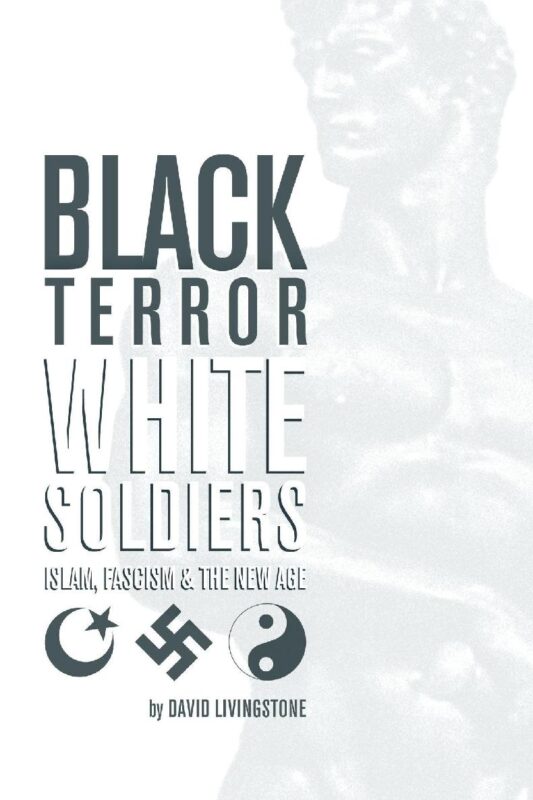
Black Terror, White Soldiers by David Livingstone uncovers the intertwined history of Western imperial ambition, secret societies, and the manipulation of Islamic movements to advance the interests of global power elites. Livingstone details how occult philosophies, clandestine networks, and religious revivalism converge to shape wars, revolutions, and ideological conflicts. The narrative reveals a continuity of strategy, connecting ancient esoteric traditions with the most consequential events and movements of the modern world.
The Engineered Specter: Islam as Geopolitical Tool
Powerful interests in Western governments select Islam as the new global antagonist following the Cold War. Policymakers construct a binary: Western secular humanism, with its claims to rational progress and universal rights, faces off against an imagined Islamic “theocracy.” News cycles fill with dramatic portrayals of Shariah law, feeding an atmosphere of suspicion. Yet, Islam originates as an ethical system closely linked to Judaism and Christianity, grounded in the Golden Rule and communal justice. Livingstone reveals how this tradition, historically committed to mutual respect and welfare, fragments under the weight of external manipulation and internal distortion.
The Rise of Fundamentalism and the Manipulation of Revival
The emergence of so-called “fundamentalism” within Islam follows deliberate policies by British and American strategists. British intelligence cultivates radical reformers in the eighteenth century, installing figures like Mohammed ibn Abdul Wahhab to rewrite Islamic jurisprudence and erode traditional authority. Saudi Arabia and Pakistan, acting in concert with the CIA, later foster the Taliban—shaping a strain of extremism that serves Western geopolitical aims in Afghanistan and beyond. Livingstone demonstrates that the term “fundamentalism,” lifted from Protestant controversies, poorly fits the complexities of Islamic belief. Yet, media and political rhetoric use it to stigmatize any resistance to secular, Western models of society.
Islamic Law: Architecture of Civilization
Islamic civilization, during the Abbasid and Ottoman eras, produces a legal and political order marked by complexity, adaptability, and sophistication. Islamic scholars codify law through consensus and reasoning, evolving a system that governs everything from personal conduct to economic exchange. Four major legal schools—Shafi, Hanafi, Hanbali, Maliki—emerge, each grounded in rigorous debate and scholarly merit. Consensus eventually limits free interpretation, closing the “Gates of Ijtihad,” and defining the boundaries of orthodoxy. Within this framework, jurists weigh evidence, apply analogical reasoning, and ensure that law aligns with public welfare, equity, and moral purpose.
Imperialism, Divide and Rule, and the Fabrication of Terror
British and later American policies nurture Islamic revivalist movements to destabilize empires and advance imperial objectives. The book traces the genealogy of groups such as the Wahhabis and Salafis, depicting them as creations of intelligence agencies rather than organic expressions of local piety. The Muslim Brotherhood arises from this milieu, serving as a vector for Western interests, sowing chaos and enabling covert operations. Livingstone places these developments in a broader strategy of “divide and conquer,” where the orchestration of religious schisms provides justification for foreign intervention and resource extraction.
Occult Foundations: Black Magic and Ancient Mysteries
Beneath the visible struggles of ideologies and empires, Livingstone uncovers a substratum of occult knowledge and secret societies. He describes how esoteric traditions, rooted in ancient Near Eastern religions and the Kabbalah, shape elite worldviews and inform the strategies of ruling classes. The Western occult tradition derives its rituals and symbols from pagan myths of dying and resurrected gods—Osiris, Baal, Mithras—whose stories encode cycles of death and renewal, power and subjugation. Secret societies such as the Freemasons emerge as inheritors of these mysteries, wielding influence in politics, finance, and culture.
Media, Propaganda, and the Manufacture of Consent
Livingstone examines how Western societies perfect propaganda, concealing manipulation beneath the appearance of a free press and intellectual discourse. Entertainment, news, and academia channel narratives that obscure power structures, deflecting attention from the collusion of elites. Criticism is permitted only within safe, credentialed boundaries. Popular dissent, when it arises—such as in the Occupy Movement—faces suppression or co-option. The “conspiracy theory” label functions as an intellectual bludgeon, deterring inquiry into genuine patterns of elite control.
The Architecture of Tolerance: Dhimmis and Islamic Pluralism
Classical Islamic empires develop a model for religious coexistence. Non-Muslims—Jews, Christians, Sabeans, Zoroastrians, and others—receive protected status as “People of the Book.” Each community governs its internal affairs, raises taxes for communal welfare, and maintains courts in line with its own laws. The state shields minority populations, upholds their religious autonomy, and collects tribute in exchange for protection. This arrangement produces flourishing centers of learning and culture, particularly in Moorish Spain, where Muslims, Jews, and Christians forge an environment of tolerance and innovation.
Economic Justice and the Challenge to Neoliberalism
Livingstone outlines how Islamic economic principles disrupt the logics of modern capitalism. Zakat—a 2.5% tax on net assets—ensures redistribution, funds social welfare, and binds the wealthy to the broader community. Islam prohibits interest and demands shared risk in financial ventures. Essential resources—water, energy, and fuels—belong to the collective, not private monopolies. These structures offer solutions to persistent failures in Western economic models, challenging the dominance of banking cartels and speculative finance.
Occult Continuity and the Formation of Modern Ideologies
The narrative traces the migration of occult ideas from Babylon and the ancient Near East into Greece and Rome, and through the Magi and Kabbalistic mystics, into Western philosophy and secret societies. Greek philosophers such as Pythagoras and Plato absorb and reinterpret these traditions, weaving them into the foundations of European thought. The “dying-god” motif and dualistic cosmologies infuse religious sects, mystery cults, and eventually Gnostic heresies. Freemasonry, Rosicrucianism, and other societies emerge as modern custodians of these esoteric doctrines, exercising influence in revolutionary and counter-revolutionary movements across centuries.
The Protocols of Power: Elites, Conspiracies, and Covert War
Livingstone maps a lineage of control, where secret societies, intelligence agencies, and financial networks intersect. Occult philosophy underpins the self-conception of the ruling class. Western elites, steeped in esoteric symbolism and clandestine ritual, direct revolutions, sponsor terror, and impose ideological narratives that advance global domination. The Illuminati, the Nazis, the CIA—all figure in a continuum of covert action and mythmaking. Livingstone interrogates the function of conspiracy theory, challenging readers to distinguish between paranoia and structural analysis. He asserts that deep conspiracies operate not at the margins, but as the organizing logic of world history.
The Construction of the “Clash of Civilizations”
The “Clash of Civilizations” narrative serves as a vehicle for imperial aggression, veiling resource grabs and regime change as campaigns for freedom and democracy. Livingstone shows how this storyline emerges from deliberate policy choices and sophisticated propaganda, rather than spontaneous antagonism. The specter of an unyielding, hostile Islam legitimates endless war, surveillance, and the expansion of Western power into new frontiers. The author challenges the idea of inevitable civilizational conflict, urging readers to recognize the material and ideological interests driving global disorder.
The New Age, Fascism, and the Continuity of Secret Traditions
In the late twentieth century, Western elites adapt esoteric traditions to new contexts, blending them into the New Age movement, neoliberal ideology, and even resurgent forms of fascism. Livingstone details connections between intelligence agencies, experimental psychology, psychedelic culture, and the resurgence of occultism. Institutions like the Esalen Institute, media moguls, and covert operatives repackage ancient doctrines for modern audiences, creating new forms of social control and cultural engineering.
Conclusion: Patterns of Power, Myths of Modernity
Black Terror, White Soldiers advances a sweeping thesis: behind the surface of wars, ideologies, and social upheaval stands a network of secret alliances, occult doctrines, and strategic manipulations. Livingstone proposes that understanding world events requires attention to both the visible agents of history—politicians, armies, corporations—and the hidden actors operating through secret societies, intelligence agencies, and arcane philosophies. The myth of inevitable civilizational conflict dissolves when examined through the lens of structural power, engineered consent, and the unbroken chain of occult influence. This analysis challenges conventional wisdom and provokes a reconsideration of both history and the present. The true engine of change, Livingstone asserts, lies in the convergence of ancient mysteries, imperial ambition, and the calculated orchestration of belief and conflict. The call to inquiry emerges: Who engineers the narratives that govern thought and action? Which networks hold the keys to power? The answers, Livingstone contends, reside where history, conspiracy, and the occult converge—at the shadowy heart of the modern world.
