The Poisoned Loving-Cup – United States School Histories Falsified Through Pro-British Propaganda in Sweet Name of Amity
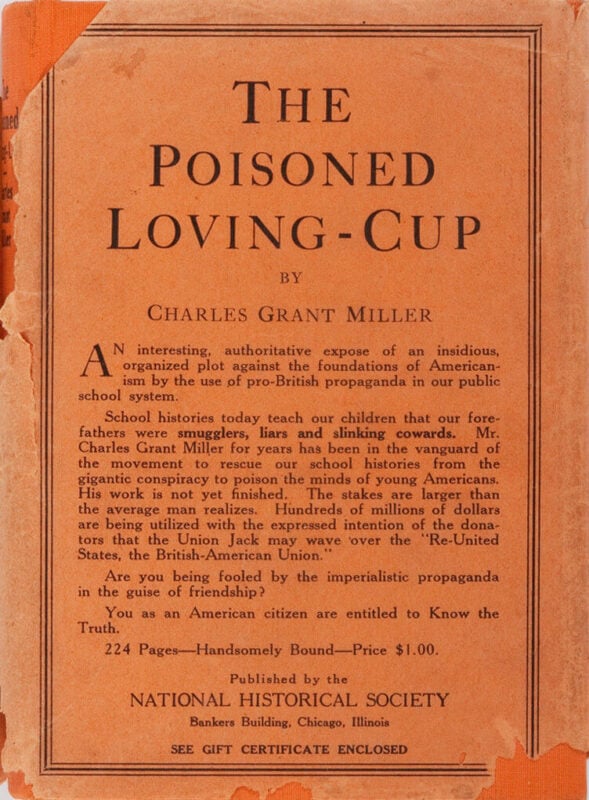
The Poisoned Loving-Cup by Charles Grant Miller confronts the infiltration of pro-British ideology into early 20th-century American school textbooks, exposing how historical narrative has been weaponized to undermine the spirit of the American Revolution. Miller indicts the educational establishment for cultivating passive admiration of Britain, replacing the legacy of 1776 with a narrative of imperial reconciliation. His evidence reveals a coordinated, long-term effort to dissolve American identity through subtle shifts in historical language, editorial omission, and moral inversion.
Textbooks as Strategic Instruments of Psychological Reorientation
Miller treats textbooks not as neutral conveyors of fact but as deliberate instruments of cultural conditioning. He tracks editorial decisions that erase or dilute the grievances against British monarchy—taxation without representation, military occupation, suppression of local governance—and recast them as misunderstandings, even noble efforts by the Crown to maintain order. By reframing British policies as reasonable and American resistance as emotional or premature, textbook authors reposition students’ sympathies toward the mother country.
This reframing carries structural consequences. When the founding revolutionaries appear impulsive, rather than principled and courageous, students absorb the implication that revolution is rash. When British actions appear protective rather than predatory, colonial independence becomes an unfortunate break rather than a triumph of conscience. Through repetition and controlled vocabulary, the textbooks forge a docile allegiance to imperial governance dressed in modern clothing.
A Silent Coup in the Curriculum
Miller catalogues direct examples of this epistemological warfare. He documents instances where textbook authors omit the Stamp Act’s real economic burden, recast the Boston Massacre as a street riot, or describe George III as misunderstood rather than despotic. These are not careless errors. They emerge from editorial boards aligned with Anglophile academics and publishing interests intent on harmonizing American and British values for strategic alliances.
He identifies the Carnegie Foundation and similar institutions as key players in this campaign, supplying financial incentives to historians who promote transatlantic unity. The goal is not historical accuracy. It is the gradual erasure of ideological distinctions that once justified the American experiment in liberty. When students no longer see the British Empire as a threat to self-government, they no longer recognize the stakes of preserving republican institutions.
From Revolution to Reconciliation: The Language of Surrender
Throughout the book, Miller demonstrates how the vocabulary of resistance is replaced with the vocabulary of consensus. “Tyranny” becomes “mistake.” “Oppression” becomes “policy.” Even the word “freedom” begins to vanish, displaced by more ambiguous references to “order” or “civil progress.” The revolutionary generation disappears beneath layers of compromise language designed to soothe rather than sharpen. The past becomes a series of unfortunate disputes resolved through inevitable maturation, rather than a deliberate break from imperial control.
By the 1920s, Miller argues, this narrative reprogramming had created a generation of students who respected the monarchy more than the Constitution. He cites classroom surveys, textbook passages, and public opinion essays that demonstrate the trend: reverence for kings over founders, fascination with empire over federalism, admiration for British diplomacy over Jeffersonian clarity. The result is an educational environment primed to accept foreign entanglements, internationalist legal frameworks, and technocratic control—all under the guise of historical maturity.
The Structural Mechanics of Subversion
Miller breaks down the methods by which textbook distortion takes place. First, through deletion: vital names, events, and motives are simply removed. Second, through generalization: specific abuses are collapsed into vague descriptions, stripping them of urgency. Third, through moral reversal: those who resisted British authority are portrayed as extremists, while the Crown is depicted as patient and misunderstood.
He highlights how textbooks glorify figures like William Pitt and Edmund Burke, while marginalizing Sam Adams, Thomas Paine, and Patrick Henry. Figures who articulated the natural rights tradition receive brief, flattened mention. Their arguments for liberty are reduced to slogans, while British counterpoints receive paragraphs of sympathetic explanation. Through asymmetric exposition, the textbooks elevate one worldview and trivialize another.
The Role of Philanthropy in Reframing American Memory
Miller investigates the philanthropic machinery behind this narrative shift. He names endowments and trusts that sponsor textbook adoption campaigns, fund teacher training programs, and control the boards of major university presses. These organizations fund chairs of history and curriculum advisory committees that shape public school standards.
He shows how this influence extends to national textbook review boards, which pressure publishers to revise language deemed “divisive.” In practice, this means de-emphasizing revolutionary rhetoric and avoiding narratives of conflict between free men and imperial systems. Through this philanthropic pipeline, cultural memory is redirected, not through direct censorship, but through curated consensus.
Erosion of Civic Identity Through Narrative Substitution
One of Miller’s strongest assertions involves the collapse of civic confidence. He contends that when students grow up believing the founders were overreacting, or that monarchy evolved naturally into democracy, they lose the conceptual tools necessary to defend their rights. Historical cause and effect disappears. The price of liberty becomes abstract. The sacrifice of 1776 becomes symbolic rather than structural.
Without knowledge of why the revolution occurred, modern citizens cannot recognize when similar encroachments take place. They accept bureaucratic expansion, centralized economic planning, and foreign arbitration as signs of maturity. In truth, these are the same patterns of control the founders resisted. But the textbook narrative blinds them to the continuity. Civic identity dissolves into passive allegiance to global consensus.
Call for Intellectual Rebellion and Structural Realignment
Miller ends his book with a challenge. He calls on educators, parents, and students to recover the original vocabulary of American liberty—not as nostalgia, but as a functional tool for recognizing tyranny. He urges a reexamination of textbook content through the lens of cause, consequence, and motive. He recommends community-based textbook audits, the establishment of independent review boards, and the creation of alternative materials that present historical events without euphemism.
His tone throughout the conclusion reflects urgency. He does not see this distortion as accidental or benign. It reflects a psychological realignment imposed by a managerial class that finds revolution inconvenient and self-rule antiquated. The antidote, he claims, is structural clarity—teaching students to identify shifts in framing, ask who benefits from narrative changes, and demand accountability from textbook producers.
A Blueprint for Reclaiming Narrative Sovereignty
The Poisoned Loving-Cup stands as an early blueprint for identifying epistemological warfare in education. Long before critical pedagogy or culture war discourse entered the mainstream, Miller mapped the mechanics of ideological capture within curriculum design. He traced the funding, identified the patterns, and named the consequence: the erosion of American independence through the slow poison of selective memory.
The book carries renewed relevance in an age where textbooks once again serve as battlegrounds. Its method—close reading, pattern recognition, source tracing—offers a practical model for citizens seeking to preserve historical integrity. Its thesis—that empire hides in the footnotes, in the omissions, in the softened language of consensus—forces a confrontation with how stories shape consent.
Those who control the past shape the grammar of the future. Miller’s work stands as a clear warning: a nation that forgets its resistance narratives will not recognize the need to resist again. The poisoned cup offers the illusion of amity, but beneath it flows the quiet surrender of thought.