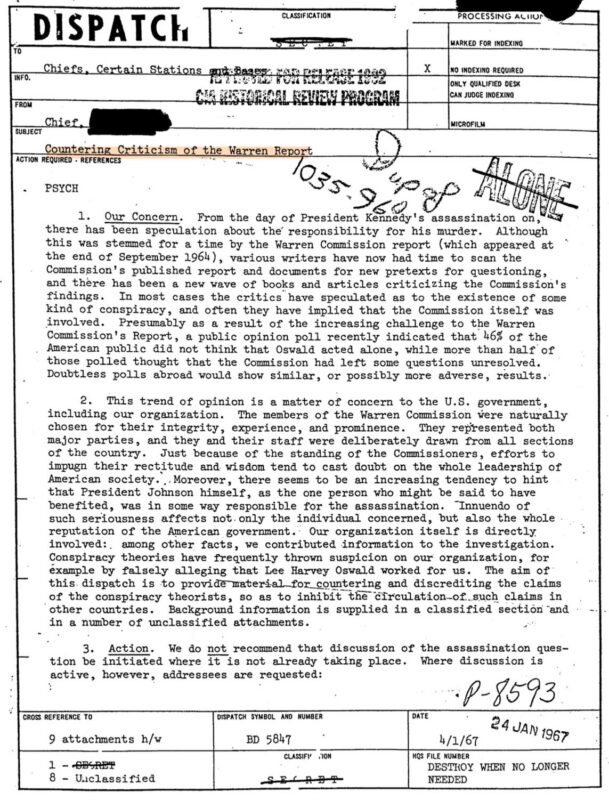
Are the Cominform Countries Using Hypnotic Techniques to Elicit Confessions in Public Trials
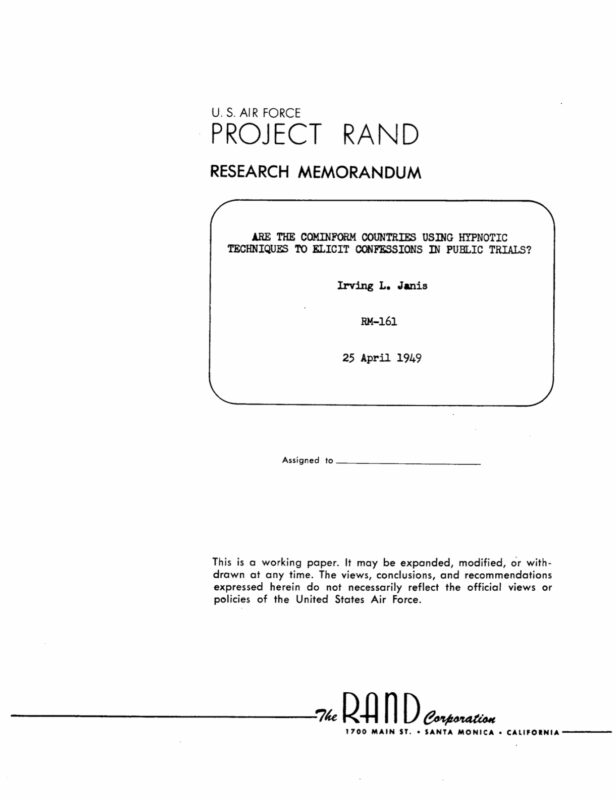
The document that kicked off the MK-Ultra program. (cover story?)
A memorandum explores the hypothesis that the Russians are using hypnotic techniques, possibly in conjunction with drugs, to elicit false confessions from individuals who would not confess under normal duress. Soviet psychologists had demonstrated 20-30 years ago that hypnosis could be used to induce innocent individuals into giving false confessions. The memorandum presents evidence indicating how hypnotic techniques could be used to produce false confessions, and highlights the difficulty in detecting a post-hypnotic trance state. However, the hypnosis explanation presented is still weak.
The author suggested disguising the hypnotic induction by talking relaxation allegedly as part of a medical examination, using drugs to induce hypnosis, inducing post-hypnotic amnesia, building up a favorable attitude towards the hypnotist, implanting false memories, and training the subject to go into a trance state whenever a simple signal is encountered.
Are the Cominform Countries Using Hypnotic Techniques to Elicit Confessions in Public Trials by Irving L. Janis proposes a provocative inquiry into Cold War psychological warfare, framing hypnosis not as medical therapy but as a potential tool of coercive manipulation in political theater.
Soviet Research into Hypnosis and False Confessions
Between 1923 and 1930, Soviet psychologists pursued systematic studies in hypnosis at the State Institute of Experimental Psychology. Their aim was to investigate human motivational conflict by inducing guilt and behavioral change through hypnotic suggestion. A. R. Luria’s experiments introduced criminal scenarios to subjects under trance, prompting confessions of events that had never occurred. These implanted memories triggered emotional reactions, even post-hypnotic denial, as subjects struggled with internalized guilt.
These cases illustrated a mechanism that could fabricate sincere belief in falsified actions. Subjects did not simply repeat dictated lies—they adapted, justified, and emotionally internalized them. By embedding guilt through hypnotic suggestion, investigators manipulated subjects to produce seemingly spontaneous, emotionally charged admissions of invented misdeeds.
Training Behavior That Mimics Normalcy
Post-hypnotic conditioning allowed subjects to behave convincingly in public while under trance. With carefully calibrated signals—a specific phrase, the presence of a courtroom figure, or a change in lighting—the subject could enter a trance state undetectable to observers. This covert trance, paired with embedded false memories, enabled staged courtroom confessions that appeared authentic and self-driven.
Subjects trained under hypnosis retained ordinary demeanor and speech patterns. Their responses included hesitations, elaborations, and emotional appeals consistent with genuine testimony. These performances concealed the scripted nature of their statements. The façade of sincerity depended on training subjects to replicate spontaneous language, maintaining realism within fabricated narratives.
Observational Evidence from Communist Trials
Trial transcripts and press descriptions supported behavioral anomalies consistent with hypnotic influence. Observers of Cardinal Mindszenty’s trial noted mechanical, flattened speech devoid of the oratorical vigor he once displayed. Eyewitnesses described him as monotonous, dazed, and disconnected—symptoms mirrored in other defendants, who appeared confused, emotionally dulled, or robotically deferential.
Some defendants offered confessions framed by ambiguous caveats, suggesting internal conflict. One began his statement by declaring mistrust in mankind’s honesty, subtly undermining the confession that followed. These indirect resistances matched patterns of dissociation and ambivalence found in hypnotized subjects performing ethically dissonant tasks.
Overcoming Resistance Through Deep Conditioning
Subjects often resisted hypnotic suggestions that conflicted with core values. To ensure compliance, interrogators employed repetitive hypnotic induction, emotional manipulation, and strategic reinforcement. Building rapport with the subject—posing as a sympathetic figure—became a means to bypass defenses. Through staged protection or feigned kindness, the hypnotist cultivated loyalty and trust.
When resistance persisted, interrogators refined suggestions to avoid triggering internal conflict. Each confession was tailored to the subject’s psychological profile, incorporating only those falsehoods the subject could assimilate without overt revolt. This “hand-tailored” method maximized conformity while minimizing the risk of visible noncompliance during public testimony.
Inducing Trance Without Consent
Janis details several covert methods of inducing hypnosis in unwilling subjects. These included disguised medical procedures, such as blood pressure tests or fatigue assessments, that masked hypnotic induction. Alternatively, drugs like sodium pentothal or paraldehyde facilitated hypnoidal states, after which subjects received post-hypnotic suggestions that prepared them for future trance sessions without chemical aid.
Another method involved hypnotizing individuals during natural sleep. Subjects could be spoken to gently, transitioned from sleep to trance, and conditioned to respond to cues. Once induced into somnambulism, subjects followed instructions as if under their own volition, while remaining unaware of the hypnotic state’s origin.
Engineering Amnesia and Memory Control
Subjects could be trained to forget the hypnosis itself. Post-hypnotic amnesia rendered them unaware of the sessions, the methods used, or the fabricated nature of their confessions. This allowed subjects to testify sincerely to experiences they falsely remembered. They defended their captors, praised re-education, and cited moral revelation as the source of their guilt.
Without memory of coercion or hypnosis, defendants described their confessions as the product of conscience and reflection. Statements emphasized awakening, responsibility, and redemption—narratives consistent with implanted moral transformation. The hypnotic script extended beyond the courtroom, shaping the defendants’ behavior during imprisonment and their statements after sentencing.
Scaling Depth of Trance for Functional Control
Producing reliable post-hypnotic behavior required reaching somnambulistic trance depth. Studies showed only a fraction of untrained subjects reached this level on first induction. However, repeated sessions, combined with fractionation—alternating trance and wakefulness—enhanced susceptibility. With multiple daily inductions, many subjects previously resistant could be brought to full compliance.
Drug-assisted inductions further increased trance depth. Compounds such as scopochloralose, combining scopolamine and chloralose, created conditions ideal for somnambulism. These pharmacological agents enabled deep trance in individuals unresponsive to verbal methods alone. Once achieved, trance responses could be reinforced and repeated without the drug, making the subject perpetually accessible to control.
Electroshock as an Adjunct to Hypnosis
Reports from Hungary introduced the possibility that electroshock therapy played a role in conditioning. Eyewitnesses described defendants who appeared dazed, emotionally flat, and physically debilitated. Some mentioned the use of head-mounted electrodes and amnesia following convulsions. The psychological aftermath of electroshock—reduced cognitive resistance, suggestibility, and memory fragmentation—aligned with known effects of intense hypnosis.
Janis explored whether electroshock could serve as a bridge to hypnosis. In theory, a weakened ego state might lower the threshold for trance induction. Combined with post-shock hypnosis, this sequence could produce compliance and amnesia in otherwise resistant individuals. Anecdotal accounts of defendants staggering, displaying vacant expressions, or expressing reverence for their captors added plausibility to this hypothesis.
Embedding Ideological Transformation
Some defendants demonstrated extreme ideological shifts. In one case, a defendant who previously defended religious freedom began lauding the Communist state and advocating political re-education. Others invoked Marxist texts or denounced former allies with rhetorical precision. These transformations reflected a core function of the hypothesized hypnosis protocol—not only to extract confession but to embed loyalty.
Sessions could induce guilt, revise moral allegiance, and train subjects to associate past beliefs with shame. Over time, the subject internalized a new ideological orientation, mirroring the values of their captors. In public, they voiced gratitude for the transformation, aligning their new identity with the state’s goals and justifying their confession as a moral duty.
Strategic Recommendations and Ethical Imperatives
Janis proposed a structured research agenda to investigate the feasibility of these techniques. He recommended reviewing classified intelligence, interviewing former detainees, and analyzing trial transcripts for behavioral anomalies. He called for experimental trials to replicate public confessions using hypnosis, testing how far implanted guilt and ideological shifts could be extended.
At the same time, Janis recognized the danger inherent in developing these methods. He warned of their potential misuse in psychological warfare and the erosion of democratic norms. Research in this domain required ethical constraints, rigorous oversight, and clear boundaries to prevent the weaponization of behavioral science against civil populations.
Convergence of Evidence and Implications for Policy
Are the Cominform Countries Using Hypnotic Techniques to Elicit Confessions in Public Trials merges empirical precedent with observational analysis to articulate a coherent, actionable hypothesis. Through layered evidence—scientific, anecdotal, and procedural—it constructs a plausible case for the covert use of hypnosis in high-stakes political coercion.
The memorandum highlights the technological sophistication and psychological ambition of Cold War authoritarian regimes. It underscores the convergence of science, ideology, and strategy in shaping public perception through performance. By examining the mechanism behind the confession, Janis redirects attention from spectacle to control, posing a critical question: When speech serves the state, how do we identify the author of the words?