This Difficult Individual Ezra Pound
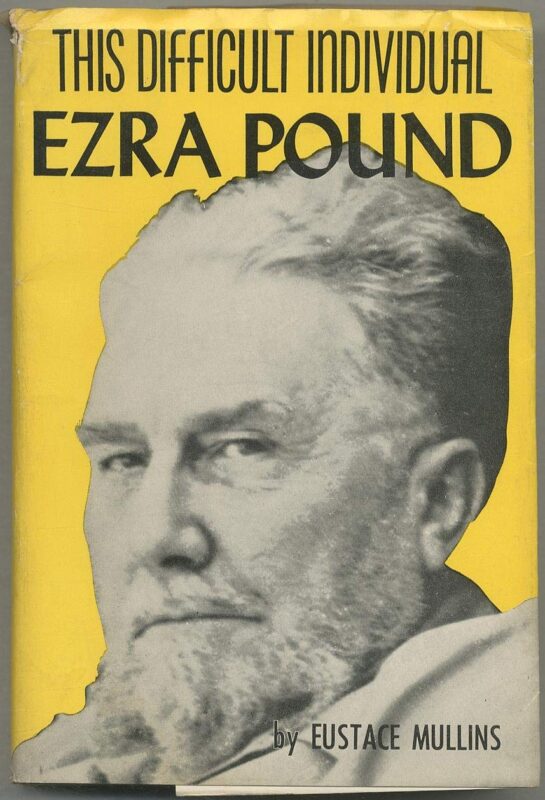
This Difficult Individual, Ezra Pound by Eustace Mullins opens with a stark image: the poet incarcerated in St. Elizabeths, a federal asylum in Washington, D.C., surrounded by political prisoners and violent criminals. The book frames Ezra Pound’s postwar confinement not as the result of madness but as a deliberate silencing of one of America’s most influential cultural figures. Mullins constructs a biographical arc that traces Pound’s life from frontier Idaho through literary ascendancy in Europe to isolation in a psychiatric institution. He threads together personal encounters, archival insight, and polemical commentary to examine how the U.S. government used psychiatry as a means of political suppression.
From Poet to Political Prisoner
Ezra Pound’s indictment for treason in 1945 stemmed from radio broadcasts he delivered during World War II while living in Italy. He criticized U.S. financial institutions, war policy, and what he termed the decay of democratic principles. Mullins contends that Pound's prosecution did not arise from his alleged wartime disloyalty but from his persistent challenge to centralized banking and political orthodoxy. The legal strategy, he argues, was less concerned with conviction than with containment. A federal court declared Pound mentally unfit for trial and remanded him indefinitely to St. Elizabeths Hospital, where he remained for over a decade.
Why confine a poet with violent offenders? Why silence a literary critic by pathologizing dissent? Mullins frames these questions not as philosophical inquiries but as investigative prompts. His response hinges on institutional structure. In his reading, federal psychiatric commitment served as a mechanism to bypass constitutional guarantees. A criminal trial would have exposed the fragility of the evidence. Psychiatric detention erased the need to prove guilt. It also deprived Pound of a platform.
Literary Formation in the American East
Pound’s early education in Philadelphia and at the University of Pennsylvania shaped his scholarly sensibilities. At Hamilton College, he studied the classics and formed lifelong friendships with Hilda Doolittle and William Carlos Williams. These academic settings grounded his literary method in historical continuity and multilingual reference. Mullins notes that from the outset, Pound resisted prevailing academic orthodoxies. He rejected rote learning and formulaic verse, preferring creative risk and philological rigor.
Mullins traces Pound’s intellectual rebellion back to the monetary collapse experienced by his grandfather, Thaddeus Coleman Pound, a former congressman and currency reformer. This family history provided Ezra with both symbolic language and economic critique. He saw the shift from production to speculation not just as a financial phenomenon but as a cultural betrayal. Mullins emphasizes that Pound’s poetry and polemics derive from a coherent framework—an attempt to articulate value across literary, political, and monetary domains.
London and the Invention of Modernism
In London, Pound catalyzed the emergence of modernist literature. He championed imagism, supported the early careers of T.S. Eliot and James Joyce, and served as literary editor for several influential periodicals. His relationship with Ford Madox Ford at The English Review opened avenues for publishing his poetry and essays. With Harriet Monroe at Poetry magazine in Chicago, he defined a transatlantic network of modernism.
Pound’s literary activism extended to translations and cultural criticism. He popularized the Chinese classics and medieval troubadour poetry, asserting their relevance to the 20th century. Mullins argues that Pound’s literary choices expressed a political judgment. His search for form mirrored his search for justice. He praised merit, denounced mediocrity, and treated poetry as a civic act. This approach placed him at odds with institutions that prioritized bureaucratic conformity.
Rapallo and the Roots of Dissent
Pound relocated to Rapallo, Italy, in the 1920s, seeking refuge from London’s literary politics and America’s financial orthodoxy. In Rapallo, he entered his most prolific period, completing major installments of The Cantos and promoting economic theory based on social credit. He aligned himself with figures advocating for monetary reform and national sovereignty. Mullins documents how Pound’s writings during this period rejected gold-backed currency and usury-based banking systems, proposing instead a system grounded in productive capacity.
As Mussolini’s regime intensified, Pound maintained an ambiguous position. He supported aspects of fascist economic policy while criticizing militarism and racial persecution. His radio broadcasts for Rome’s propaganda service, though inflammatory, included references to Jeffersonian democracy, Confucian ethics, and Renaissance humanism. Mullins interprets these broadcasts as misread acts of civic loyalty rather than betrayal. He suggests that Pound’s target was not America itself but its deviation from constitutional principle.
Detention Without Trial
When American forces captured Pound in 1945, they placed him in a cage at a military detention camp near Pisa. Mullins recounts these events with clinical precision. Pound endured weeks of outdoor confinement under harsh conditions. The experience produced the Pisan Cantos, a work that blends classical allusion with lyrical meditation on collapse, memory, and judgment. Awarded the Bollingen Prize in 1948, this volume reignited controversy over his detention. Public outcry intensified, but the federal government avoided trial. Instead, it certified him insane.
St. Elizabeths functioned as a carceral hospital. Pound was housed in Howard Hall, a ward for the criminally insane. Surrounded by violent offenders, denied privacy, and subjected to continuous surveillance, he nevertheless continued to write. Mullins describes the atmosphere of the ward with vivid detail: the stench of decay, the disjointed babble of broken minds, the institutional disregard for dignity. Visitors endured security screening, government suspicion, and professional risk. Yet intellectuals and admirers continued to seek him out. Among them were E.E. Cummings, T.S. Eliot, and Ernest Hemingway.
Legacy and Release
Pressure for Pound’s release mounted through the 1950s. Mullins credits this shift to a growing awareness that the insanity ruling lacked clinical basis. Medical staff at St. Elizabeths eventually admitted that Pound’s symptoms did not align with psychiatric diagnosis. In 1958, the federal government dropped all charges and released him. The decision contained no apology and issued no clarification. Pound returned to Italy without trial, censure, or exoneration.
Mullins presents this resolution as emblematic. The refusal to prosecute or exonerate left Pound suspended in public imagination—a genius, a traitor, a madman, a prophet. The ambiguity served institutional interest. It preserved the authority of psychiatric power while avoiding the spectacle of legal defeat. Pound’s legacy thus remained entangled in contradiction, a condition that continues to shape his reception.
Cultural Resistance and Structural Power
This Difficult Individual, Ezra Pound articulates a broader critique of power. Mullins argues that literary figures who challenge dominant institutions—especially those who articulate economic or constitutional alternatives—face mechanisms of erasure. The combination of legal ambiguity, psychiatric confinement, and media vilification operates as a structural defense. Pound’s case exemplifies this pattern. His intellectual independence, economic critique, and refusal to recant placed him outside permissible discourse.
Mullins rejects the idea that Pound’s ideas became dangerous only when voiced through fascist radio. He insists the content of those ideas—anti-usury economics, cultural meritocracy, constitutional loyalty—remained consistent from the start. The danger lay in their coherence. Pound unified aesthetic, economic, and civic life into a single system of value. For institutions dependent on fragmentation, that unity threatened to restore what had been suppressed: the artist as legislator.
What does a nation fear in its poets? The question animates Mullins’s biography with relentless urgency. The answer, he implies, lies not in personal deviance but in structural conflict. The state holds the power to define madness. The poet, stripped of platform and legal status, survives only in the memory of those who refused to look away.
