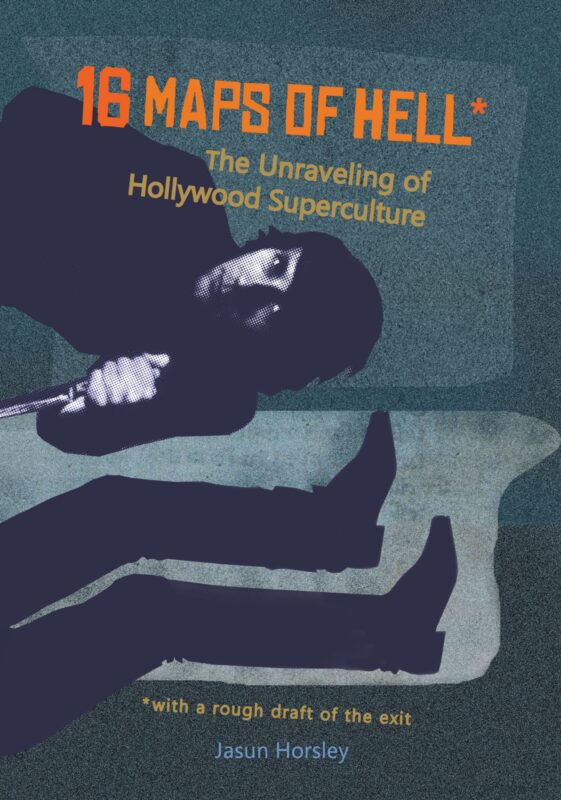
16 Maps of Hell
Series: 330 Predictive Programming & Truth or Consequences
Genre: Media Analysis
16 Maps of Hell by Jasun Horsley exposes the machinery of Hollywood as a superculture that engineers collective consciousness, steers global narratives, and sustains itself through carefully crafted illusions. Horsley interweaves cultural criticism, memoir, and investigative synthesis, revealing a network of power, secrecy, and psychological operations beneath the entertainment industry’s glamorous façade. This structure invites a forensic inquiry: what lies behind the endless proliferation of stories, images, and manufactured dreams?
The Architecture of Superculture
Hollywood structures its operations as a secular priesthood, its rituals binding audiences into a shared spell. Horsley locates the origins of this system in the rise of modern media, tracing how entertainment conglomerates absorb political and psychological power by producing myths that synchronize mass desires and fears. The book details Hollywood’s mechanisms for shaping identity, offering narrative blueprints that circulate through film, television, and digital platforms. These stories shape not only tastes and values but the infrastructure of memory and belief. By distributing images and scripts that root in the psyche, the industry seeds archetypes that become reference points for conduct, aspiration, and self-understanding.
Secret Society Dynamics
The Hollywood system operates as an open secret society, its existence visible but its true workings obscured. Initiation rites, unspoken codes, and the management of insider knowledge regulate access to influence. Horsley draws on research from anthropology and psychology to demonstrate how this system of selective secrecy functions as a control mechanism. He emphasizes that the power of Hollywood does not reside in what is hidden from public view, but in the selective revelation of privilege, ritual, and manipulation. This dynamic fosters the creation of social hierarchies, in which the few with access to knowledge shape the emotional and psychological reality of the many.
Engineering Consent Through Propaganda
Hollywood functions as a powerful instrument of sociocultural propaganda, engineering mass consent through myth-making and narrative management. Horsley frames the film industry as a continuous psychological operation that leverages the art of storytelling to shape cultural memory and direct collective behavior. The industry’s narratives synchronize public perception with elite interests, merging entertainment with political objectives. The book draws from the insights of Jacques Ellul and others, analyzing how propaganda flows from both the producers and the receivers of culture, co-creating a feedback loop that reinforces a manufactured consensus. Through repetition, spectacle, and strategic omission, Hollywood molds the cognitive terrain in which people interpret events, understand morality, and locate their place in the world.
The Power of Parasocial Enchantment
Hollywood manufactures intimacy by fostering parasocial relationships between audiences and stars. These one-sided attachments cultivate emotional investment in figures who remain perpetually distant, driving the consumption of products and stories that promise proximity but deliver only mediated connection. Horsley explores how these relationships bind viewers into ongoing cycles of desire and identification, rendering them susceptible to the industry’s psychological cues and emotional manipulations. The cultivation of longing becomes a tool of governance, redirecting attention away from the world of lived experience toward a synthetic universe of fantasy and spectacle.
Networks of Blackmail and Exploitation
The investigation extends into Hollywood’s entanglement with organized crime, blackmail, and abuse. Horsley substantiates his claims through detailed case studies, tracing a pattern in which personal compromise and criminal leverage become instruments of control within the entertainment hierarchy. He examines figures such as George Hodel and the Black Dahlia murder, demonstrating how networks of secrecy, collusion, and silent complicity enable cycles of exploitation. These dynamics reinforce the system’s power, deterring whistleblowers and ensuring that the mechanisms of coercion remain intact. Blackmail functions as a currency within the industry, sustaining the architecture of silence that protects powerful interests and perpetuates abuse.
Incest, Trauma, and Hollywood’s Familial Scripts
The book foregrounds the recurrence of incest, hidden parentage, and family trauma as both themes within Hollywood films and realities behind the scenes. Horsley unpacks how stories of transgression and concealment become embedded in cultural mythologies, shaping not only the entertainment product but the psychological experience of audiences. He connects these motifs to personal narratives, revealing how the convergence of family secrets, ambition, and mythmaking produces both individual and collective trauma. By examining the biographies of Hollywood figures and the scripts they help create, the book illustrates how the industry recycles trauma as spectacle, simultaneously drawing from and reinforcing wounds that bind viewers to its world.
Hollywood as Cultural Psy-Op
The machinery of Hollywood integrates with broader systems of political power, serving as both a reflection and an agent of cultural engineering. Horsley documents the collaboration between the film industry and intelligence agencies, revealing how entertainment becomes an instrument of geopolitical influence and social control. The industry’s capacity to shape perception, normalize surveillance, and reframe narratives serves the interests of those who wield power behind the screen. The book exposes specific instances where Hollywood operations dovetail with covert action, blurring the lines between fiction, propaganda, and real-world manipulation.
Self-Reflection and Personal Unspelling
Horsley places his own journey at the center of the analysis, using memoir as a counterpoint to the collective story of Hollywood’s rise. He narrates his early fascination with the film industry, his encounters with illness and disillusionment, and his eventual recognition of the system’s destructive allure. This narrative arc mirrors the wider cultural process he describes: the seduction by myth, the entrapment in fantasy, and the painstaking work of extrication. Through self-interrogation and critical synthesis, he models a path for readers who sense the spell but seek an exit.
Cycles of Deception and Narrative Collapse
The Hollywood system functions through cycles of mythologization, deception, and concealment. The industry’s core product is narrative itself—a medium that generates emotional engagement while masking the processes and costs of its own creation. Horsley dissects the ways in which Hollywood constantly remakes its own image, offering new stories to explain, distract, or justify its patterns of excess and abuse. The recurring collapse of old narratives and the introduction of new mythologies serve to refresh the collective trance, preserving the structure’s capacity for self-renewal and expansion. In this context, the exposure of secrets does not lead to resolution, but to the creation of yet another story for consumption.
Mapping the Way Out
The book’s structure—sixteen “maps”—functions both as an exposé and a navigational toolkit. Each chapter builds on the previous, accumulating evidence, sharpening analysis, and opening potential lines of flight. Horsley suggests that the act of mapping itself becomes a means of liberation: to trace the boundaries of the system, to name its operations, and to recognize its patterns is to weaken their grip. He asserts that the first step in escaping Hollywood’s superculture is the acknowledgment of its totalizing ambitions and the refusal to participate in its cycles of compulsion.
The Role of Collective Recognition
Cultural liberation requires more than private insight; it demands the formation of communities that recognize the operations of power and resist its spells. Horsley foregrounds the importance of public testimony, truth-telling, and the creation of alternative networks of meaning. He calls for collective action—small circles of conscious individuals who support each other in the work of unspelling, healing, and narrative reclamation. By grounding liberation in community, he reorients the struggle from solitary resistance to shared transformation.
The Science of Cultural Propaganda
The analysis extends into the “science” behind cultural propaganda. Horsley details how the apparatus of mass entertainment uses behavioral conditioning, psychological priming, and ritualized repetition to produce compliant audiences. The deployment of advanced media technologies, immersive storytelling techniques, and coordinated messaging generates states of trance and emotional dependency. By decoding the mechanics of cultural programming, Horsley illuminates the subtle interplay between audience agency and systemic control.
Consequences of Prolonged Exposure
Prolonged immersion in Hollywood’s narratives generates predictable psychological and social outcomes. Horsley traces the links between media saturation, chronic fantasy syndrome, and the proliferation of alienation, depression, and existential malaise. The construction of identity through film and television scripts fragments personal agency, fostering cycles of mimicry, dissatisfaction, and perpetual longing. The breakdown of shared reality, driven by the multiplication of images and conflicting stories, precipitates cultural disintegration and the erosion of communal bonds.
Blueprints for Exit
Horsley concludes with a provisional map for personal and collective exit. He calls for the cultivation of discernment, the restoration of embodied presence, and the reclamation of narrative agency. The process begins with self-observation and the rejection of manufactured desires. He urges readers to engage in creative acts that generate meaning outside the structures of superculture, forging relationships, art, and practices that renew authentic connection and purpose.
Liberation emerges through the cumulative work of exposure, critical synthesis, and collective imagination. Horsley’s vision depends on the willingness to confront discomfort, sustain inquiry, and persist in the search for uncorrupted meaning. The book stands as a call to dismantle the machinery of enchantment, to name the cost of manufactured dreams, and to build a culture rooted in honesty, courage, and shared aspiration.
Through relentless inquiry and layered synthesis, 16 Maps of Hell by Jasun Horsley establishes itself as both a map and a method. It invites readers to move from passive spectatorship to engaged participation in the work of cultural renewal, tracing a path through the labyrinth of illusions toward a reality anchored in truth and solidarity.

https://youtu.be/idDB-gBmk78