In the Shadows of a Presidency
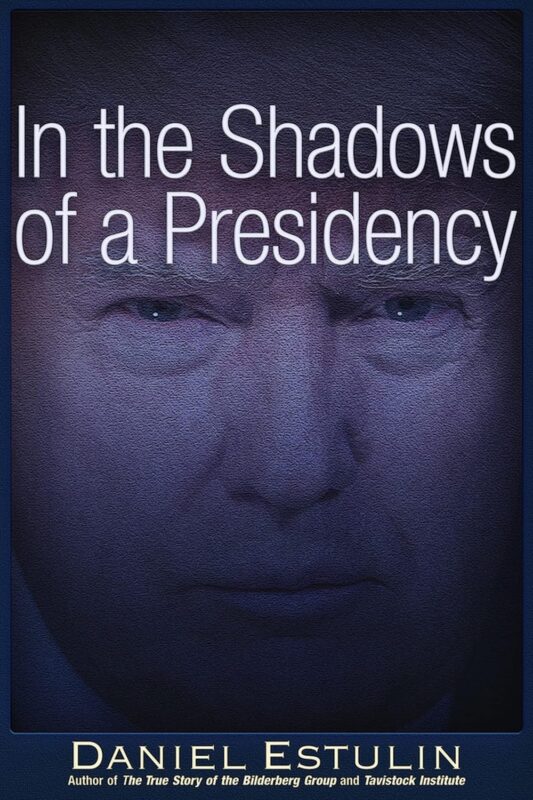
In the Shadows of a Presidency by Daniel Estulin explores the underlying structures, financial currents, and global power networks shaping the rise and governance of Donald Trump. Estulin initiates his investigation by situating the Trump presidency within the broader context of modern economic and political history. He claims that American elections increasingly serve as arenas for economic conflict, where corporate sovereignty supersedes the authority of national governments. This shift, he asserts, marks a transformation in which multinational corporations and financial institutions determine global agendas, dictating the needs and strategies of entire states, including the United States.
The Birth of Corporate Sovereignty
Estulin tracks the ascendance of corporate power, mapping the development from state-nurtured industry to multinational conglomerates that now act independently of national policy. Major transnational corporations, global financial entities, and expansive online communities have grown strong enough to set agendas and even manipulate the destinies of nations. In his analysis, the United States emerges as the prime example—a state whose sovereignty yields to the priorities of financial and corporate elites.
He traces the origins of this corporate ascendancy to neoliberal globalization, which transformed China into a formidable economic rival and introduced new tectonic fault lines in the global order. Geography and resource competition now drive international conflict, with struggles over energy, food, and water intensifying as population pressures mount. This new terrain reshapes global politics, forcing states to compete for dwindling resources while multinationals extract value and structure markets beyond the reach of conventional government oversight.
Cycles of American Power
Estulin asserts that American political life operates through cyclical periods of expansion and contraction. Democratic presidents such as Wilson, Roosevelt, Truman, and Kennedy drove outward-looking, expansionist policies. Republican leaders—save for exceptions like George W. Bush—often champion inward-focused agendas. Trump’s election, Estulin contends, reflects a periodic return to domestic priorities, a collective demand for “breathing space” and resource realignment. This inward turn, he argues, forms part of a larger rhythm in which American society retreats from global entanglements to address internal challenges.
The “America First” mantra functions within this historical cycle, channeling energies toward domestic renewal. Yet this focus remains provisional. The book claims that American strategies for resolving domestic issues invariably involve externalizing costs onto rival states and actors—hence the heightened attention to Russia, China, Iran, oil markets, and global migration flows.
Three Americas and the 2016 Election
Estulin dissects American society into three distinct “Americas.” The first consists of the financial elite—Wall Street, Hollywood, Silicon Valley, and bureaucratic centers. These actors, he claims, represent the one percent who control the printing presses, insurance conglomerates, hedge funds, and other abstract forms of capital. The second “America” is corporate and post-industrial, composed of transnational producers, energy titans, military-industrial firms, and construction giants—those who manufacture tangible goods and infrastructure. The third is the high-tech sector: the knowledge economy, information technology, and new brain-based industries that have flourished over the last four decades.
Trump, in Estulin’s analysis, unified the interests of the second and third Americas, amplifying the voice of industrial and technological actors seeking to protect national interests against global financial manipulation. The book contends that Trump’s election required support from both corporate and high-tech spheres, forging an uneasy alliance to challenge the financial class represented by Hillary Clinton.
A System in Crisis
Estulin describes a global economic system gripped by fragility. He focuses on the mountain of global debt and the $2 quadrillion derivatives bubble, arguing that debt-to-GDP ratios have soared past sustainable thresholds. He identifies specific figures: global debt at 325% of GDP, US national debt at $20 trillion, European bank leverage at 28:1, and catastrophic risk exposure at institutions like Deutsche Bank, whose derivatives portfolio dwarfs the entire German economy.
He claims that these structural imbalances cannot resolve through conventional means. Attempts to print money—quantitative easing—failed to restore solvency. Instead, they inflated asset bubbles and entrenched new vulnerabilities. The book identifies 2008 as the critical turning point, when the US and world financial systems, battered by subprime mortgage fraud and derivatives exposure, entered a protracted crisis of legitimacy and function.
Trump’s rise, Estulin claims, represented a specific strategic response. He characterizes Trump as the “anti-crisis manager”—a figure prepared to restructure the American economy at the expense of the financial sector. By raising interest rates and permitting bankruptcies, the US could shed unserviceable debt and revive real production. This agenda, he asserts, directly threatened financial elites, whose fortunes depended on asset bubbles and continuous liquidity injections.
Deep State and the Struggle for Power
The narrative identifies a “Deep State” as the central antagonist. Estulin defines this entity as a complex network of intelligence agencies, financial institutions, law firms, media conglomerates, and organized crime interests, rooted in post-WWII Anglo-American power. The Deep State operates, in his account, as a self-sustaining system dedicated to preserving the existing order—defending neoliberal globalization, maintaining open borders, suppressing wages, and manipulating public opinion through media control and psychological operations.
He claims that the Deep State’s ideology prioritizes market “freedom” and personal narcissism above collective progress, sustaining its power by propagating existentialism, pessimism, and free market dogma. The narrative links this agenda to historical British imperialism, asserting that elite actors deploy color revolutions, regime change operations, and social engineering both abroad and domestically to maintain dominance.
Color Revolutions Come Home
Estulin examines the application of “color revolution” tactics—once used to destabilize foreign regimes—within the United States. These methods include orchestrated propaganda, relentless media attacks, engineered scandals, and street-level activism directed by think tanks and foundations. The book details how leaks, hacks, and information warfare during the 2016 campaign weaponized these tools against the Trump movement.
He provides examples: the Democratic National Committee’s reliance on CrowdStrike (an entity with intelligence ties) for cyber-forensic analysis; the rapid proliferation of narratives linking Trump to Russian interference; and the circulation of unverified dossiers designed to discredit the administration. Estulin tracks the evolution of these campaigns from initial skepticism among intelligence officials to media saturation and legislative inquiries, building a case that internal US political conflict now mirrors the playbook of international destabilization efforts.
Economic Collapse and the Struggle for Survival
The book asserts that both the financial and corporate factions understood the impossibility of sustaining the global order through incremental adjustment. Estulin details how financial elites sought to install a president who would reignite quantitative easing, enabling the continued printing of dollars to prop up banks and maintain market confidence. Clinton’s candidacy embodied this vision—a temporary extension of the existing order through liquidity and asset inflation, followed by inevitable systemic crisis.
Trump’s presidency offered an alternative: raise interest rates, force bankruptcies, and reorganize the economy around tangible production rather than financial speculation. Estulin describes this as a calculated risk. The plan sought to preserve the real economy by sacrificing speculative finance, accepting short-term pain for the promise of future stability. He asserts that neither option guaranteed a benign outcome—both scenarios, he argues, entailed deep structural upheaval, with consequences for global alliances, market stability, and domestic prosperity.
Global Realignment and Multipolar Disorder
Estulin’s analysis extends to the international arena, forecasting the emergence of a multipolar world defined by new alignments and regional power blocs. He claims that the United States, facing resource constraints and strategic overextension, seeks to undermine rivals such as China and the European Union by fostering division and exploiting economic vulnerabilities. In this view, American strategy moves away from global stewardship, prioritizing deals and alignments that serve immediate national interests.
He anticipates the rise of exclusive economic zones—corporate para-states and free trade hubs that function independently of centralized authority. Cities, especially seaports, emerge as focal points for global commerce, while vast populations face marginalization and deprivation. By 2030, Estulin foresees a new Middle Ages, with a small minority thriving in advanced urban enclaves and the majority consigned to archaic, precarious existence.
Temporary Alliances and Shifting Loyalties
The narrative describes foreign policy as a dynamic field, marked by transactional relationships and fleeting alignments. Estulin argues that Trump’s outreach to Russia represents an example of short-term expediency, a marriage of convenience dictated by geopolitical need rather than ideological affinity. He cautions that such alignments remain vulnerable to reversal as underlying interests shift.
He identifies key zones of contestation: Syria, Ukraine, Crimea, Belarus, Moldova, and Central Asia. Within this framework, the US and Russia test the limits of cooperation, constrained by deeper structural antagonism. Trump, he argues, pursues American advantage in every negotiation, remaining wary of entrenched liberal factions in Russia allied with global finance.
Cultural Manipulation and Mass Media
Estulin addresses the transformation of cultural authority in the age of mass media. He describes how technological advances have shifted the locus of meaning from religious institutions to media conglomerates and digital platforms. Modern individuals, he contends, receive truth and meaning from “tele-altar techno-theatrical cathedrals,” exchanging old priests for new arbiters of reality.
He warns that this transformation creates new vulnerabilities, as the same tools that mediate meaning can be weaponized for social engineering and mass manipulation. The media’s power to shape perceptions, mobilize sentiment, and direct outrage underpins the effectiveness of color revolution tactics and Deep State operations.
The Future: Structural Upheaval and Strategic Uncertainty
Estulin concludes with a stark forecast. He asserts that the world stands at the threshold of a new era—marked by systemic financial crisis, institutional collapse, and escalating competition for resources and technological primacy. The convergence of economic, political, and technological shifts will force continual realignment, redrawing boundaries and alliances according to the imperatives of survival and control.
He cautions that the same forces destabilizing the global order also threaten to undermine social cohesion within states. The struggle between globalist and nationalist factions intensifies, with both sides wielding formidable resources and strategic acumen. The stakes, he argues, include the viability of the nation-state, the legitimacy of democratic governance, and the prospects for peace or catastrophe.
In this contest, Estulin urges readers to recognize the drivers behind the drama—the true networks, strategies, and interests shaping events. He calls for a conscious reckoning with the realities of power, urging vigilance in an era where spectacle, crisis, and manipulation converge to shape destinies.

