TransEvolution: The Coming Age of Human Deconstruction
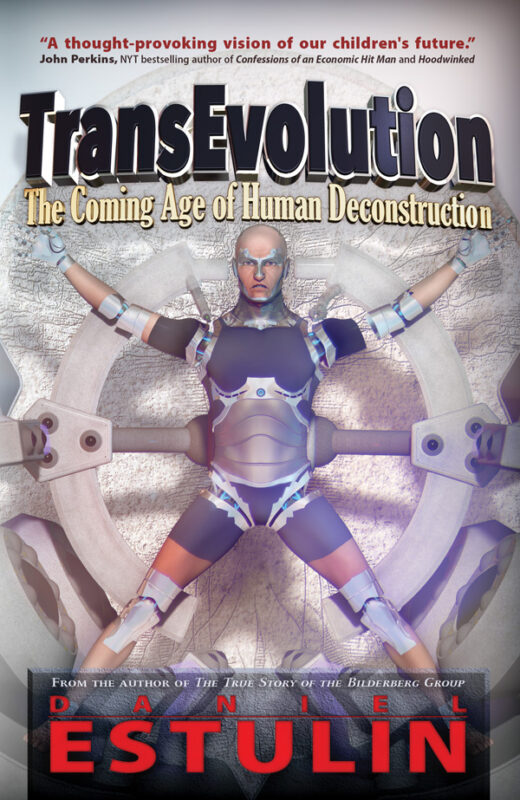
TransEvolution: The Coming Age of Human Deconstruction by Daniel Estulin exposes the architecture of a global transformation where the convergence of advanced technologies, economic engineering, and elite-driven political agendas directs the trajectory of society toward a future marked by radical redefinition of the human condition.
A Blueprint for Systemic Change
Estulin establishes the operational logic that drives transnational elites to dissolve the old order and erect a new architecture of control. Financial cartels, technology consortia, and supranational organizations operate in coordination, channeling crises to expand their influence and compress resistance. National sovereignty disintegrates as corporate interests dictate policies, convert governments into subordinate instruments, and replace democratic structures with supranational governance. The world’s financial system, built on speculation and managed crises, fuels a relentless drive toward consolidation of wealth and power, with the interests of a global managerial class overriding public welfare.
Strategic Forecasts and Mega-City Emergence
Reports generated by elite planning groups such as the UK Ministry of Defense’s Strategic Trends 2007-2036 outline the social, economic, and demographic shocks orchestrated to fragment traditional societies. Urban migration accelerates as economic displacement and environmental pressures transform rural populations into denizens of mega-cities. These urban leviathans, with populations exceeding 20 million, breed endemic instability—lawlessness, poverty, social disintegration—prompting the use of martial law and surveillance as management tools. The city itself becomes the new operational domain for social experimentation, resource management, and population control.
Technological Transformation and the Human Body
The book presents a future in which biology merges with technology. Advances in genetics, artificial intelligence, nanotechnology, and augmented reality break the barrier between organism and machine. The emergence of transhumanism, a vision driven by elite technocrats and research consortiums, reframes the human being as a programmable entity, subject to continual upgrade, monitoring, and reconfiguration. Artificial DNA, self-replicating nanomachines, and digital consciousness initiate a new epoch, subordinating natural evolution to the directives of technocratic governance.
Psychological Warfare and Social Engineering
The orchestration of public opinion, mass psychology, and collective behavior becomes a central tool for engineering consent. Entertainment, news media, and digital communication platforms operate as instruments for framing perception, shaping reality, and instilling values congruent with elite interests. Social turbulence—engineered through economic shocks, terror campaigns, and manufactured crises—renders populations vulnerable to manipulation, dependency, and acquiescence. Researchers at institutions such as the Tavistock Institute and the Frankfurt School develop protocols for inducing mass apathy, denial, and in-group/out-group segmentation, weakening resistance and fostering conformity.
Economic Engineering and Controlled Disintegration
Estulin delineates how economic shocks serve as deliberate levers of transformation. Financial crises—staged and managed by institutions such as the Inter-Alpha Group, the Bilderberg Group, and the Trilateral Commission—initiate cascades of unemployment, debt accumulation, and asset seizures. Bank bailouts and liquidity injections funnel wealth to the apex of the financial pyramid, converting public obligations into private gain and using national debt as an instrument of leverage over policy. Controlled disintegration, a doctrine formalized in strategic policy papers, pushes economies toward post-industrialization, reducing populations to managed labor pools and undermining the productive base of society.
The Structure of Global Power: Interlocking Directorates
The book traces how interlocking directorates—networks of board memberships and cross-shareholdings among multinational corporations, investment banks, and insurance giants—anchor the architecture of control. Power resides in the fusion of financial, technological, and informational capital, manifest in entities such as Royal Dutch Shell, BP, HSBC, Goldman Sachs, and their European and American affiliates. This system forms a self-reinforcing web, a fondi structure, that insulates the elite from external challenge and governs the allocation of resources, information, and influence.
Depopulation Agendas and Resource Management
Think tanks such as the Club of Rome articulate strategies that link population management to resource allocation. Their analyses, built on neo-Malthusian models, diagnose technological progress as a threat to elite dominance by enabling demographic expansion and political autonomy. The solution advanced in their reports calls for engineered scarcity, technological stagnation, and policies that suppress population growth. Environmentalist narratives, food supply manipulation, and regulatory frameworks such as Codex Alimentarius serve as operational instruments, creating artificial scarcity and justifying interventionist controls.
Surveillance, Data, and Social Order
Information Communications Technology (ICT) becomes both the nervous system and enforcement mechanism of the emerging order. Ubiquitous sensors, databases, and two-way communication streams integrate with daily life, making surveillance intrinsic to social existence. Disconnection or dissent triggers suspicion. The capacity for rapid mobilization—manifest in the emergence of flash mobs and networked resistance—provokes an escalation of monitoring and preemptive policing, institutionalizing martial law as a routine policy lever.
Biopolitics: Food, Medicine, and Human Experimentation
Estulin details the deployment of genetically modified organisms (GMOs), pharmaceuticals, and medical protocols as instruments for conditioning, controlling, and even culling populations. Corporate actors such as Monsanto, Cargill, and Archer Daniels Midland establish hegemony over the food supply, dictating not only what populations consume, but also the conditions under which they live and reproduce. The convergence of food scarcity, health crises, and regulatory capture enables interventions that blur the line between public health and population management, with the Rockefeller Global Medical Cartel exerting influence over medicine and nutrition from birth to death.
Media, Entertainment, and Cultural Programming
The control of narrative, symbol, and spectacle solidifies the dominance of elite values. Television, film, and social media become not just sources of diversion but primary sites for encoding beliefs, aspirations, and fears. Major news networks and digital platforms filter information, excluding dissent and promoting consensus around engineered crises. Reality is continuously reconstructed to support policy objectives, neutralize resistance, and habituate populations to surveillance, scarcity, and technocratic management.
Transhumanist Horizons: The End of the Normal
The project of transhumanism, championed by research agencies such as DARPA and disseminated through think tanks and cultural products, declares the obsolescence of the “normal” human. The new human becomes a digital node—augmented, surveilled, and subject to continual modification. Concepts such as the hive mind, virtual reality immersion, and total spectrum dominance dissolve boundaries between public and private, internal and external, thought and action. Psychotropic weapons, neuromodulation, and predictive analytics convert deviance into pathology, authorizing intervention at the level of cognition and desire.
Resistance, Sovereignty, and the Question of Agency
Estulin situates the struggle for the future in the tension between oligarchic ambition and the possibility of sovereign self-governance. The nation-state—conceived as the institutional expression of collective will and creativity—faces existential pressure from supranational entities that promote feudal models of dependency and hierarchy. The defense of technological progress, literacy, and participatory government forms the core of any strategy for resistance. Leaders who reclaim the power to create credit, fund infrastructure, and educate citizens represent the structural antagonists to the system Estulin describes.
Narrative Causality: From Crisis to Convergence
As the sequence of crises—financial, environmental, social, technological—unfolds, the lines connecting actors, interests, and outcomes grow clearer. Elites use the tools of finance, science, and culture to shape a world that prioritizes stability, manageability, and predictability for themselves, even as it produces turbulence and precarity for others. Each economic shock, technological innovation, and regulatory intervention brings the managed society closer. The human being, once the agent of change and creativity, becomes the subject of engineering and control. The narrative builds tension toward a convergence where decisions made in corporate boardrooms and secret conferences materialize in the structures of everyday life.
The Stakes: Human Identity and the Next Evolution
TransEvolution asserts that the stakes of the current transformation extend beyond political rights or economic opportunity. The convergence of technology, finance, and governance programs the possibility of a post-human epoch—an era where agency, creativity, and even consciousness become artifacts managed by an elite. The trajectory of mega-cities, transhumanist experimentation, and engineered crises propels humanity toward a bifurcation: the emergence of a programmable, surveilled, and managed collective or the reassertion of sovereignty, creativity, and the right to define the future.
The book posits that awareness, resistance, and the defense of sovereign government represent not only acts of survival but also the means by which humanity can reclaim its role as author of its own evolution. By tracing the operational strategies of global elites, the mechanics of crisis, and the logic of technological transformation, Estulin crafts a narrative that situates the coming age as a deliberate outcome—an epoch that demands conscious engagement, structural critique, and strategic response. The future unfolds through the alignment of interests, the management of perception, and the relentless engineering of reality itself.