Thy Will Be Done: The Conquest of the Amazon: Nelson Rockefeller and Evangelism in the Age of Oil
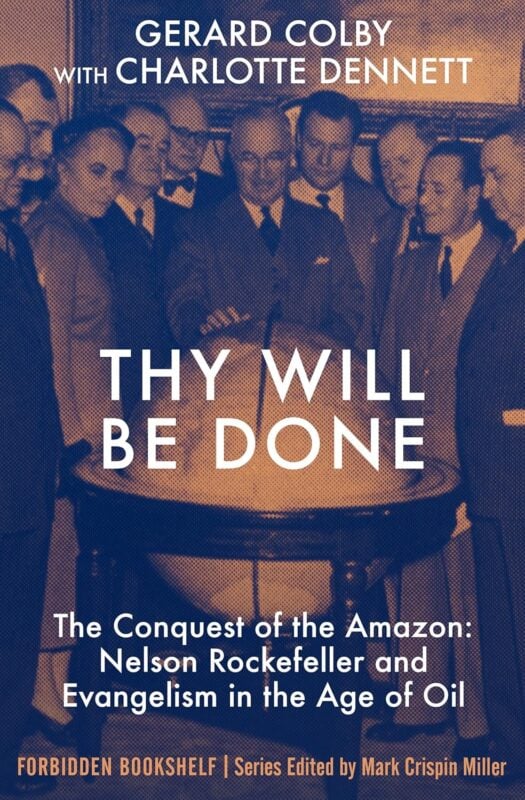
Thy Will Be Done by Gerard Colby and Charlotte Dennett exposes the entanglement of U.S. missionary movements, Cold War geopolitics, and corporate expansion into the Amazon through the Rockefeller dynasty’s covert operations.
The Rockefeller Strategy for Hemispheric Control
Nelson Rockefeller’s appointments as Coordinator of Inter-American Affairs and later Assistant Secretary of State for Latin American Affairs positioned him to fuse religious missions with intelligence operations. His coordination with fundamentalist missionary groups, including Wycliffe Bible Translators and the Summer Institute of Linguistics (SIL), integrated Christian evangelism into a U.S.-engineered system of territorial and ideological control. These missionaries, deployed under the guise of translating Bibles, mapped indigenous populations, identified tribal resistances, and facilitated access for corporate and military entities seeking land and resources. Their fieldwork served as prelude and platform for the entry of oil conglomerates, mining companies, and agribusiness interests.
Missionary Linguists and the Architecture of Extraction
The translation work extended far beyond linguistics. SIL’s 1967 publication, Indians of Brazil in the Twentieth Century, categorized tribes by degrees of hostility and susceptibility, effectively blueprinting a conquest map for the Brazilian military regime and its American allies. Missionary narratives softened the image of penetration while supplying crucial ethnographic intelligence. Their classification of “hostile tribes” signaled clearance targets for developmental and security operations. The Rockefeller-connected Institute for Cross Cultural Research published this data for strategic application, not academic analysis. Evangelical zeal and geopolitical calculus intersected through these operations, converting spiritual mandates into logistical support for resource domination.
Corporate Philanthropy as Ideological Armor
The Rockefeller foundations financed public health initiatives, academic grants, and environmental projects to build moral capital. These philanthropic endeavors reinforced the image of benevolence while enabling the foundational interests in oil, banking, and agribusiness to expand without obstruction. David Rockefeller’s global banking strategies through Chase Manhattan created interdependencies between debtor nations and American financial institutions. The Rockefeller Brothers Fund and Rockefeller Foundation’s environmental programs gained prestige as they advanced selective modernization efforts in the Global South, yet their asset portfolios retained deep fossil fuel commitments.
Cold War Counterinsurgency Through Religious Infrastructure
Evangelical missions became logistical auxiliaries for U.S. intelligence and military strategy. As early as the 1950s, Rockefeller-appointed panels under Henry Kissinger produced national security doctrines emphasizing counterinsurgency, ideological penetration, and psychological warfare. These strategies became operational blueprints during coups in Guatemala, Brazil, and Chile. Missionary groups facilitated territorial stability by translating not only Scripture but the terms of surrender to global capitalism. Their outreach neutralized indigenous resistance, synchronized rural cultures with extractive economies, and preempted socialist alternatives.
The Council of the Americas and the Path to NAFTA
David Rockefeller founded the Business Group for Latin America, later renamed the Council of the Americas, to institutionalize hemispheric corporate governance. This council advanced structural reforms across Latin American economies, integrating regional trade into U.S.-dominated frameworks. It served as a soft power conduit for neoliberal doctrines—privatization, deregulation, and austerity—long before their official implementation under NAFTA. Rockefeller-backed policy circles aligned these economic reforms with missionary outreach, producing parallel tracks of cultural and economic restructuring.
Evangelism Scaled to Globalization
Wycliffe and SIL exported their model from the Amazon to Africa, Central Asia, and the Middle East. As oil was discovered in Ghana, Wycliffe intensified its work among three key tribes in the newly branded Black Gold Coast. Their linguistic outreach corresponded precisely with areas marked for energy exploration by Chevron, Shell, and ExxonMobil. Wycliffe’s Global Alliance, often misrepresented as independent, operated within the same logistical and ideological schema established in South America. Bible translation acted as a cultural wedge, aligning tribal identities with modern capitalist frameworks while opening space for infrastructural penetration.
Rockefeller-Driven Governance in Post-War Presidencies
Presidents from Eisenhower to Obama inherited and advanced Rockefeller-linked strategies. Jimmy Carter, recruited through the Trilateral Commission, staffed his administration with Commission members and Council on Foreign Relations veterans. The Rockefeller investment in leadership cultivation produced alignment across decades of U.S. foreign policy. From Salvador Allende’s overthrow in Chile to structural adjustment programs in the 1990s, each pivot matched Rockefeller economic objectives. The Rockefeller-funded policy networks embedded themselves in statecraft, guiding trade, military, and development policy toward capital-convergent outcomes.
Climate Crisis and Internal Family Revolt
In the early 21st century, fissures appeared within the Rockefeller family over ExxonMobil’s denial of climate science. Descendants like Neva Rockefeller Goodwin publicly challenged the corporation’s misinformation campaigns and pressed for divestment. Despite internal resistance, several family funds withdrew holdings and criticized ExxonMobil’s refusal to transition toward sustainable energy. However, major family blocs, including members tied to direct energy investments in Russia and real estate ventures in Asia, remained absent from reform efforts. The family’s historical entwinement with fossil fuel dominance compromised the effectiveness of its environmental advocacy.
Russian Energy Ambitions and Financial Expansion
Steven Rockefeller Jr. extended the family’s energy legacy into Siberia by acquiring Techneftinvesta, a major Russian oil and gas company. He financed this $1 billion acquisition through VTB Bank, a Russian state-controlled financial institution. The deal made Rockefeller Oil Company one of the largest foreign stakeholders in Western Siberia’s fossil reserves. These investments underscored the persistence of Rockefeller capital strategies, even as environmental narratives from other family branches sought to reframe the legacy. Rockefeller capital flows adjusted to geopolitical shifts, embedding influence in both Western and Eastern blocs.
Contested Legacies in Latin America
In Brazil, the Rockefeller-linked Council of the Americas supported market-oriented regimes as President Dilma Rousseff faced impeachment. Her removal marked a return to pro-austerity, pro-privatization governance. Missionaries, already embedded for decades, faced minimal resistance under the new regime. Gold miners massacred members of uncontacted tribes in the Amazon with impunity. These acts coincided with cuts to indigenous protection agencies and re-energized extractive projects. Evangelical missions, less overtly violent, remained instrumental in pacifying tribal populations and preparing the terrain for commercial encroachment.
Strategic Philanthropy and Image Rebuilding
David Rockefeller donated $10 million to Harvard’s Latin American Studies Center, framing the initiative as a contribution to regional understanding. Meanwhile, Poder magazine celebrated his role in shaping Latin American policy as a model of democratic capitalism. This reframing coincided with increasing public backlash against globalization’s effects on labor, sovereignty, and ecological stability. David Rockefeller’s memoirs attempted to recast the Rockefeller influence as visionary rather than coercive, emphasizing leadership, philanthropy, and foresight. However, the authors of Thy Will Be Done demonstrate how these narratives obscure the underlying mechanisms of domination.
The Arc of Empire
The Rockefeller strategy fused religion, finance, and foreign policy into a coherent apparatus of control. From linguistic outreach to structural economic reforms, from coups to corporate mergers, each operation aligned with long-term goals of resource access, political stability, and ideological conformity. Thy Will Be Done uncovers how American missions served not only as spiritual projects but as operational arms of empire. Evangelism, stripped of its theological autonomy, functioned as a methodology of conquest. The convergence of faith and finance shaped the fate of tribes, states, and continents. The book charts this trajectory with documentary precision, mapping an empire that preached salvation while securing oilfields.