The Lost Hegemon: Whom the Gods Would Destroy
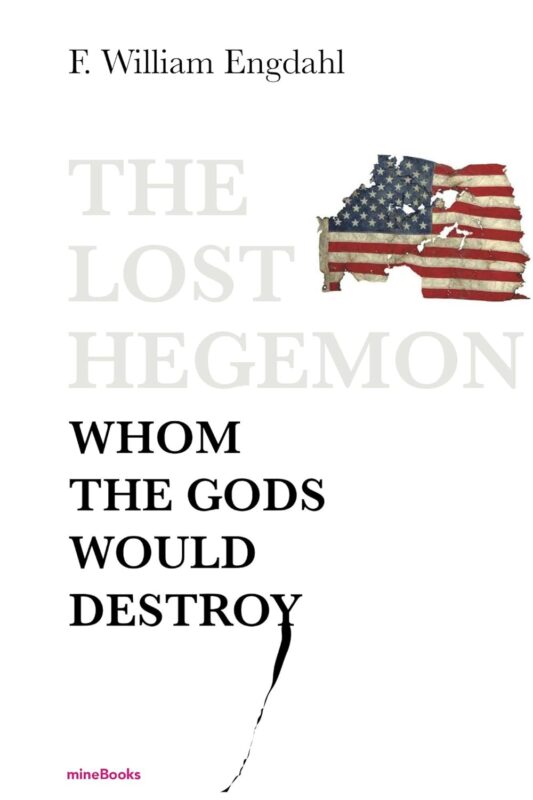
The Lost Hegemon: Whom the Gods Would Destroy by F. William Engdahl reveals the deep infrastructure of American geopolitical strategy through its decades-long manipulation of political Islam. Engdahl uncovers how U.S. intelligence agencies cultivated Islamic fundamentalism as a tool to destabilize rivals and secure influence across Eurasia, the Middle East, and Africa.
From Brotherhood to Battlefield
The narrative begins with the Muslim Brotherhood, formed in Egypt in the 1920s as a puritanical Islamic revivalist movement. Engdahl tracks its transformation into a covert instrument of statecraft. After World War II, the Brotherhood emerged in Europe under CIA guidance, establishing a foothold in Munich that served as a springboard for continental infiltration. U.S. agencies recruited these networks to counter Soviet influence during the Cold War. This alliance expanded into Afghanistan in the 1980s under Operation Cyclone, where the CIA and Saudi intelligence funneled weapons and ideology into the hands of Islamist militants. The battlefield legacy of this campaign seeded groups such as al-Qaeda and later ISIS.
Manufacturing a New Enemy
The fall of the Soviet Union left the United States without a clear adversary. Engdahl shows how policymakers replaced the communist threat with the specter of radical Islam. This strategic substitution served a dual function: it justified continued military spending and global deployment, and it enabled the redirection of Islamic extremism toward geopolitical adversaries. The War on Terror did not emerge from a vacuum. It arose from deliberate planning to use political Islam as a proxy force.
Syria, Iraq, and the Rise of ISIS
Engdahl situates the emergence of ISIS within a broader continuum of U.S.-sponsored insurgencies. The group’s rapid territorial gains in 2014 astonished observers, but the infrastructure behind its ascent reflected years of covert preparation. Trained in camps in Jordan and funded through Gulf monarchies aligned with U.S. interests, ISIS acted as a destabilizing force in Syria and Iraq. Its brutality and spectacle generated international support for re-intervention, securing U.S. military presence under the banner of humanitarian necessity. Engdahl links ISIS to earlier CIA operations in Chechnya, Bosnia, and Kosovo, where jihadist movements served as instruments to fracture opposition alliances.
The Gülen Network: Schools as Strategic Assets
Beyond violent insurgency, the book investigates the use of education and cultural infiltration through the Gülen Movement. Fethullah Gülen, a Turkish cleric operating from Pennsylvania, developed a global network of schools and religious centers under the guise of moderate Islam. Engdahl documents how these institutions, including more than a hundred charter schools in the United States, functioned as ideological platforms and recruitment hubs. Leaked intelligence and testimonies from insiders point to deep ties with U.S. agencies. In former Soviet territories and across Europe, Gülen’s schools served as nodes for cultural penetration, often in regions critical to Chinese and Russian energy interests.
Arab Spring: Revolution Repackaged
The Arab Spring is often remembered as a spontaneous democratic uprising. Engdahl dismantles this perception by tracing the funding, training, and media strategy back to U.S. entities like the State Department, the National Endowment for Democracy, and NGOs linked to George Soros. In Tunisia, Egypt, and Libya, protests facilitated the insertion of U.S.-friendly regimes or the deliberate collapse of functional states. In each case, the aftermath favored Islamist factions supported or tolerated by Washington. In Egypt, the Muslim Brotherhood briefly assumed power before being ousted, revealing the fragility of this experiment.
Pipeline Geopolitics and Energy Wars
Energy corridors form the backbone of Engdahl’s thesis on U.S. interventionism. Control over oil and gas flows through Eurasia and the Middle East remains a strategic imperative. The book details efforts to circumvent Russian energy dominance through projects like the Baku-Tbilisi-Ceyhan pipeline while destabilizing key regions like Syria, which blocked rival Qatari gas routes to Europe. The Syrian conflict is thus reframed as a proxy war over pipeline politics, with ISIS functioning as both a military disruptor and a justification for U.S. re-engagement.
The Eurasian Response
Russia and China, the principal targets of American strategy, began responding by deepening ties through BRICS and the Shanghai Cooperation Organization. Engdahl highlights how these alliances offered financial, military, and diplomatic alternatives to U.S.-led institutions. As the U.S. attempted to encircle Russia through NATO expansion and fomented unrest in Ukraine, it simultaneously supported ethnic and religious insurgencies along China’s western frontier. The Uyghur movement in Xinjiang, radicalized through Salafist channels, received external support under humanitarian pretenses. These operations mirrored Cold War containment strategies, now filtered through religious and cultural vectors.
From War on Terror to Civilizational War
Engdahl draws parallels between the medieval Christian Crusades and the modern War on Terror. Quoting U.S. officials who invoked religious language, he illustrates a worldview shaped by evangelical zeal, where geopolitics merges with apocalyptic theology. Figures like General William Boykin explicitly cast military campaigns as spiritual battles. This fusion of religion and strategy mirrors the ideological foundation of jihadist movements, generating a clash of absolutes with no room for negotiation. The deployment of fundamentalist Christianity within the U.S. military ranks functions as a mobilization strategy for endless war.
Institutionalized Chaos and Perpetual War
The book defines the post-9/11 geopolitical order as one of managed instability. Regime change, sectarian conflict, and proxy warfare maintain U.S. military-industrial relevance and suppress regional autonomy. This strategy eliminates the possibility of sovereign development in targeted countries. Infrastructure destruction, economic sanctions, and psychological operations erode national cohesion. Engdahl identifies this as a doctrine of Full Spectrum Dominance, extending beyond physical warfare to information control, cultural subversion, and cyber operations.
Terminal Hegemony and Strategic Exhaustion
By 2015, the limitations of this strategy had become clear. The U.S. faced insurgencies it could no longer control, alliances fraying under contradictory interests, and an economic order increasingly bypassed by multipolar alternatives. The rise of Russia in Syria, China’s Belt and Road Initiative, and resistance within the European Union signaled fractures in the architecture of unipolarity. Engdahl concludes that the American empire, having exhausted the utility of its terror-based strategy, now faces the very chaos it sought to orchestrate. The hegemon, once unrivaled, flounders amid self-created entropy.
What drives a superpower to sponsor terror, fracture states, and incite religious extremism under the guise of democracy? The answer lies in strategic desperation, the need to forestall rivals by any means. Engdahl’s thesis reorients understanding of modern conflict. Wars no longer erupt between nations over borders or treaties. They now unfold through proxies, ideologies, and invisible networks. Political Islam, far from a grassroots insurgency, emerges as the chosen architecture of 21st-century warfare.
The logic of manufactured enemies leads inevitably to blowback. Engdahl traces this arc with relentless precision. From the mosques of Munich to the deserts of Syria, from the training camps in Jordan to the classrooms of Gülen’s charter schools, the pattern reveals itself. Ideology becomes weapon. Chaos becomes method. Power becomes its own undoing. As the American-led order strains under the weight of its contradictions, Engdahl’s account stands as both diagnosis and indictment. The gods have indeed driven the hegemon mad.

