On Thermonuclear War
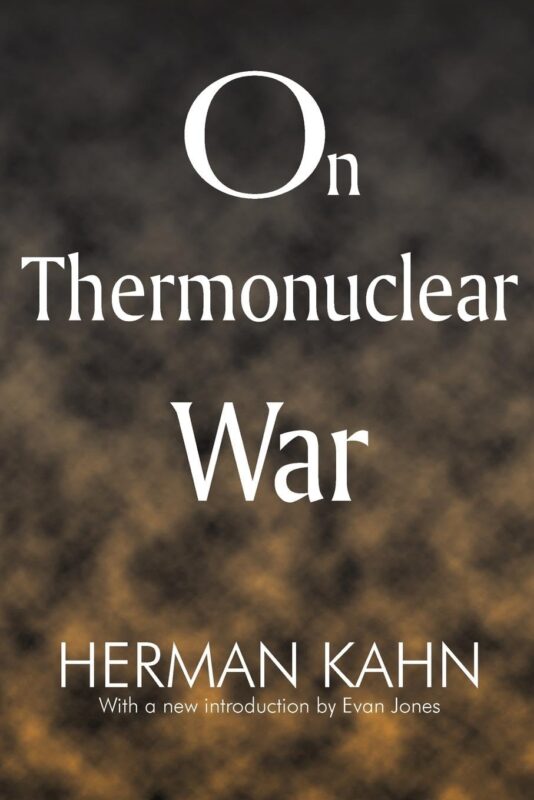
On Thermonuclear War by Herman Kahn dissects the strategic logic, political assumptions, and ethical dilemmas of nuclear conflict through the lens of systemic planning and probabilistic thinking. Kahn constructs a strategic vocabulary capable of expressing the unprecedented military, economic, and civil realities introduced by thermonuclear weapons.
The Framework of Strategic Posture
Strategic posture defines the architecture of intent and capability. Kahn categorizes national strategies into a spectrum of military postures, ranging from internal policing under global authority to credible first-strike capability. These are not theoretical gradations but operational templates determining force structure, deployment, and diplomatic leverage. Each posture entails different assumptions about enemy rationality, alliance reliability, and escalation thresholds. Kahn challenges readers to confront the consequences of each configuration—not only in deterrence but in survivability, recuperation, and long-term geopolitical balance.
Minimum Deterrence proposes that mutual possession of thermonuclear weapons deters rational actors from initiating war. The existence of such force, it argues, is sufficient to produce stalemate. Kahn contests the simplicity of this claim. He demands clarity: deterrence depends on the credibility, survivability, and perceptibility of retaliation, not merely on stockpiles. He treats strategic forces as systems governed by degradation rates, command latency, and uncertainty of opponent intent.
Finite Deterrence extends this logic. It assumes the necessity of reliability under stress. A force must survive first strike, function under disruption, and impose costs sufficient to deter. This shift demands hardened silos, dispersed assets, and robust communication protocols. It calls for measures that reduce ambiguity and delay under conditions of incomplete information. Systems analysis becomes essential—not to simulate war, but to map its variables and failure points.
The Role of Civil Defense
Civil defense becomes a strategic instrument, not an auxiliary service. Kahn integrates civil defense into the logic of deterrence and recovery. He argues that protection of population and infrastructure reduces the incentive for enemy first strike, strengthens post-attack bargaining position, and mitigates internal collapse. He details shelters, evacuation strategies, medical preparedness, and resource stockpiles, all embedded within calculated scenarios of attack types, fallout zones, and recovery timelines.
He confronts skepticism directly. He quantifies mortality projections, contamination dispersion, and infrastructure degradation under various conditions. He models recovery curves under investment- versus consumption-oriented policies. Civil defense, for Kahn, becomes a test of national seriousness. It signals to adversaries that survival is plausible, retaliation assured, and war unattractive at all levels of escalation.
Escalation and Controlled Response
Escalation is neither spontaneous nor linear. It follows structures of perception, misinterpretation, and strategic signaling. Kahn charts escalation ladders that include diplomatic warnings, alert level increases, localized hostilities, limited nuclear exchanges, and full thermonuclear retaliation. Each rung represents a distinct decision point. Strategic planning must prepare options that fit each level without compelling premature leaps upward.
He introduces the concept of controlled response. This involves calibrated actions designed to communicate resolve while preserving space for de-escalation. Examples include warning shots, limited strikes on military targets, or demonstrative evacuations. These acts aim not to punish but to inform—targeting the opponent’s belief system, not merely its assets.
World Wars I through VIII: Hypothetical Histories
Kahn reframes military history by numbering past and future global conflicts as World Wars I through VIII. He uses this structure to trace how technological shifts alter the premises of conflict. Each hypothetical war illustrates a strategic failure—failure to deter, to limit, to defend, to recover. These vignettes are not predictions but heuristic devices. They force examination of assumptions about escalation, victory, and postwar stability.
World War III might resemble a miscalculated limited nuclear exchange that escalates due to communication collapse. World War IV could involve attacks on orbital infrastructure and cyber-capabilities. World War V might focus on non-kinetic economic disruption followed by conventional interventions. By mapping these scenarios, Kahn dissects the convergence of technology, doctrine, and policy inertia.
The Logic of Doomsday Machines
Kahn introduces the provocative concept of Doomsday Machines—automated systems designed to retaliate even if leadership is destroyed. These machines embody pure deterrence. Their credibility lies in their automaticity. Yet their very reliability removes human agency. They transform deterrence into destiny.
Kahn rejects these constructs. He explores their implications not as viable strategies but as ethical and political nightmares. They exemplify what happens when strategic logic severs itself from policy, when engineering substitutes for judgment. The real threat, he suggests, lies in systems that outpace human control under stress.
The Economics of Recuperation
Postwar recovery demands investment, planning, and institutional robustness. Kahn models economic recuperation under varying levels of destruction. He measures productive capacity, labor loss, contamination impact, and infrastructure degradation. His tables show timelines for rebuilding GDP, reestablishing governance, and reabsorbing displaced populations.
He explores tradeoffs between wartime investment in shelters and peacetime economic growth. He calculates the long-term costs of underpreparedness. Strategic decisions about civil defense, infrastructure dispersion, and industrial redundancy all manifest in recovery timelines. Recuperation is not a humanitarian issue alone—it is a strategic determinant.
Policy, Ethics, and Uncertainty
Kahn insists on rigorous ethical reflection grounded in probabilistic reasoning. Policy cannot rely on intuition or moral outrage. It must integrate values into system behavior, decision thresholds, and damage expectations. He demands clarity about what society is willing to defend, absorb, and reconstruct.
He addresses the charge of immorality in discussing nuclear war planning. He answers that to ignore plausible scenarios is to invite them. Planning does not presume endorsement. It expresses the responsibility of decision-makers to reduce surprise, error, and destruction. The ethical imperative lies in the effort to foresee and mitigate.
A Vocabulary of Strategic Analysis
Kahn constructs a lexicon for thinking about nuclear strategy—terms like “second-strike capability,” “counterforce,” “deterrent posture,” “recuperation curve,” and “escalation ladder.” These are not abstractions but analytical tools. They allow decision-makers to differentiate among forms of damage, risks of miscalculation, and levels of preparedness. Without precise language, strategy becomes rhetoric. Without categories, risk becomes chaos.
This vocabulary enables policy formation under uncertainty. It allows planning across multiple possible futures, each with its own probabilities, time horizons, and feedback loops. It empowers analysts to identify failure points in doctrine and capability.
Strategic Stability as Dynamic Process
Stability does not result from symmetry or mutual fear. It emerges from managed ambiguity, credible capability, visible preparation, and adaptive response. It depends on the opponent’s perceptions, the clarity of communication, and the resilience of systems. Kahn presents strategic stability as a dynamic equilibrium, vulnerable to shocks, distortion, and decay.
He warns against assuming permanence in deterrence relationships. Technological shifts, doctrinal innovation, or political realignments can destabilize the structure. Strategic systems require continuous evaluation, testing, and recalibration. Complacency becomes the most dangerous adversary.
The Imperative of Imagination
Imagination, for Kahn, serves a strategic function. It identifies what planners refuse to consider. It exposes gaps between doctrine and possibility. It demands confrontation with the unacceptable before it becomes unavoidable. Strategic imagination is not fantasy. It is disciplined scenario construction.
He trains readers to imagine disaster precisely to prevent it. He asks them to visualize failure modes, to inhabit the logic of adversaries, and to measure consequences. He embeds imagination within systems analysis, converting conjecture into policy relevance.
Crisis Management and Decision Pressure
Decision-makers must act under conditions of time pressure, incomplete information, and existential stakes. Kahn analyzes the structure of crisis decision-making, modeling timelines, communication lag, and response latency. He outlines mechanisms for predelegation, decision support, and failsafe systems.
He stresses the importance of pre-crisis planning. Decision space shrinks dramatically under stress. Scenarios must be rehearsed, thresholds clarified, and chains of command tested before the moment arrives. Strategic prudence depends on preparation, not improvisation.
Toward Strategic Rationality
Kahn calls for a synthesis of logic, foresight, and ethical constraint. He does not offer reassurance. He demands responsibility. Thermonuclear war transforms politics into system management. It recasts ethics as policy design. It elevates imagination into a function of survival.
Strategic rationality, in Kahn’s terms, entails designing systems that account for failure, uncertainty, and escalation. It means accepting complexity, resisting simplification, and planning for what cannot be predicted. In that space of uncertainty lies both peril and the last leverage of human agency.