TWA 800: The Crash, the Cover Up and the Conspiracy
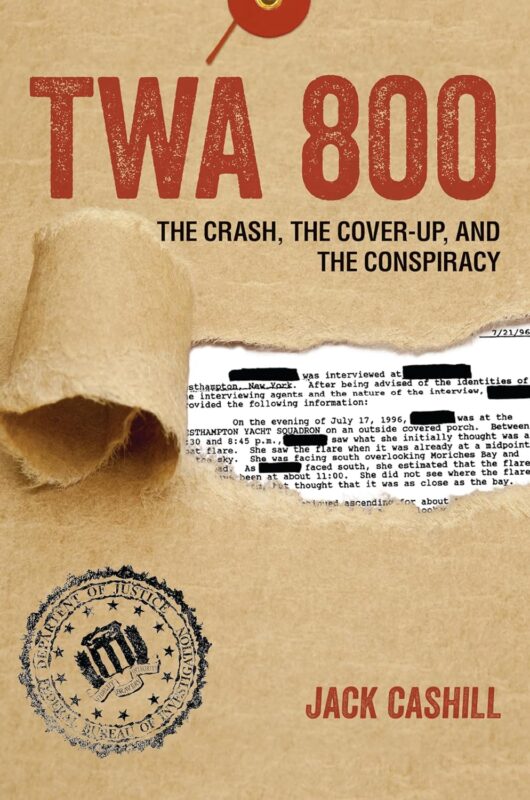
TWA 800: The Crash, the Cover-Up, and the Conspiracy by Jack Cashill challenges official accounts of the 1996 crash of Trans World Airlines Flight 800 with a rigorously detailed investigation that constructs a counter-narrative of government deception, media compliance, and institutional manipulation. The book scrutinizes federal agency actions, highlights discrepancies in official findings, and amplifies eyewitness testimony previously sidelined by mainstream discourse.
The Event That Triggered National Alarm
On the evening of July 17, 1996, TWA Flight 800 departed JFK Airport en route to Paris. Twelve minutes later, an explosion tore the Boeing 747 apart over the Atlantic Ocean, off Long Island’s south shore. All 230 passengers and crew died. Witnesses on the ground and in the air reported a streak of light ascending toward the aircraft, describing it as a missile or rocket. Federal investigators launched one of the most extensive aviation inquiries in American history, and the National Transportation Safety Board (NTSB), backed by the FBI and later the CIA, concluded the explosion originated in the plane’s center wing fuel tank due to a mechanical failure.
Witnesses and the Suppression of Testimony
Cashill draws on the FBI’s own documentation—specifically over 700 witness interviews—and isolates over 250 accounts that describe a missile-like object approaching the aircraft. Fifty-six of these observers reported that the projectile appeared to rise from the horizon or ground. Among them, “Witness 73,” later identified pseudonymously as Sandy, watched from Moriches Inlet and described a red streak that looped and struck the aircraft near the right wing. The FBI recorded her statement promptly after the event, but her testimony was later contradicted in a second report, which she insists never occurred. This systematic erosion of witness credibility, repeated across multiple accounts, anchors Cashill’s case for coordinated suppression.
Clinton White House: Political Calculus in a Crisis
In the immediate aftermath, President Bill Clinton and his staff treated the crash as a possible terrorist incident. The Coordinating Security Group, headed by counterterrorism advisor Richard Clarke, convened within an hour. Discussions included retaliatory scenarios against Iran, referencing recent U.S. casualties in the Khobar Towers bombing. Yet, as the political implications of a foreign attack escalated, the administration pivoted toward a mechanical cause narrative. This decision converged with Clinton’s reelection campaign, during which national stability became a central theme. Cashill interprets the redirection not as reactionary but as preemptive crisis management shaped by electoral incentives.
Federal Agencies and the Architecture of Deflection
The book outlines a rapid transfer of investigative authority from the NTSB to the FBI and, curiously, to the CIA—an agency without jurisdiction over domestic aviation incidents. The CIA produced an animated video in 1997 asserting that witnesses saw not a missile, but the aircraft itself, climbing nose-less in a bizarre upward arc due to momentum following the explosion. This “zoom climb” theory, Cashill demonstrates, failed both on aerodynamic grounds and on witness correlation. Experts such as retired United pilot and accident investigator Ray Lahr dissected the physics and found no model to support such a maneuver under the observed conditions.
Silenced Experts and Media Conformity
Cashill underscores how federal pressure and media reticence muted dissent. Journalists who might have questioned the official line ignored or vilified whistleblowers. He revisits the case of James and Elizabeth Sanders, who exposed chemical residue evidence and faced criminal prosecution for acquiring seat fabric samples from the wreckage. Elizabeth lost her job at TWA; James was convicted of conspiracy to steal airplane parts. Their legal treatment, Cashill contends, was not punitive but cautionary—a signal to others in possession of inconvenient truths.
The CIA Video: Construction of an Official Myth
In Cashill’s reconstruction, the CIA’s animation of the crash presented fabricated visuals contradicting FBI reports. The animation claimed that eyewitness Mike Wire had seen the climbing aircraft, when FBI documentation showed Wire reported a zigzagging object originating from the ground. Analysts claimed to have re-interviewed Wire to align his account with the animation, yet no such second interview occurred. The case file contains only one interview from 1996. This inconsistency, multiplied across similar accounts, suggests intentional narrative engineering rather than interpretive error.
Radar, Sonic Evidence, and Technical Testimony
The author examines radar records showing anomalous objects approaching TWA 800 at speeds near 1,200 knots—far above commercial aircraft velocity. FAA official Jim Holtsclaw and retired pilot Dick Russell corroborated the radar anomalies and communicated the data to journalist Pierre Salinger. Though Salinger’s delivery at a 1996 aviation conference in France was clumsy and lacked documentary precision, the information stemmed from vetted professionals. Cashill positions Salinger’s fallout as illustrative: the ridicule directed at him functioned to deter serious inquiry by others.
Eyewitness Patterns and Analytical Gaps
Cashill aggregates more than anecdotal fragments—he builds a structured argument based on pattern analysis. Eyewitnesses across multiple vantage points describe converging timelines, common directional vectors, and visible impact zones. The language remains consistent: “flare,” “streak,” “arc,” “impact,” “explosion.” The government’s interpretation requires that hundreds of trained and casual observers alike simultaneously hallucinated missile-like events under calm weather conditions.
Media Strategy and Information Management
Major networks offered initial coverage of witness accounts but quickly reoriented toward the mechanical failure thesis. Cashill identifies a media convergence in late 1996 that mirrors administrative talking points. He traces how outlets like CNN, The New York Times, and AP reduced complexity to authoritative repetition: absence of physical missile fragments, absence of motive, and presumed misperception. He highlights that this shift did not stem from new forensic discoveries but from CIA intervention and administrative guidance.
Judicial and Legislative Roadblocks
Attempts to re-open the investigation or litigate its findings ran into federal roadblocks. Cashill details how Ray Lahr filed a Freedom of Information Act (FOIA) suit and uncovered thousands of pages of CIA documents, including internal memos questioning the zoom climb model. Despite judicial acknowledgement of inconsistencies, the case faltered. Cashill does not characterize this as procedural inertia. He defines it as coordinated institutional resistance reinforced by reputational investment from agencies and actors who could not afford reversal.
Toward a New Historical Reckoning
Cashill concludes that TWA 800 remains an open wound, not a closed case. He does not ask what caused the crash; he asserts that federal actions obstructed the discovery of causality. The mechanics of deception—from document revision to witness alteration to prosecutorial intimidation—form the real subject of the book. The crash triggered the inquiry; the cover-up became its legacy. TWA 800: The Crash, the Cover-Up, and the Conspiracy presents an unflinching analysis of systemic manipulation that reshaped the event’s meaning and silenced those positioned to reveal the truth.

