War Against the Weak: Eugenics and America’s Campaign to Create a Master Race
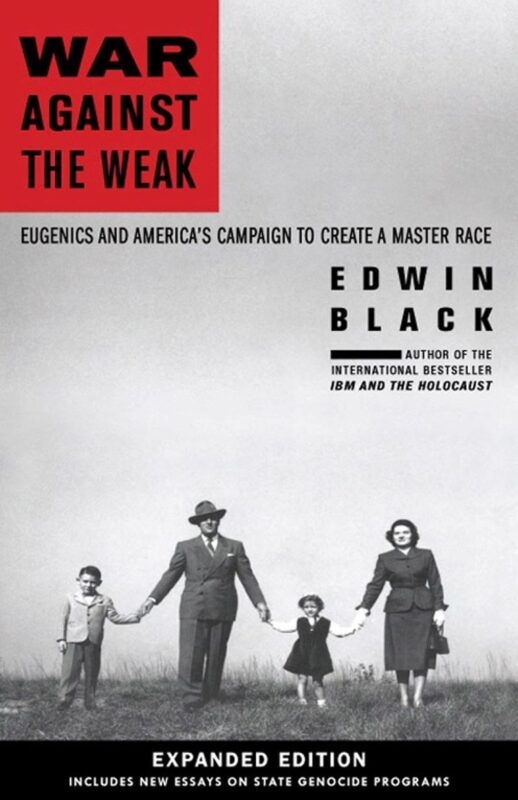
War Against the Weak: Eugenics and America’s Campaign to Create a Master Race by Edwin Black traces the rise, spread, and enduring legacy of the American eugenics movement, exposing the deep roots and catastrophic impact of state-sponsored pseudoscience in the twentieth century. Black builds his narrative through rigorous investigation, thousands of archival documents, and personal accounts, revealing how respected scientists, elite universities, philanthropic foundations, and government officials constructed a machinery of social engineering with global consequences.
The Rise of Eugenics: Science, Power, and the Pursuit of Purity
Edwin Black demonstrates that the eugenics movement in the United States developed as a powerful alliance of academics, industrialists, policymakers, and social reformers. They claimed the authority of science to rationalize the segregation, sterilization, and eventual erasure of those they labeled unfit. The eugenic campaign began as a theory of selective breeding, rooted in the belief that heredity determines human potential and that society holds a duty to foster the “best” stock while preventing the reproduction of the “worst.” These ideas gained currency in elite circles, with institutions such as the Carnegie Institution and Rockefeller Foundation underwriting expansive research and outreach programs. Politicians, judges, and educators collaborated to enact sweeping sterilization laws, enforce marriage restrictions, and validate intelligence testing as a tool for social classification.
The American eugenics enterprise drew on a language of improvement and uplift. Advocates framed their work as a humanitarian crusade to eliminate poverty, crime, and disease at the source. Black reveals how this rhetoric of progress masked a deep current of racism, classism, and xenophobia. Eugenicists pursued an ideal of the “Nordic” or “Anglo-Saxon” race, targeting immigrants, African Americans, Native Americans, Mexicans, the poor, the disabled, and anyone deemed outside the prescribed norm. Scientific journals, professional conferences, and public exhibitions broadcast these ideas to wide audiences, fostering consensus and enthusiasm among the nation’s elite.
The Machinery of Persecution: Laws, Institutions, and the Production of Victims
States across the country adopted eugenics laws with a zeal that revealed the movement’s reach and its alignment with the era’s dominant values. Black recounts the mass sterilization campaigns that swept through Virginia, California, North Carolina, and beyond. The process operated through an expanding network of “feebleminded” homes, asylums, welfare offices, and county courts. Sheriffs and social workers rounded up families, often from isolated rural regions, and delivered them to institutions for evaluation and surgery. Judges rubber-stamped petitions for sterilization. Surgeons performed operations with minimal consent or explanation. Bureaucratic routines obscured the reality of violence and the permanence of loss.
Personal stories fill the early chapters with voices of those who endured the blade: teenagers told they needed an appendectomy, children separated from families, adults denied the chance to have offspring or marry. The procedures left lifelong wounds—physical, psychological, and communal. These individual tragedies converged into a national pattern. California alone accounted for nearly half of all recorded sterilizations, but the campaign spanned two dozen states, shaped by both local initiative and national coordination.
Institutions enforced eugenic policy at every level. The Supreme Court, in Buck v. Bell, declared compulsory sterilization constitutional, with Justice Oliver Wendell Holmes’s infamous assertion that “three generations of imbeciles are enough.” The decision emboldened officials and gave eugenicists the authority of law. Hospitals, universities, and government agencies maintained archives, tracked lineages, and devised new criteria to expand their reach. Data flowed upward to national organizations, which used statistics to justify more ambitious programs.
Exporting Eugenics: International Influence and the Path to Atrocity
As American eugenicists consolidated their power, they exported their theories, laws, and methodologies abroad. Black reveals the direct and deliberate connections between American leaders and the architects of Nazi Germany’s racial hygiene policies. American journals reached German scientists, American laws inspired German legislation, and American grants financed research that would culminate in the Holocaust. Adolf Hitler and his inner circle cited American precedents as models for their own sterilization and euthanasia programs. The eugenics congresses and networks that spanned the Atlantic served as channels for collaboration.
The book details the career trajectories of leading eugenicists, including those who later became central figures in Nazi science. The Rockefeller Foundation supported German eugenics institutions, including the Kaiser Wilhelm Institute, where Josef Mengele would later pursue research. The Cold Spring Harbor Laboratory on Long Island became a clearinghouse for data, ideology, and political strategy. Black exposes the chilling correspondence between American and German scientists, the mutual admiration, and the shared commitment to constructing a new human order through selective breeding and elimination.
Scientific Fraud and the Myth of Objectivity
Edwin Black foregrounds the systematic manipulation and invention of scientific data at the heart of eugenics. Intelligence tests, family pedigrees, and “feeblemindedness” diagnoses masked subjective, arbitrary, and often openly prejudiced criteria. Experts constructed elaborate genealogies to trace social problems to heredity. IQ scores functioned as instruments of exclusion and social sorting. Black documents cases in which children who spoke another language, appeared shy, or belonged to a stigmatized community were classified as unfit. Academic journals and government reports repeated these findings as settled fact, reinforcing the legitimacy of the campaign.
Professional societies and foundations underwrote this enterprise. The American Medical Association, the American Museum of Natural History, and leading psychology departments participated in the creation and dissemination of eugenic ideology. The use of statistics gave an aura of inevitability to programs that rested on invention, conjecture, and bias. The movement advanced as a self-reinforcing system: researchers manufactured evidence, policymakers demanded action, and philanthropies provided the funds.
Eugenics and Its Cultural Reach: From Popular Science to Policy
Eugenics shaped popular discourse and daily life. Textbooks, newspapers, and public health campaigns spread eugenic ideas beyond the academy. State fairs held “fitter family” contests, celebrating ideal traits and offering prizes to those deemed genetically superior. Charitable organizations joined the movement, believing they could eradicate the root causes of dependency by ending reproduction among the poor. Educators segregated children and tracked them according to perceived ability, often conflating cultural difference with biological deficiency. Public policy operated through this lens, shaping welfare, immigration, and criminal justice.
The movement’s popularity generated resistance among those who experienced its effects, but few avenues existed to contest the system. The bureaucratic machinery operated through layers of authority that obscured responsibility and insulated decision-makers from scrutiny. Black shows how eugenics adapted to local contexts, merging with southern Jim Crow laws in some states and with anti-immigrant campaigns in others. Social workers played a central role, serving as both agents of reform and enforcers of exclusion.
Transition to Genetics: The Movement Rebrands
After World War II and the exposure of Nazi atrocities, eugenicists faced mounting criticism and public revulsion. Many organizations changed their names, adopting the language of “genetics” and “human engineering.” Foundations that once funded sterilization programs shifted to basic science, often retaining the same personnel and research agendas. Laws remained on the books, and practices such as forced sterilization persisted in several states for decades.
Black identifies a pattern of adaptation rather than repudiation. The American eugenics movement mutated in response to scandal and defeat, but many of its assumptions and methods migrated into new fields. Genetics, population control, and reproductive technology carried forward the impulse to shape human destiny by managing heredity. Black situates this continuity within a broader cultural tendency to believe in the power of science to improve society by controlling birth, health, and lineage.
Contemporary Relevance: The Return of Old Questions
The narrative draws a line from the early twentieth-century campaign for “racial betterment” to the present, when advances in genetic engineering, biotechnology, and reproductive medicine revive questions about who should decide the limits of human variation. The book’s closing sections frame the emergence of “newgenics,” where commercial and scientific interests pursue genetic modification, designer babies, and population management. Black urges readers to consider whether today’s genomic science, shaped by profit and corporate influence, risks repeating the injustices and crimes of the past.
Who holds the authority to define fitness in the age of gene editing? What safeguards exist to prevent the resurgence of discrimination through new technologies? The persistence of structural inequities, coupled with the allure of genetic solutions, raises the stakes for contemporary policy and ethics. Black asserts that confronting the legacy of eugenics remains essential for ensuring justice and dignity in the face of rapidly advancing science.
The Investigative Journey: Research and Documentation
Edwin Black grounds his account in meticulous research, tracking archives, correspondence, institutional records, and first-person accounts across the United States, Britain, and Germany. He describes the obstacles faced in uncovering the decentralized and often hidden history of eugenics—restricted archives, fragmented documentation, and the deliberate destruction or concealment of records. Black’s team assembled tens of thousands of documents, organized chronologically and thematically, to reconstruct the machinery of eugenics and identify the actors responsible for its advance.
Black highlights the resistance and cooperation he encountered among institutions and individuals. While some archivists and officials facilitated access, others refused or restricted materials, citing confidentiality or institutional reputation. The process of verification, fact-checking, and cross-examination forms a critical part of the narrative. Black situates his work within the expanding field of eugenics scholarship and investigative journalism, emphasizing the need for continued research and public reckoning.
Conclusion: The Lessons of War Against the Weak
Edwin Black’s investigation converges on a singular argument: eugenics operated as a coordinated, elite-driven campaign of social control, cloaked in the language of science and progress, but animated by prejudice, arrogance, and a drive for domination. The consequences shaped lives, families, and societies, leaving a legacy that extends into the present. The machinery that operated in courtrooms, asylums, laboratories, and boardrooms imposed irrevocable loss and suffering on tens of thousands of Americans and millions worldwide. Black calls for recognition, accountability, and vigilance.
The power of eugenics derived from its ability to mask violence behind respectability. As the field of genetics advances, the questions Black raises demand urgent attention. Who bears responsibility for the future shaped by new science? What patterns of exclusion and harm risk reemergence under new guises? The history chronicled in War Against the Weak stands as both a warning and a call to action, urging society to confront its past and shape a more just future.


About the Book
Edwin Black: War on the Weak from NorCalMedia on Vimeo.