The Devil’s Chemists – 24 Conspirators of the International Farben Cartel Who Manufacture Wars
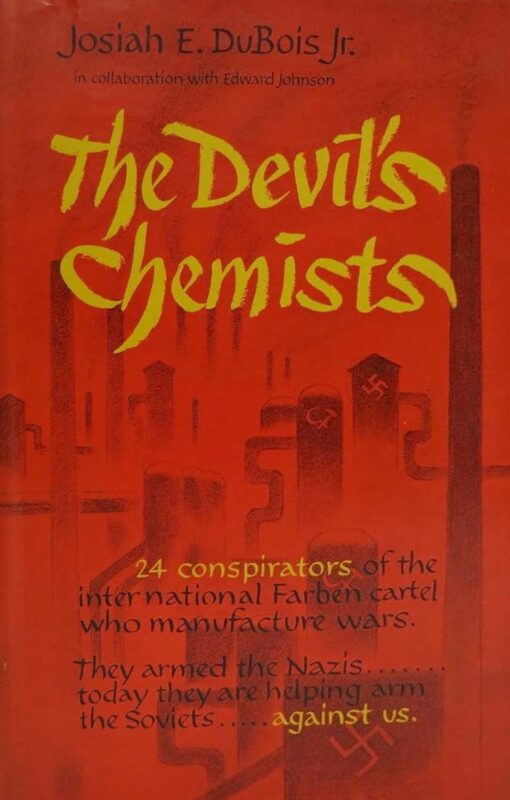
The Devil’s Chemists by Josiah E. DuBois Jr. exposes the twenty-four I.G. Farben executives tried at Nuremberg and reveals how industrialists manufactured war, enabled Hitler’s rise, and shaped postwar global politics through chemical empire-building. DuBois writes as a prosecutor who studied thousands of documents, questioned witnesses, and recognized the scale of Farben’s conspiracy. His book stands as both a record of the trial and a warning about the alliance between industry and authoritarian power.
Origins of a Chemical Empire
I.G. Farben emerged in 1925 as a conglomerate of Germany’s leading chemical companies. Its leaders included Carl Bosch, Hermann Schmitz, and Fritz ter Meer, men celebrated for scientific innovation and industrial efficiency. Farben transformed coal into gasoline, nitrogen into fertilizers and explosives, and laboratories into engines of political leverage. By the early 1930s, the company controlled more than 80 percent of Germany’s chemical production. Farben’s scientists developed synthetic rubber, fuels, plastics, and dyes, creating industrial monopolies that tied the economy to their boardroom decisions.
Farben functioned as a state within the state. The directors financed Nazi propaganda, funded Hitler’s campaigns, and negotiated exclusive contracts with the Wehrmacht. They exchanged patents with Standard Oil of New Jersey and General Aniline & Film, spreading their reach across the Atlantic. Farben executives viewed resources, markets, and nations as elements to be rearranged by chemical transformation. DuBois demonstrates that their drive for profit and power preceded political alliances and made military aggression inevitable.
Farben and Hitler’s War Economy
The Nuremberg evidence traced Farben’s role in rearming Germany in defiance of the Treaty of Versailles. Farben built massive plants at Leuna and Ludwigshafen that produced synthetic fuels vital for tanks and aircraft. Their Buna rubber plants supplied tires essential for Blitzkrieg campaigns. Farben managed poison gas production, including Tabun and Sarin, and coordinated with the SS to test chemical weapons. Their contracts with the army included not only materials but entire strategies of supply that determined operational feasibility.
Farben did not simply respond to Nazi demands. The company actively lobbied for military expansion because war increased demand for its products. Farben executives sat in planning councils that designed Hitler’s Four-Year Plan. The company used its cartel agreements with foreign corporations to restrict access to vital patents, keeping rivals dependent. DuBois presents Farben’s war preparation as deliberate industrial policy rather than incidental cooperation.
Auschwitz and Industrial Slavery
The Buna plant at Auschwitz stands as the central exhibit of Farben’s crimes. Built adjacent to the concentration camp, it relied on thousands of slave laborers supplied by the SS. Workers toiled in brutal conditions, starved, and were executed when exhausted. Farben managers designed the camp-factory complex with efficiency in mind: prisoners lived within walking distance of the plant, guarded by soldiers, with a crematorium nearby to eliminate the dead.
Farben invested hundreds of millions of Reichsmarks in Auschwitz because the site offered cheap labor, access to coal, and proximity to railways. DuBois records testimony that executives visited the camp, inspected operations, and approved the conditions. Witnesses described the smell of burning flesh drifting into the plant. Farben chemists developed Zyklon B, the gas used in extermination chambers, and supplied it to the SS. This convergence of science, business, and genocide demonstrates the depth of Farben’s complicity.
The Trial at Nuremberg
The I.G. Farben Trial opened in August 1947, one of twelve subsequent Nuremberg proceedings after the International Military Tribunal. DuBois and his colleagues charged twenty-four executives with war crimes, crimes against humanity, plunder, and conspiracy to wage aggressive war. The indictment described how Farben financed the Nazi regime, planned invasions, and profited from occupation.
The defense insisted Farben was a normal business enterprise that pursued profits like any corporation. Executives portrayed themselves as chemists and administrators with limited control. DuBois dismantled these claims by tracing board minutes, contracts, and personal correspondence that showed direct involvement in strategic planning. The prosecutors presented evidence of joint ventures in occupied territories, forced expropriation of factories, and participation in deportations.
The verdicts delivered in July 1948 convicted thirteen defendants on charges of slavery and plunder. Others escaped with acquittals. Sentences ranged from one and a half years to eight years. DuBois records his dismay that penalties were light compared to the magnitude of the crimes. Within a decade, many convicted directors returned to high positions in West German industry.
Global Reach of the Farben Cartel
DuBois demonstrates that Farben’s influence stretched beyond Germany. Subsidiaries and joint ventures operated in Latin America, the United States, and Asia. Farben controlled drug patents, dyes, and photographic chemicals that dominated world markets. In Japan, Farben worked with the zaibatsu to integrate chemical production into military strategy. In Latin America, Farben manipulated banks and governments to secure dominance.
The book documents Farben’s relationship with Standard Oil, including patent-sharing agreements on synthetic fuels and rubber. These alliances restricted American independence in vital technologies during the 1930s. Farben’s American affiliates, such as General Aniline & Film, became focal points of U.S. investigations. DuBois argues that without dismantling such cartels, peace could not be secured because industrial empires transcended national borders.
Postwar Policy and the Farben Legacy
The Allied Control Council initially ordered the dissolution of I.G. Farben into smaller units. However, Cold War priorities soon shifted American policy toward rebuilding West German industry as a bulwark against communism. Former Farben executives regained authority in firms like Bayer, BASF, and Hoechst. DuBois warns that this rehabilitation of industrialists who had fueled fascism risked repeating history.
The book situates Farben within broader debates about economic policy after World War II. DuBois criticizes U.S. leaders for misunderstanding the resentment of populations in Europe and Asia who had suffered under industrial exploitation. He argues that supporting cartels eroded faith in democracy and fed communist propaganda. His narrative underscores how decisions about corporations shaped geopolitical alignments more than speeches or treaties.
The Industrial Roots of Aggression
DuBois defines war as a process that begins long before armies march. Chemical monopolies, cartel agreements, and patent restrictions create conditions for conflict by concentrating power in the hands of executives. Farben directors did not pull triggers, but they determined whether armies had fuel, rubber, and weapons. The book illustrates that economic strategy can precede and direct military strategy.
What does it mean when businessmen determine the survival of nations? DuBois insists that the Farben story answers this question with chilling clarity: profit-driven industrialists, when aligned with authoritarian states, manufacture wars. Their factories become arsenals, their laboratories become test sites for human experimentation, and their boardrooms become war councils.
The Evidence of Conspiracy
DuBois structures his book around the mountains of evidence collected during the trial. He condenses more than 150 volumes of testimony and documents. He recounts specific incidents: secret meetings in Berlin, financial transfers to Switzerland, and patent deals with American firms. He describes witnesses who recalled the stench of death at Auschwitz or the cruelty of overseers. He reveals coded messages, hidden ledgers, and elaborate corporate shells.
Through these details, the book refuses abstraction. Farben’s conspiracy appears not as an idea but as a set of contracts, investments, and daily decisions that advanced aggression. DuBois shows that conspiracy does not require dramatic declarations. It unfolds in the steady alignment of industrial goals with military expansion.
Lessons for the Future
The book closes with a warning about reliance on industrialists who have histories of collaboration with totalitarian regimes. DuBois questions what will happen if such men, restored to power, align with communism or other authoritarian forces. He emphasizes that justice requires vigilance, dismantling of cartels, and recognition that corporations can threaten peace as much as armies.
The Devil’s Chemists asserts that the fight for peace depends on understanding how industries create the conditions for war. By documenting Farben’s crimes, DuBois urges readers to see chemistry, patents, and boardrooms as arenas where global destinies are shaped. The narrative insists that memory and accountability are necessary safeguards against repetition.
Enduring Relevance
The story of Farben continues to resonate because its successor firms remain central players in pharmaceuticals, chemicals, and plastics. The trial reveals that corporate leaders, when unchecked, can enable atrocities. DuBois provides a rare insider’s record of how prosecutors confronted the complexity of holding businessmen accountable for war crimes.
Why does this matter now? Because the questions DuBois posed remain unresolved: How should societies limit industrial power? What safeguards prevent corporations from exploiting authoritarian alliances? How can justice reach those who operate behind the facade of commerce? The book refuses closure, instead demanding sustained attention to these issues.
The Devil’s Chemists by Josiah E. DuBois Jr. stands as a record of crime, trial, and warning. It identifies the conspirators of I.G. Farben, explains their methods, and demands recognition of the link between industrial ambition and global catastrophe. Its specificity—fact by fact, plant by plant, executive by executive—gives the work enduring authority in understanding how industry manufactures wars. by Josiah E. DuBois Jr. exposes the twenty-four I.G. Farben executives tried at Nuremberg and reveals how industrialists manufactured war, enabled Hitler’s rise, and shaped postwar global politics through chemical empire-building. DuBois writes as a prosecutor who studied thousands of documents, questioned witnesses, and recognized the scale of Farben’s conspiracy. His book stands as both a record of the trial and a warning about the alliance between industry and authoritarian power.
Origins of a Chemical Empire
I.G. Farben emerged in 1925 as a conglomerate of Germany’s leading chemical companies. Its leaders included Carl Bosch, Hermann Schmitz, and Fritz ter Meer, men celebrated for scientific innovation and industrial efficiency. Farben transformed coal into gasoline, nitrogen into fertilizers and explosives, and laboratories into engines of political leverage. By the early 1930s, the company controlled more than 80 percent of Germany’s chemical production. Farben’s scientists developed synthetic rubber, fuels, plastics, and dyes, creating industrial monopolies that tied the economy to their boardroom decisions.
Farben functioned as a state within the state. The directors financed Nazi propaganda, funded Hitler’s campaigns, and negotiated exclusive contracts with the Wehrmacht. They exchanged patents with Standard Oil of New Jersey and General Aniline & Film, spreading their reach across the Atlantic. Farben executives viewed resources, markets, and nations as elements to be rearranged by chemical transformation. DuBois demonstrates that their drive for profit and power preceded political alliances and made military aggression inevitable.
Farben and Hitler’s War Economy
The Nuremberg evidence traced Farben’s role in rearming Germany in defiance of the Treaty of Versailles. Farben built massive plants at Leuna and Ludwigshafen that produced synthetic fuels vital for tanks and aircraft. Their Buna rubber plants supplied tires essential for Blitzkrieg campaigns. Farben managed poison gas production, including Tabun and Sarin, and coordinated with the SS to test chemical weapons. Their contracts with the army included not only materials but entire strategies of supply that determined operational feasibility.
Farben did not simply respond to Nazi demands. The company actively lobbied for military expansion because war increased demand for its products. Farben executives sat in planning councils that designed Hitler’s Four-Year Plan. The company used its cartel agreements with foreign corporations to restrict access to vital patents, keeping rivals dependent. DuBois presents Farben’s war preparation as deliberate industrial policy rather than incidental cooperation.
Auschwitz and Industrial Slavery
The Buna plant at Auschwitz stands as the central exhibit of Farben’s crimes. Built adjacent to the concentration camp, it relied on thousands of slave laborers supplied by the SS. Workers toiled in brutal conditions, starved, and were executed when exhausted. Farben managers designed the camp-factory complex with efficiency in mind: prisoners lived within walking distance of the plant, guarded by soldiers, with a crematorium nearby to eliminate the dead.
Farben invested hundreds of millions of Reichsmarks in Auschwitz because the site offered cheap labor, access to coal, and proximity to railways. DuBois records testimony that executives visited the camp, inspected operations, and approved the conditions. Witnesses described the smell of burning flesh drifting into the plant. Farben chemists developed Zyklon B, the gas used in extermination chambers, and supplied it to the SS. This convergence of science, business, and genocide demonstrates the depth of Farben’s complicity.
The Trial at Nuremberg
The I.G. Farben Trial opened in August 1947, one of twelve subsequent Nuremberg proceedings after the International Military Tribunal. DuBois and his colleagues charged twenty-four executives with war crimes, crimes against humanity, plunder, and conspiracy to wage aggressive war. The indictment described how Farben financed the Nazi regime, planned invasions, and profited from occupation.
The defense insisted Farben was a normal business enterprise that pursued profits like any corporation. Executives portrayed themselves as chemists and administrators with limited control. DuBois dismantled these claims by tracing board minutes, contracts, and personal correspondence that showed direct involvement in strategic planning. The prosecutors presented evidence of joint ventures in occupied territories, forced expropriation of factories, and participation in deportations.
The verdicts delivered in July 1948 convicted thirteen defendants on charges of slavery and plunder. Others escaped with acquittals. Sentences ranged from one and a half years to eight years. DuBois records his dismay that penalties were light compared to the magnitude of the crimes. Within a decade, many convicted directors returned to high positions in West German industry.
Global Reach of the Farben Cartel
DuBois demonstrates that Farben’s influence stretched beyond Germany. Subsidiaries and joint ventures operated in Latin America, the United States, and Asia. Farben controlled drug patents, dyes, and photographic chemicals that dominated world markets. In Japan, Farben worked with the zaibatsu to integrate chemical production into military strategy. In Latin America, Farben manipulated banks and governments to secure dominance.
The book documents Farben’s relationship with Standard Oil, including patent-sharing agreements on synthetic fuels and rubber. These alliances restricted American independence in vital technologies during the 1930s. Farben’s American affiliates, such as General Aniline & Film, became focal points of U.S. investigations. DuBois argues that without dismantling such cartels, peace could not be secured because industrial empires transcended national borders.
Postwar Policy and the Farben Legacy
The Allied Control Council initially ordered the dissolution of I.G. Farben into smaller units. However, Cold War priorities soon shifted American policy toward rebuilding West German industry as a bulwark against communism. Former Farben executives regained authority in firms like Bayer, BASF, and Hoechst. DuBois warns that this rehabilitation of industrialists who had fueled fascism risked repeating history.
The book situates Farben within broader debates about economic policy after World War II. DuBois criticizes U.S. leaders for misunderstanding the resentment of populations in Europe and Asia who had suffered under industrial exploitation. He argues that supporting cartels eroded faith in democracy and fed communist propaganda. His narrative underscores how decisions about corporations shaped geopolitical alignments more than speeches or treaties.
The Industrial Roots of Aggression
DuBois defines war as a process that begins long before armies march. Chemical monopolies, cartel agreements, and patent restrictions create conditions for conflict by concentrating power in the hands of executives. Farben directors did not pull triggers, but they determined whether armies had fuel, rubber, and weapons. The book illustrates that economic strategy can precede and direct military strategy.
What does it mean when businessmen determine the survival of nations? DuBois insists that the Farben story answers this question with chilling clarity: profit-driven industrialists, when aligned with authoritarian states, manufacture wars. Their factories become arsenals, their laboratories become test sites for human experimentation, and their boardrooms become war councils.
The Evidence of Conspiracy
DuBois structures his book around the mountains of evidence collected during the trial. He condenses more than 150 volumes of testimony and documents. He recounts specific incidents: secret meetings in Berlin, financial transfers to Switzerland, and patent deals with American firms. He describes witnesses who recalled the stench of death at Auschwitz or the cruelty of overseers. He reveals coded messages, hidden ledgers, and elaborate corporate shells.
Through these details, the book refuses abstraction. Farben’s conspiracy appears not as an idea but as a set of contracts, investments, and daily decisions that advanced aggression. DuBois shows that conspiracy does not require dramatic declarations. It unfolds in the steady alignment of industrial goals with military expansion.
Lessons for the Future
The book closes with a warning about reliance on industrialists who have histories of collaboration with totalitarian regimes. DuBois questions what will happen if such men, restored to power, align with communism or other authoritarian forces. He emphasizes that justice requires vigilance, dismantling of cartels, and recognition that corporations can threaten peace as much as armies.
The Devil’s Chemists asserts that the fight for peace depends on understanding how industries create the conditions for war. By documenting Farben’s crimes, DuBois urges readers to see chemistry, patents, and boardrooms as arenas where global destinies are shaped. The narrative insists that memory and accountability are necessary safeguards against repetition.
Enduring Relevance
The story of Farben continues to resonate because its successor firms remain central players in pharmaceuticals, chemicals, and plastics. The trial reveals that corporate leaders, when unchecked, can enable atrocities. DuBois provides a rare insider’s record of how prosecutors confronted the complexity of holding businessmen accountable for war crimes.
Why does this matter now? Because the questions DuBois posed remain unresolved: How should societies limit industrial power? What safeguards prevent corporations from exploiting authoritarian alliances? How can justice reach those who operate behind the facade of commerce? The book refuses closure, instead demanding sustained attention to these issues.
The Devil’s Chemists by Josiah E. DuBois Jr. identifies the conspirators of I.G. Farben, explains their methods, and demands recognition of the link between industrial ambition and global catastrophe. Its specificity—fact by fact, plant by plant, executive by executive—gives the work enduring authority in understanding how industry manufactures wars.

