The Art of Not Being Governed: An Anarchist History of Upland Southeast Asia
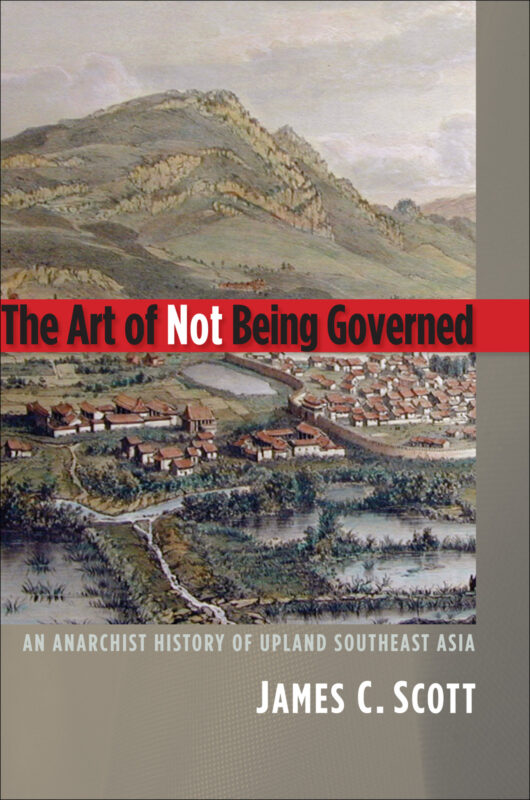
The Art of Not Being Governed by James C. Scott dismantles dominant narratives about state formation and cultural development in Southeast Asia’s upland frontiers. Scott asserts that the peoples of Zomia—an expansive, mountainous zone across Vietnam, Laos, Thailand, Burma, and parts of China and India—have strategically shaped their societies to avoid incorporation into state systems. Their migrations, agricultural practices, and social structures constitute a deliberate political project: the refusal of governance.
The Invention of Zomia
Zomia refers to a highland zone that spans 2.5 million square kilometers across the peripheries of multiple nation-states. These territories support nearly 100 million people of diverse ethnic, linguistic, and religious identities. Scott defines Zomia through its shared elevation, geographical inaccessibility, and political estrangement from centralized authority. Unlike regions carved by dynasties or economic systems, Zomia resists fixed boundaries. It is a relational space, defined by how its inhabitants avoid the valley-based states surrounding them.
The Friction of Terrain
Mountain ridges, dense forests, and rugged plateaus obstruct state penetration. These physical barriers limit administrative extension and tax collection, block armies, and frustrate efforts at surveillance. Terrain does not simply deter; it shapes social possibility. Upland dispersal favors autonomy. Steep gradients separate groups, enabling linguistic, cultural, and political multiplicity. Dispersion fragments authority, dilutes hierarchies, and reinforces horizontal social orders. Political power in Zomia dissipates over distance.
Escape as Strategy
Upland populations have not drifted into isolation. They have fled. They have evaded capture, conscription, enslavement, corvée, taxation, and war. Hill societies are histories of escape. These migrations leave trails in folklore, kinship memory, and geographical patterns of settlement. Communities flee not to vanish, but to reconfigure their lives on terms that preclude state dominance. This is not retreat but resistance.
Cultivation Against Capture
Swidden agriculture, often misclassified as primitive or inefficient, serves specific political ends. Slash-and-burn farming discourages state appropriation by remaining mobile, diverse, and opaque to fixed survey. Crops such as tubers and maize are harder to assess and seize than wet-rice or irrigated grains. Agrarian variability frustrates the imposition of taxes and boundaries. The forest garden absorbs labor without yielding easily quantifiable surplus.
Orality and the Refusal of Record
State systems thrive on legibility. Writing, census, mapping, and naming anchor state presence. Zomian communities sidestep these mechanisms. Oral traditions, fluid lineages, and localized dialects deny bureaucratic capture. Identity remains situational, not institutional. Records harden difference; orality preserves ambiguity. By refusing inscription, these communities decline to be fixed. They maintain the capacity to mutate under pressure, merge under threat, and vanish under pursuit.
The State’s Hunger for People
Agrarian states require people. They cannot sustain themselves without concentrated labor for irrigation, war, and administration. Historically, states have expanded not by cultivating allegiance but by seizing bodies. They wage campaigns for captives, enforce relocations, and assign lands. Zomia absorbs the overflow—the refugees, defectors, and escapees who abandon the valley order. Its populations accrete in cycles of state expansion and collapse, becoming a shatter zone of historical debris and human refusal.
Egalitarianism Through Dispersal
Concentration enables hierarchy. Dispersion constrains it. Zomian societies favor mobility, kinship flexibility, and leaderless organization. They reject centralized political authority and hereditary rule. Leadership, when it emerges, often centers on charisma, prophetic vision, or ritual fluency, not permanent office. Communities assemble around temporary needs, dissolve, and reconfigure. Political cohesion flows through affiliation, not subordination.
Ethnogenesis as Political Process
Ethnic identity in Zomia evolves through conflict, migration, and adaptation. It is constructed, not inherited. Groups rename themselves, adopt new languages, and reassemble narratives of origin to secure territory, resist assimilation, or court patronage. Ethnicity operates tactically. It defines boundaries that can be moved, opened, or obscured. Ethnogenesis is not a symptom of marginalization—it is the method of survival in contested space.
Millenarianism and Social Transformation
Prophetic movements arise in periods of crisis. They catalyze community renewal, reassert autonomy, and reimagine social order. Zomia hosts traditions of millenarianism that contest domination through spiritual revelation. These movements resist externally imposed hierarchies by projecting new cosmologies and embodying alternative sources of legitimacy. Prophecy inverts command structures and recalibrates collective identity.
The Expansion of State Reach
Modern states seek total sovereignty over territory and population. Their technologies—roads, air surveillance, digital record-keeping—overcome the friction of terrain. Nation-states press into upland zones to exploit resources, administer borders, and integrate minorities. They settle loyal populations in resistant areas, standardize languages, and enforce citizenship. These encroachments erode the spatial and cultural distance Zomia once leveraged.
The Last Enclosure
Colonial and postcolonial governments extend power by turning nonstate land into taxable, regulated, and exploitable property. They fix populations in place, replace common tenure with private titles, and criminalize shifting cultivation. Development policies serve extraction, not livelihood. The state reclaims what it previously could not reach, converting marginal spaces into commodities. In doing so, it displaces the very autonomy these landscapes once afforded.
The Decline of Statelessness
Since 1945, the idea of the sovereign nation-state has displaced alternatives. National borders cut through Zomia, forcing divided ethnicities into separate allegiances. International systems demand legibility—of land, people, and economy. Refuge becomes trespass. Autonomy becomes sedition. Statelessness contracts under surveillance, counterinsurgency, and development. The spaces that once sheltered freedom now expose resistance.
Cultural Subjugation as Policy
Assimilation advances through schools, media, religious missions, and legal systems. State power no longer relies on conquest alone—it reshapes desire, language, and identity. The hill is reimagined as backward, its inhabitants infantilized or vilified. State narratives celebrate integration as uplift, masking coercion with rhetoric of inclusion. Indigenous systems of knowledge and belief are denigrated, criminalized, or absorbed into state ideologies.
Repertoires of Resistance
Despite growing pressure, Zomia continues to generate forms of resistance. Some communities hide. Others bargain, adapt, or camouflage. Smuggling, counterfeiting, and migration persist as shadow economies. Languages mutate. Religious revivals flare. Alliances form across borders. Statelessness becomes a moving target, rearticulated through action, territory, and belief.
The Political Imagination of Stateless Peoples
Scott reveals a different genealogy of freedom. Zomian peoples do not merely escape; they imagine and enact political orders outside the state. Their practices—mutable, situated, and improvisational—embody a vision of governance that privileges autonomy over authority, flexibility over order, and community over command. These are not failed states or unfinished histories. They are polities of refusal, built to endure without dominating and to adapt without surrendering.
This is not nostalgia. It is method. Zomia teaches how people shape the margins of empire not as exiles, but as architects of space, identity, and resistance. Their history is a record of choices made under duress, strategies refined in crisis, and values forged in flight. In a world where state power expands its reach daily, these histories illuminate the art of remaining ungoverned.
