Addresses to the German Nation
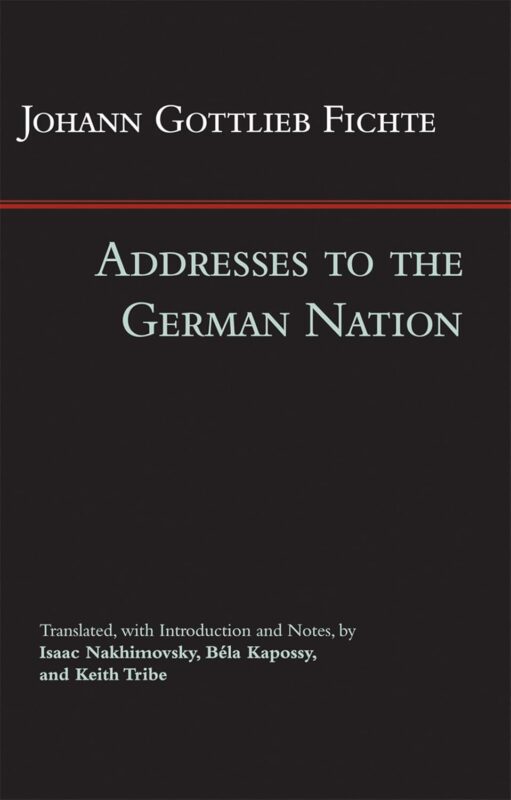
Addresses to the German Nation by Johann Gottlieb Fichte outlines a bold philosophical framework for national regeneration through education, moral transformation, and cultural self-determination.
Fichte’s core proposition arises from a moment of national crisis. Prussia’s military defeat and occupation by Napoleon had devastated German sovereignty. Fichte does not grieve this loss; he diagnoses it. A culture built on self-interest, fragmented loyalties, and materialism had exhausted its moral reserves. From this collapse, he calls for an inward transformation, beginning not with policy, but with education.
A New Beginning Through Education
Fichte identifies the failure of prevailing systems not in tactical decisions or political structure, but in the moral fiber of the people. Education must reforge the national character. He defines education not as instruction or knowledge accumulation but as a method of forming the will. A truly educated person wills the good because the good is inseparable from their character. This principle, once rooted, must permeate every layer of society.
How does a nation re-engineer its core instincts? Fichte proposes an educational architecture that begins in childhood and governs the whole organism of social formation. Instruction must engage the spirit, not manipulate the will through fear or reward. Educators must be models of the ideals they teach. Without self-activity—without the child seeing itself as creator of the good it learns—the entire program collapses into manipulation.
Self-Activity as the Foundation of Freedom
Self-activity is the central engine in Fichte’s conception of national rebirth. Moral independence begins not with compliance but with interior mastery. This mastery develops through active engagement with ideals. It deepens through practice. As individuals generate and inhabit the forms of truth and duty, they internalize them as second nature. From this root grows a society that no longer depends on external compulsion or enforcement.
What form must education take to produce this effect? Fichte answers without ambiguity. Every child must undergo the same rigorous moral training. The purpose of this uniformity is not social leveling. It is structural cohesion. A nation emerges only when all its members participate in the same ideal. Diversity of function may follow, but unity of foundation is non-negotiable.
The Nation as an Ethical Organism
For Fichte, Germany is not a territory or a legal structure. It is a people capable of moral self-determination. Its unity rests on language, historical continuity, and a unique spiritual vocation. The German language, uncorrupted by Latin influence, expresses inner freedom. In it, thought and speech mirror each other. This linguistic integrity enables philosophical rigor and ethical clarity.
The nation is not defined by blood. It is defined by an ideal: to embody and advance the moral development of humanity. Germany’s historical mission lies in this: to lead not by conquest, but by character. This claim is not sentimental. It demands precision, sacrifice, and vigilance. National decline begins with moral laxity. Recovery requires unflinching discipline.
Love of the Fatherland as a Practical Ideal
Fichte redefines patriotism. Love of country, he insists, is not attachment to soil, monarchy, or tradition. It is devotion to a collective moral project. The fatherland is wherever a people commit to living by truth. This commitment must be manifest, not rhetorical. It must show in the courage to reject lies, to correct errors, and to rebuild institutions.
He warns against the degeneration of this love into sentimentality or chauvinism. A true patriot serves not comfort, but clarity. When the nation deviates from its moral path, loyalty means resistance. Only through constant self-examination can the people retain their ethical mission. This vigilance must begin in education and continue in every sphere of civic life.
The Role of the Educated Class
The educated must lead. Fichte rejects the distinction between intellectual elite and common people. The new system demands that everyone be educated. However, those already possessing knowledge bear unique responsibility. Their privilege is not a status. It is a debt. They must use their insight to guide the nation back to life.
This leadership cannot remain theoretical. Educated Germans must take direct responsibility for building the institutions that form youth. They must organize, teach, and sacrifice. They cannot delegate this work to bureaucracies or rely on foreign models. The task is urgent and existential. Delay invites further dissolution.
Moral Clarity in the Face of Foreign Power
Napoleon’s rule exposed German weakness, but Fichte does not indulge in hatred. He accepts the presence of foreign power as fact. The response must not be vengeance. It must be regeneration. No external alliance or uprising can substitute for inner renewal. The true battlefield lies in the formation of will.
How can a nation under occupation undertake such a project? Fichte argues that the occupying force, concerned only with outward compliance, will ignore educational transformation. This space must be seized. While the enemy governs the state, Germans must rebuild the people. If successful, this new people will outlast any regime.
The Education of the Whole Person
Fichte insists that education cannot remain limited to academic knowledge. It must reach the emotions, the imagination, the will. Aesthetic training becomes crucial. Children must learn to love harmony, to feel revulsion at ugliness, and to act out of joy in the good. This cultivation begins in language, music, art, and continues into ethics and civic duty.
How does one design such a system? Fichte looks to Pestalozzi and other reformers, but insists the German project must go further. The educator must model the ideal human. He must engage the student as a moral subject. He must reject mechanical methods, memorization, or reward-based discipline. The student must see himself as author of his moral being.
Unity as the Goal of National Life
The ultimate purpose of education is national unity. Not uniformity of opinion, but unity of moral aim. In such a nation, differences of profession or temperament enhance the common life rather than fracture it. Every role serves the same ideal. Each action confirms the shared commitment.
Fichte envisions this unity as organic. Like a living body, the nation grows from a single seed: a common will to the good. When this will takes root, laws become expressions of character. Armies become expressions of purpose. Culture becomes the visible form of interior strength. Such a nation cannot be conquered, because its true essence lies beyond politics.
The Task Ahead
Fichte closes with a challenge. The time for lamentation has passed. The task now is to act. The German nation will endure only if it becomes worthy of endurance. That worth cannot be declared. It must be built, child by child, school by school, mind by mind.
What prevents this transformation? Only hesitation. The structure exists. The models are ready. The crisis has made the need undeniable. What remains is to decide. Will Germans accept the labor of self-recreation? Will they rise to their historic vocation?
Fichte believes they can. He calls them to begin.
