The Face of Battle
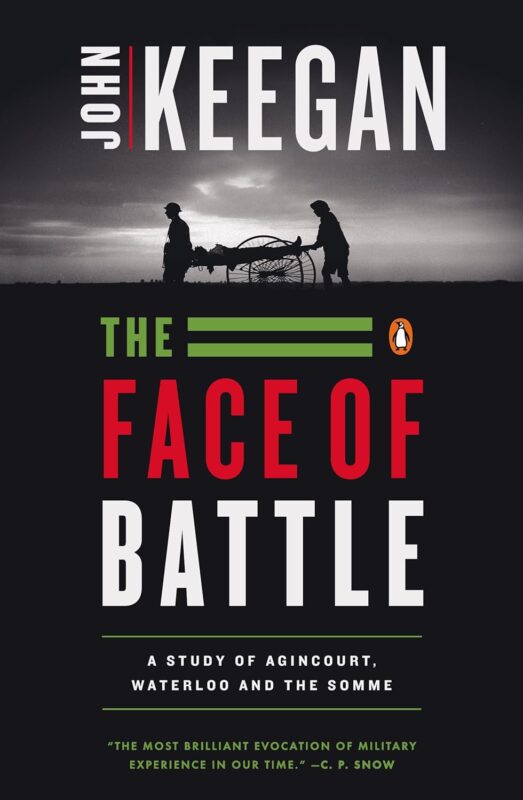
The Face of Battle by John Keegan redefines how modern readers understand the realities of combat by focusing on the human experience rather than the abstract strategies of generals. Instead of aligning war history with grand maneuvers and heroic myth, Keegan examines what it means to participate in battle through the perspective of the ordinary soldier. His approach challenges traditional military historiography by asking what a battle feels like for those in its center, not what it looks like from above.
Rethinking the Historical Method
Keegan begins by confronting the limits of his own knowledge. As a historian who has never experienced combat, he situates his inquiry within the broader context of postwar Europe, where direct combat experience has become rare. He admits this distance from the battlefield yet insists that his professional responsibility demands understanding the emotional and physical landscape of combat. This position leads him to critique conventional military history, which often privileges strategic abstraction over lived reality.
He dissects the “battle piece” tradition—a stylized, literary genre that dramatizes events and glorifies courage—arguing that it hides the terror and disorder of real combat. These battle descriptions, built on tropes rather than evidence, turn soldiers into symbols and strip events of their unpredictability. What if instead of dramatizing, historians analyzed the anatomy of confusion on the battlefield?
The Centrality of the Participant’s Experience
The structure of the book centers around three case studies—Agincourt (1415), Waterloo (1815), and the Somme (1916)—each selected for its distinct era, tactical structure, and technological environment. Keegan explores how soldiers moved, saw, heard, fought, and died in these battles. Rather than asking how commanders won or lost, he asks how men endured. He reconstructs these moments not from command centers but from the dirt, blood, and noise of the front lines.
Each chapter investigates a different configuration of combat: the muddy crush of armored knights at Agincourt, the smoke-choked artillery duels of Waterloo, and the industrial slaughterhouse of the Somme. Through each lens, Keegan emphasizes physical and psychological strain, spatial chaos, and moral confusion. How does a man fire a weapon while trembling? What forces allow someone to move forward into a storm of steel? What does discipline look like when death comes from invisible sources?
Agincourt: Constraint and Attrition
In 1415, Henry V’s army met the French on a narrow field, flanked by woods and soaked in autumn mud. The English archers, armed with longbows and planted behind sharpened stakes, unleashed volleys into advancing French cavalry and disorganized infantry. Keegan maps the scene as a function of terrain, physical effort, and exhaustion. The field trapped bodies. Horses tripped and fell. Men-at-arms drowned in the crush. The longbow did not merely pierce armor; it imposed psychological paralysis.
Keegan strips the nobility from medieval combat. He describes how close-quarters battle became an act of suffocation. Armor turned bodies into coffins. Heat, panic, and weight collapsed the boundary between soldier and corpse. The most decisive acts were not swordplay but maintenance of order under pressure. Victory came not through brilliance but through attritional resilience.
Waterloo: Smoke, Shock, and Motion
In 1815, two centuries of tactical development reshaped battle into an encounter of formations and firepower. At Waterloo, the battlefield was a stage of movement, deception, and fatigue. Keegan’s narrative follows the experience of infantrymen, cavalrymen, and artillery crews as they faced waves of attack in an environment clouded by gunsmoke and fragmented by terrain.
Visibility vanished within moments of engagement. Infantrymen often saw only the backs of their comrades or shadows of enemy troops emerging from haze. Keegan emphasizes the importance of command proximity—junior officers guiding units by voice and presence. When cavalry charged, infantry held square formations that turned men into walls. Horses fell against bayonets, momentum met steel, and the results depended less on courage than on structure.
Artillery altered perception and rhythm. Shells killed without warning and created spatial disorientation. The psychological effect of bombardment, the roar and pressure waves, was as destructive as the metal itself. Keegan interprets the combat as a system breaking under tension, where formations held or failed based on alignment, morale, and timing.
The Somme: Machine, Meat, and Memory
By 1916, war abandoned movement. The Somme revealed the transformation of battle into industrial-scale killing. Trenches, wire, machine guns, and artillery locked soldiers into a landscape of obliteration. Keegan examines the opening day of the battle—1 July 1916—when British infantry advanced across no-man’s-land into prepared German defenses. The result: nearly 60,000 British casualties in a single day.
Keegan shifts focus to the body as both weapon and target. Men moved slowly under packs, into fields of fire they could not suppress or outflank. The soundscape became a zone of terror—artillery roar, whistling shells, cries of the wounded. Communication lines snapped under pressure. Platoons advanced without support. Junior officers died first, leaving confusion behind.
The battle killed the concept of the heroic individual. What replaced it was the problem of endurance. Who could cross the ground, reload, climb a parapet, crawl, survive long enough to influence anything? Keegan calls attention to the ritual of repetition—waves of men doing what others had done hours before. The Somme, he argues, eroded the idea of battle as a discrete event and replaced it with duration and decay.
The Will to Combat
In each case study, Keegan interrogates motivation. He challenges assumptions about discipline, fear, and courage. He shows how the social fabric of units—shared background, routines, ritual, humor—reinforced cohesion. Soldiers advanced not for ideology but for their comrades. They endured because the alternative was isolation or shame. He emphasizes the fragility of these motivations, especially under prolonged stress.
Keegan sees leadership not as charisma from afar but as presence among men. The officers who held positions and re-formed lines did so through physical example, gesture, and command in moments of near-collapse. He decouples bravery from triumph. Soldiers who ran, froze, or survived without firing their weapons are part of the battle story, not its margins.
The Future of Battle
Keegan concludes by assessing how warfare changed in the 20th century and what that change implies for historical understanding. The battlefield has become more diffuse, mechanized, and impersonal. Precision weapons, surveillance, and long-range delivery systems reduce the role of the human participant. He contemplates whether future battle will resemble anything he describes in the book. Will there be a “face” of battle if the combatant remains unseen?
He does not mourn this evolution. Instead, he frames it as a transformation of the human relationship to violence. The shift from individual presence to remote control changes how societies understand war and responsibility. Keegan warns that historical memory—rooted in the tactile, the shared, the visible—risks dissolution when replaced by abstraction.
Historiographic Intervention
Keegan’s contribution to military history lies in his method. He demands that historians treat combat as a subject of anthropology, psychology, and spatial analysis. He reads diaries, letters, drill manuals, and battlefield topographies not as supplemental to strategy but as essential to interpretation. He rejects heroism as a historical framework and insists on particularity—what happened to these men, in this formation, on this terrain.
His critique of traditional narrative is not stylistic but epistemological. He views the formulaic “battle piece” as a failure of inquiry, a retreat into rhetoric. He asserts that historians must reconstruct the sensory, emotional, and material dimensions of violence. The battlefield is not a map. It is mud, blood, noise, and breath. It is fear and confusion, command and collapse. Understanding battle demands that the historian think like a soldier, walk the ground, feel the weight, and hear the silence after fire.
By making the soldier’s body and mind the center of his inquiry, Keegan realigns the axis of military historiography. He shows how historical truth resides not in declarations of victory but in the granular movements of men trying to survive. Through this lens, The Face of Battle becomes an act of ethical historical labor—an insistence that the costs of war be understood not as numbers, but as experiences.

