Report From Iron Mountain: On The Possibility And Desirability Of Peace
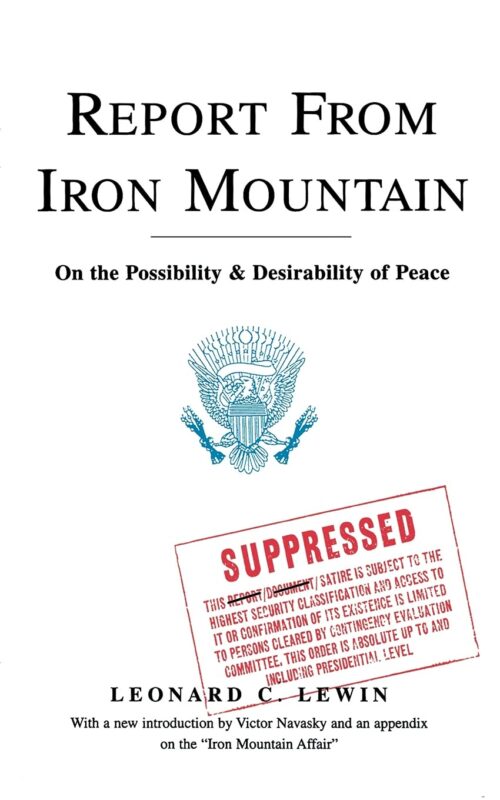
Report from Iron Mountain by Leonard C. Lewin enters the American political imagination as a confidential study commissioned at the height of the Cold War, assigned to a secretive panel known as the Special Study Group. The author, presenting a work both provocative and disquieting, asserts that the prospect of genuine and lasting peace would confront the United States—and by extension, the modern world—with unprecedented challenges to economic stability, social cohesion, and governmental authority. The narrative follows the commission’s formation, methodology, and conclusions, offering a systematic inquiry into the unspoken roles war occupies within society and the profound transformation demanded by the prospect of disarmament.
Origins of the Study and the Secret Group
A select assembly of intellectuals, scientists, and professionals forms the core of the Special Study Group, called together by shadowy government directive in 1963. The group meets over two years in shifting locations—hotels, private estates, and the underground facilities of Iron Mountain—shielded from scrutiny and authorized to pursue its mandate with uncompromising objectivity. Their charge: to anticipate the structural problems arising from a shift to permanent peace, and to recommend policies for managing this transition.
The group’s interdisciplinary nature and strict anonymity foster intellectual candor. Members draw on diverse expertise, ranging from economics and law to chemistry and psychiatry, facilitating a comprehensive analysis of war’s pervasive impact on modern societies. The resulting report, marked by methodical reasoning and a deliberate avoidance of moral or ideological presupposition, prioritizes structural stability as its central evaluative criterion.
Redefining War and Peace
The authors adopt precise definitions. War, in this analysis, constitutes an organized system encompassing military engagement, the apparatus of readiness, and the institutionalized capability for violence on behalf of the nation-state. Peace, in their usage, signifies a condition devoid of such preparation, a comprehensive and sustained disarmament extending beyond transient armistices or “cold wars.” This distinction underpins the inquiry’s radical scope.
The report asks: What structural changes would peace require? What functions does war fulfill that peace must address? The investigation proceeds through economic, social, political, and cultural dimensions, integrating quantitative and qualitative assessments.
The Economic Structure of War
The report asserts that military expenditure, far from accidental or peripheral, forms a stabilizing core of the national economy. U.S. military spending, comprising a significant fraction of national output—cited as upward of $60 billion per year during the 1960s—anchors both public and private economic systems. The war industry absorbs labor and capital, sustains technological development, and creates controlled “waste” that prevents unsustainable surpluses and stabilizes cyclical volatility.
Attempts to reconvert war industries into civilian production face technical, geographic, and social obstacles. Specialized skills and infrastructures built for military purposes lack natural civilian analogues. The report critiques conventional conversion models, arguing that localized plans for reemployment and retraining cannot scale to match the macroeconomic scope of disarmament. Fiscal tools—such as tax cuts or public works—offer insufficient leverage to transform the core structure of an economy organized for war.
Disarmament scenarios outlined in policy circles, including phased reductions of arms and the establishment of international inspection regimes, fail to address the fundamental problem: no current plan articulates how to replace war’s unique economic functions with structurally equivalent civilian alternatives.
War as Social System
The group claims that war serves as more than a tool of policy or diplomacy; it operates as a primary organizing system, structuring the legal, economic, and psychological foundation of modern society. Political authority, economic allocation, and social discipline coalesce around the apparatus of war-readiness.
The persistent prioritization of military spending, the exemption of armed forces from normative legal and economic standards, and the centrality of threat management all converge in a social order calibrated for the production and management of conflict. The group’s analysis contends that political and economic systems subordinate themselves to this underlying structure, rather than shaping war as a secondary phenomenon.
Functions of War Beyond Defense
The report catalogues nonmilitary functions war provides. Military organization absorbs surplus production and labor, acting as an economic “flywheel” to prevent collapse into depression or stagnation. War mobilizes populations, fosters social cohesion, and generates collective identity in service of national objectives. It legitimizes government authority and provides outlets for aggression, dissent, and the energies of potentially disruptive segments of society.
War’s impact extends to cultural, psychological, and even ecological domains. The existence of a credible external threat sustains internal order and compliance, while military service and preparation function as mechanisms of socialization and discipline. These effects cannot be dismissed as incidental; they constitute structural necessities for societal stability, as defined by the authors.
Peace Games and Scenario Analysis
To model the consequences of disarmament, the Special Study Group develops what it calls “peace games,” an analytical methodology using computer simulations to explore cascading effects across social systems. These simulations expose interdependencies linking military expenditure, employment, urban development, and international relations, allowing the group to test hypotheses about the viability of various peace strategies.
The group evaluates scenarios that propose redirecting military spending to space exploration, environmental programs, or vast public works. While such projects offer partial substitution, the analysis concludes that no existing civilian initiative replicates the stabilizing effects, scale, or central control characteristic of the war system.
Challenges of Disarmament and Economic Conversion
The report examines proposals for converting the arms economy to civilian purposes. Economic models suggesting tax rebates, public works, or expanded social services struggle to match the absorptive power of military spending. Attempts to envision massive peacetime programs—such as interplanetary exploration or engineered environmental challenges—raise questions of political acceptability, resource allocation, and technological feasibility.
The transition from a war economy to a peace economy, the authors argue, cannot rely on incremental adaptation. The scale and complexity of modern military production require systemic transformation, not piecemeal adjustment. Without a credible replacement for the centralizing, demand-creating power of military spending, the risk of economic instability and political fragmentation increases.
Social and Political Implications of Permanent Peace
The group considers the implications for social discipline and political authority. War, through the constant presence of threat and the mobilization of collective energies, legitimizes centralized power and sustains social order. The transition to peace would demand new institutions capable of fulfilling these functions.
The report explores the idea of creating alternative threats—genuine or manufactured—that might substitute for the unifying effects of war. These could include staged environmental crises, orchestrated extraterrestrial events, or vast technological undertakings. The discussion extends to population control, universal military service redirected toward nonmilitary tasks, and the deliberate construction of large-scale social projects. The feasibility and desirability of these alternatives remain unresolved within the group’s analysis, underscoring the magnitude of the challenge.
Controversial Proposals and Public Reaction
The group’s willingness to consider radical, even disturbing, solutions exemplifies its commitment to structural analysis over conventional morality. Suggestions such as planned “economic waste,” the possibility of organized repression, or the deliberate intensification of environmental problems, appear in the report as hypothetical substitutes for war’s functions.
The report acknowledges the likelihood of public shock and outrage upon encountering these arguments. The group’s recommendation to suppress the document and limit its circulation arises from a concern over misinterpretation and the political instability that could follow its disclosure. Nonetheless, dissent within the group leads to the eventual release of the report, with the stated goal of provoking open debate and rigorous scrutiny of the underlying issues.
Conclusion and Recommendations
The group concludes that, in the absence of robust and fully developed alternatives, the functions of war remain indispensable to the stability and cohesion of modern society. The report recommends maintaining—and even enhancing—the war system until such substitutes can be identified, tested, and implemented at scale. The authors express skepticism regarding the prospects for near-term solutions, while urging policymakers to initiate further research and public discussion of these structural imperatives.
The report’s narrative arc closes on a note of unresolved tension. Its publication, facilitated by Leonard C. Lewin, stands as an invitation to public inquiry into the foundations of social order, the demands of economic stability, and the potential costs of genuine peace. The questions it raises remain acute: What structures can take the place of war in modern civilization? What institutional innovations can ensure stability, discipline, and cohesion in a disarmed world? The analysis insists that solutions must match the scale and complexity of the challenges they address.
Legacy and Relevance
Report from Iron Mountain by Leonard C. Lewin endures as a touchstone for debate on the role of war in society, the true costs of peace, and the architecture of political authority. The report’s methods, arguments, and recommendations have provoked controversy, conspiracy, and critical reflection since their first publication. As societies confront new forms of global crisis, from climate change to technological upheaval, the report’s core insight—that the structural functions of war demand careful, innovative replacement—continues to inform policy, scholarship, and public debate.
In the era of global interdependence and existential risk, the vision of permanent peace entails more than the end of violence; it calls for the deliberate construction of new systems equal to the stabilizing power of the war system itself. The path toward such transformation remains open, contingent on the willingness of leaders, thinkers, and communities to grapple with the complexity and gravity of the questions raised by this extraordinary document.