The War of the Worlds
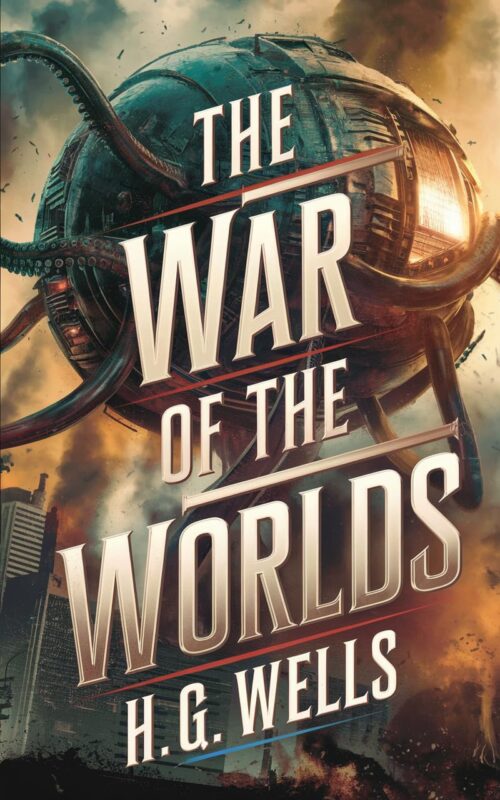
The War of the Worlds by H. G. Wells begins with a vision of a serene late-Victorian England under the quiet gaze of a distant, older planet. Astronomers observe unusual eruptions on Mars, and these events mark the origin of a calculated invasion. Wells presents Mars as a world approaching the end of its natural life cycle, its inhabitants driven by necessity to seek a younger, more fertile planet. From the first sighting of the strange cylindrical objects descending to Earth, the narrative builds an unbroken sequence of discovery, fear, and confrontation.
A calculated descent from Mars
Martian engineers launch projectiles across millions of miles with precision. Their landings in the quiet heathlands of Surrey introduce an alien presence that transforms the landscape into a theatre of survival. The first cylinder opens to reveal beings with vast eyes, tentacled faces, and bodies adapted for an environment less bound by gravity. Their physiology—lacking digestive systems, feeding on blood, and relying on mechanical extensions—signals a species shaped entirely for efficiency and conquest. The invasion’s opening moments dissolve the boundaries between science, spectacle, and dread.
Emergence of the Heat-Ray and Black Smoke
The Martians unveil weapons that redefine human understanding of warfare. The Heat-Ray sweeps through fields and villages, reducing resistance to ash. The Black Smoke, a dense poisonous vapor, drifts over the countryside, extinguishing life with a single breath. These tools of destruction compel mass evacuations, transforming roads and railways into rivers of desperate humanity. The imagery of London’s streets choked with refugees frames a new scale of crisis that transcends local defense and demands a coordinated survival strategy.
Two perspectives on collapse
The novel splits between the unnamed narrator, a science writer in Surrey, and his brother, a medical student in London. This structure broadens the scope, capturing the invasion’s impact on rural and urban landscapes alike. Through the narrator, readers witness the mechanical efficiency of the Martian advance, the devastation of artillery units, and the psychological unraveling of companions. Through the brother, the story conveys the chaos of urban flight, the violence among refugees, and moments of sudden heroism. This dual perspective roots the cosmic threat in human ground-level experience.
Encounters that reveal human character
During his escape, the narrator meets an artilleryman with visions of an underground human resistance. The plan imagines a future shaped by discipline, selective survival, and scientific preparation. Yet the artilleryman’s own indulgences undercut his vision. The curate, another companion, responds to the invasion with theological confusion and emotional instability, his breakdown endangering them both. In the brother’s flight from London, Miss Elphinstone emerges as a figure of capability and resolve, defending herself and aiding others in the midst of danger. Each figure embodies a distinct response to systemic collapse.
Occupation and exploitation
The Martians establish bases and deploy towering tripod fighting machines across the countryside. They capture humans for direct blood transfusion, sustaining themselves without rest or sleep. Their reproduction through budding and their telepathic communication suggest a species unified in thought and purpose. Wells positions these traits as both strengths and limitations, emphasizing the Martians’ inability to account for Earth’s microscopic life. The physical domination of the landscape, from Surrey commons to the outskirts of London, renders familiar spaces alien.
Urban desolation and Dead London
As the invasion reaches its peak, the narrator navigates through a silent capital stripped of human presence. Streets once teeming with life echo under the shadow of the Martian tripods. The imagery shifts from the chaos of battle to an eerie stillness. This moment marks the turning point: the tripods stand unmoving, their operators succumbing to infections for which they have no defense. The suddenness of the collapse, following such overwhelming superiority, underscores the vulnerability inherent in any system of conquest.
Resolution through unseen forces
The Martians die rapidly, their bodies unable to resist Earth’s bacteria. Wells frames this as an unplanned salvation, a biological defense as decisive as any military campaign. The narrator’s return to Woking and reunion with his wife closes the personal arc, yet the broader implications remain unresolved. The invasion has altered human perception of security and the cosmos. The epilogue affirms a new awareness that Earth exists within a wider field of potential contact and conflict.
A transformed understanding of survival
The experience forces a reevaluation of human preparedness. Wells embeds in the conclusion the idea that the invasion’s scientific and political lessons could shape a more unified global order. The recognition of shared vulnerability may encourage cooperation and advancement in technology, governance, and environmental adaptation. The work suggests that survival depends on foresight as much as resilience, and that progress emerges from recognizing the interdependence of planetary life.
Enduring cultural impact
The War of the Worlds has sustained influence across media and generations. Its layered design functions as both an adventure and a framework for thinking about technological asymmetry, ecological limits, and civilizational fragility. The novel’s relocation to New Jersey in Orson Welles’ 1938 radio adaptation triggered widespread panic, demonstrating its capacity to inhabit and transform public imagination. Later adaptations in film and literature continue to draw on its core images of mechanical giants, fleeing crowds, and silent cities.
Why the invasion endures in memory
The strength of Wells’ vision lies in the compression of cosmic scale into local geography. The heathlands, villages, and streets are mapped with precision, their transformation into alien territory heightening the immediacy of the threat. The Martians’ weapons, physiology, and methods are described with a clinical attention that grounds the extraordinary in plausible detail. The alternating viewpoints allow the narrative to shift between intimate survival and sweeping destruction, sustaining momentum without diminishing scale.
The precision of Wells’ social allegory
Beneath the unfolding disaster runs a critique of imperial ambition and societal complacency. The Martians’ disregard for human life mirrors historical patterns of conquest, while the varied human responses illustrate the range of adaptation and denial in the face of systemic collapse. Wells uses the alien threat to dissolve assumptions about permanence and to frame survival as a process of adaptation under pressure.
Legacy of the New Republic ideal
Wells’ other works, particularly Anticipations, outline a vision of a scientifically governed future led by a technocratic elite. The Martians can be read as an external embodiment of that vision: unified, efficient, and relentless. Their failure does not invalidate their model but reveals its incompleteness. Biological resilience and ecological context emerge as factors no technological mastery can ignore. The novel thus operates both as a warning and as a speculative framework for thinking about governance and survival in a connected world.
Narrative economy and intensity
The story unfolds over roughly two weeks, a compressed timespan that amplifies urgency. The pacing mirrors the acceleration of crisis, from initial curiosity to full-scale collapse. The brevity of the invasion, followed by the rapid return of life to apparent normalcy, leaves a residual tension in the narrative. The final pages acknowledge that beneath the restored routines lies an enduring awareness of vulnerability.
A closing vision of altered horizons
The narrator ends with a reflection on the permanent change in human outlook. The sky now holds the possibility of other watchers. The ground beneath the feet, once a secure domain, has proved open to intrusion from beyond. The Martians’ failure does not diminish the scale of their attempt. The invasion stands as proof that survival rests on the interplay between intelligence, environment, and unforeseen variables. In this convergence, Wells situates the enduring significance of the events, ensuring that the story remains an active presence in cultural memory.
