The Island of Doctor Moreau
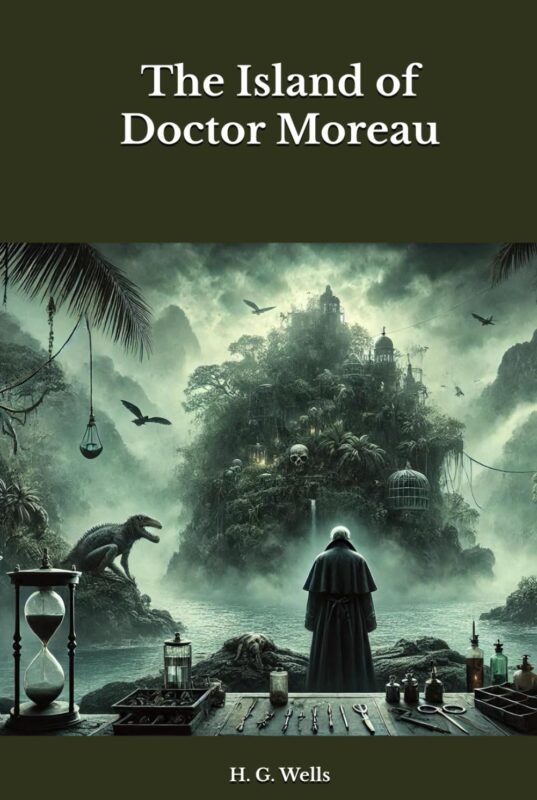
The Island of Doctor Moreau by H. G. Wells begins with Edward Prendick adrift at sea after the sinking of the Lady Vain. Days without food or water weaken him until a schooner, the Ipecacuanha, rescues him. Onboard, he meets Montgomery, a medical man transporting a strange cargo of caged animals. Montgomery cares for Prendick, but their journey ends at a remote tropical island where Montgomery works with the reclusive Dr. Moreau. The island’s isolation and the hostility of the ship’s captain force Prendick ashore, beginning his exposure to the unsettling life that Moreau has built.
Arrival on the Island
Montgomery’s welcome is reluctant, and Moreau is wary. The island holds a fortified enclosure where the new animals are taken, their cries echoing across the shore. Prendick notices the uncanny appearance of the island’s laborers—figures with distorted limbs, animal-like faces, and furtive eyes. Moreau’s secrecy deepens when he locks Prendick into a small outer room and restricts his access. The name Moreau stirs Prendick’s memory of a scandal in London involving gruesome vivisection experiments, and he begins to suspect the purpose of the animals and the strange inhabitants.
The Law and the Beast Folk
Prendick ventures beyond the compound and encounters beings who walk upright yet carry the physical traits of animals. They speak in broken language and chant a series of prohibitions known as the Law: commands that forbid going on all fours, eating flesh, and other animal behaviors. These rules, recited with ritual solemnity, anchor the creatures’ fragile human-like conduct. The Sayer of the Law leads them, reinforcing obedience through fear of Moreau’s punishment. Prendick’s shock intensifies when he realizes the island teems with such hybrids—beasts reshaped through surgery and conditioned into humanoid form.
Moreau’s Philosophy
Moreau explains his work without hesitation. He views his procedures as pure scientific inquiry, severed from moral boundaries. Pain, for him, is a tool of transformation, not a cruelty. He operates to accelerate evolution, using surgery and discipline to force animals toward human traits. His laboratory becomes the axis of the island’s life, a place of constant screams and smells of antiseptic. Montgomery assists, bound by loyalty and a history that drove him from conventional society. Prendick listens, horrified, but understands that the creatures outside are the living results of these experiments.
A Breach of the Law
Order collapses when a Leopard Man kills a rabbit, breaking the prohibition against eating flesh. Moreau and Montgomery hunt the creature into the forest, Prendick in uneasy pursuit. Cornered, the Leopard Man attacks, and Prendick shoots it to end its suffering before Moreau can drag it back to the lab. This act disrupts the hierarchy among the Beast Folk, who begin to question the Law’s authority. Without constant enforcement, their behaviors shift toward their original instincts.
Deaths and Disorder
Soon after, the puma Moreau had been working on breaks free and mortally wounds him. Montgomery reacts with despair, drinks heavily, and releases many of the Beast Folk from their bindings. That night, violence spreads through the island as the hybrids, freed from constraint, revert to chaotic patterns of dominance and fear. Montgomery is killed in a confrontation, leaving Prendick alone among creatures whose obedience erodes by the hour.
Alone Among the Beasts
Prendick survives by invoking Moreau’s authority, exploiting the lingering awe the Beast Folk hold for the Law. He avoids confrontation, remains armed, and shelters near the enclosure. Over time, the hybrids grow less responsive to his commands. Physical changes mark their regression—stooped postures, coarser hair, sharpened teeth. Prendick observes the process with mounting dread, recognizing that the human traits imposed by surgery are giving way to the forms and behaviors of their animal origins.
Rescue and Return
Months pass before a passing ship rescues Prendick. He returns to London physically safe but psychologically altered. Crowds and familiar streets unsettle him. In the faces of people around him, he perceives echoes of the Beast Folk—glimpses of hunger, cunning, and primal drive. The experience strips away his trust in the stability of human nature. He withdraws into solitary study, avoiding society and keeping the memory of the island’s truth to himself.
Themes of Transformation and Control
The narrative presses the question of what defines humanity. Moreau’s work asserts that physical form can be reshaped, but behavior resists control without constant reinforcement. The Law functions as a fragile scaffolding for civility, dependent on fear rather than internal conviction. When fear dissipates, the imposed identity collapses. The island becomes a closed system where domination, obedience, and reversion cycle endlessly.
The Role of Isolation
The island’s remoteness seals the experiments from outside scrutiny, enabling Moreau’s unchecked ambition. Isolation also magnifies Prendick’s ordeal, trapping him with no hope of escape except through survival among beings who blur the boundary between man and animal. The ocean surrounding the island becomes as much a barrier as the walls of Moreau’s compound, locking the drama into an inescapable stage.
Enduring Impact
By the conclusion, Prendick’s perspective on life has shifted irrevocably. He sees human society as a thin veneer over instinct, sustained by law, habit, and mutual watchfulness. The Beast Folk’s reversion mirrors his fear of humanity’s own fragility. The island’s horrors become a permanent lens through which he views the world, ensuring that even in safety, he remains captive to the knowledge of what he witnessed.
