Air-Mech-Strike: Asymmetric Maneuver Warfare for the 21st Century
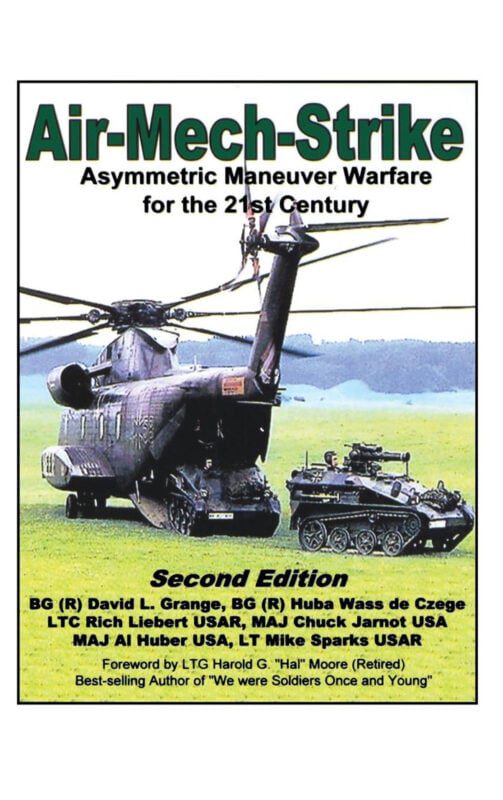
Air-Mech-Strike: Asymmetric Maneuver Warfare for the 21st Century by David L. Grange introduces a military framework designed to project lethal mechanized forces globally with unprecedented speed, precision, and flexibility. Drawing on decades of operational lessons and visionary design, the book presents a 3D maneuver strategy rooted in airland, paradrop, and helicopter assault capabilities, integrating light tracked armored vehicles to achieve rapid terrain dominance and strategic reach.
The Crisis of Inertia in Ground Force Projection
Post-Cold War conflicts revealed structural lag in traditional U.S. Army ground operations. Heavy divisions required complex logistics chains, predictable routes, and extended deployment timelines. Grange and his co-authors reimagine battlefield mobility as a dynamic synthesis of air and mechanized capabilities, calibrated for shock deployment, forced entry, and asymmetric terrain control. The book responds to the hard constraint of time: how do commanders inject combat-ready units into contested zones within 96 hours?
The Air-Mech-Strike concept engineers a solution. It fuses tracked armored vehicles with air mobility platforms, allowing rapid deployment of mechanized infantry without dependence on port infrastructure or lengthy overland convoys. This mobility enables decisive positioning, where forces arrive under armor, dismount swiftly, and maneuver with synchronized lethality.
Constructing a 3D Maneuver Force
Air-Mech-Strike defines mechanization through function, not weight. The authors distinguish AMS from wheeled motorization, emphasizing tracked vehicles for core combat mobility and survivability. Paradrop, sling-load, and airland capabilities converge into an integrated deployment strategy. Vehicles like the M113A3 and the proposed Ridgway and Gavin models serve as platforms for infantry delivery, fire support, reconnaissance, and overwatch. These assets displace forces into austere or defended environments with armor protection intact, removing the need for post-insertion link-up or recovery operations.
Air insertion alone does not confer advantage. AMS doctrine couples vertical maneuver with terrain agility, ensuring vehicles maintain mobility after touchdown. Commanders use terrain—not only firepower—to gain positional advantage, disrupt enemy cohesion, and fracture layered defenses. Vehicle-based mortars, autocannons, and guided munitions extend striking range, enabling decentralized but coordinated assaults. Infantry arrives protected, capable of immediate action across a 400-kilometer radius.
Strategic Timelines and Global Reach
The authors envision brigade-level AMS forces capable of complete strategic deployment within four days. This includes loading 300 combat vehicles onto wide-body jets, airlanding or parachuting them directly into theater, and synchronizing with rotorcraft self-deploying from home bases. Compound helicopters with extended range and speed amplify this reach, enabling operations deep behind enemy lines. The Winged Army Prepositioned Stocks (APS) concept accelerates readiness by forward-basing entire AMS brigades aboard commercial aircraft, stored and maintained for rapid launch.
These timelines align with Joint Vision 2010 and Army transformation mandates to field lighter, faster, digitally connected forces. The book critiques the over-reliance on digital situational awareness as a substitute for physical movement. By prioritizing terrain over transmission, AMS restores mechanical advantage to maneuver warfare. Speed, lift capacity, and route independence become force multipliers when enabled by compound aircraft and lighter armor.
Air-Mech-Strike in Operational Context
In simulated and historical scenarios, AMS forces outperform legacy units in response time, adaptability, and tactical effect. During planning for a potential entry into Kosovo, the limitations of 2D heavy ground routes became clear. British forces employing air-mech tactics with CH-47s and light tracked vehicles secured critical terrain within hours. U.S. units, reliant on river crossings and heavy bridging, arrived days later. The authors use this contrast to highlight the necessity of vertical maneuver capability embedded in mechanized doctrine.
The Afghanistan 2010 scenario illustrates full-spectrum AMS employment. Strategic lift deploys entire brigades from U.S. bases to a staging area in Uzbekistan. Helicopters self-deploy across continents, freeing fixed-wing assets. Within six days, AMS brigades conduct air assaults up to 400 kilometers from base, destroying terrorist encampments, controlling urban centers, and isolating insurgent strongholds. Infantry squads deploy from Ridgway vehicles under armor, supported by high-angle 120mm mortar fire and guided munitions. Combat operations proceed without forward fuel or supply lines.
Compound Helicopters and Self-Deployment
Aircraft performance underpins AMS feasibility. The Piasecki Ringtail and other compound rotorcraft designs extend helicopter speed and range while reducing rotor fatigue. UH-60, AH-64, and CH-47 variants equipped with compound modifications double combat radius and enable transatlantic self-deployment. These modifications increase load-bearing capacity and maneuver agility, allowing helicopters to carry streamlined external loads or internally transport vehicles like the M973A1.
Self-deploying rotorcraft eliminate the dependency on fixed-wing transport for intra-theater mobility. This independence strengthens operational tempo, allowing commanders to launch synchronized assaults from dispersed staging zones without awaiting follow-on logistics. Compound helicopters thus function as both assault platforms and enablers of autonomous ground force projection.
Light Logistics for Heavy Impact
AMS restructures logistics for tempo. Blivets replace tankers. Pallets replace convoys. Maintenance occurs through line-item replacement and modular swap rather than depot-level repair. These reforms slash deployment weight, reduce vulnerability, and increase aerial resupply velocity. The system anticipates surge operations, not extended entrenchment. Light forces move fast, strike hard, and reset through the air.
The logistical model draws inspiration from German and British air-mech units. German Wiesel brigades deploy on commercial 747s with externally strapped fuel drums and ammunition. British Scimitars airland with immediate combat readiness. These examples validate AMS’s premise: armored mobility does not require bulk if vehicles are purpose-built for airlift, rapid offload, and direct action.
The Role of Asymmetric Maneuver Warfare
AMS defines asymmetric maneuver as the systematic application of mobility to disrupt and dislocate enemy forces across multiple axes. Instead of attacking strength head-on, commanders deploy AMS units to bypass, encircle, or isolate. This form of warfare collapses enemy command and control by fracturing their internal coherence. Terrain advantage replaces attrition. Synchronization replaces saturation.
The AMS phalanx draws from classical military formations. Like the Greek phalanx, it operates as a structured unit designed to exploit formation density, but with 3D depth. By embedding infantry within mechanized platforms, AMS units combine shock action with precision targeting and mobility. They maneuver to create dilemmas the enemy cannot resolve, forcing reactive disaggregation and exposure.
Vehicles of the Air-Mech-Strike Force
The M113A3, Ridgway, and Gavin fighting vehicles provide the structural spine of AMS brigades. These tracked platforms integrate modular weapons systems, digital C4ISR, and lightweight armor optimized for airlift. The Ridgway serves as the air-assault platform, designed for UH-60 or CH-47 sling load and capable of delivering infantry with internal protection. The Gavin supports medium-level missions with increased armament and heavier payloads, suitable for parachute or STOL airland insertion.
Each vehicle performs specific battlefield roles: reconnaissance, fire support, logistics relay, or squad transport. Modularity allows tailored armament packages, including 30mm autocannons, 120mm mortars, missile launchers, and counter-drone systems. This specialization ensures AMS brigades retain combined-arms capabilities within a light, rapidly deployable framework.
Future Integration and Transformation Trajectories
AMS complements and enhances ongoing Army transformation goals. It provides a mechanical platform for Joint Vision principles of dominant maneuver, focused logistics, and full-spectrum engagement. Its design philosophy aligns with modular force packages, mission-tailored structures, and inter-service integration. The book outlines potential upgrades to legacy heavy systems like the M1 and Bradley, including unmanned turret concepts and modular weapon pods to reduce weight and increase transportability.
AMS doctrine enables selective force modernization without full fleet replacement. It leverages existing inventory, field-tested components, and commercial platforms. This practicality accelerates adoption, ensuring AMS capabilities are operational within current fiscal and industrial constraints.
Command Culture and Leadership for 3D Warfare
AMS demands a cultural shift among commanders. Vertical maneuver requires decentralized initiative, intuitive spatial reasoning, and real-time decision-making. Leaders must think in three dimensions—zonal control, altitude layers, and mobility corridors. The book stresses the need for aggressive, self-reliant leaders capable of integrating movement, fires, and terrain in dynamic, unpredictable environments.
Training must reflect this mindset. AMS units require joint rehearsal, rapid loading drills, terrain-mobility exercises, and live-fire assaults launched from air platforms. Success hinges on confidence in movement under uncertainty. Commanders must lead by maneuver, not by directive.
Convergence of Doctrine and Capability
Air-Mech-Strike consolidates operational theory, platform design, and deployment strategy into a coherent, executable framework. It offers commanders the tools to initiate decisive operations across distance, terrain, and threat spectrum. AMS responds to the hard requirements of 21st-century warfare—speed, reach, flexibility, and armored protection—by integrating them at the level of unit structure and operational design.
Grange and his team deliver a blueprint for transformation, not as speculation, but as functional doctrine with global implications. Where speed meets protection, and mobility converges with lethality, Air-Mech-Strike becomes the instrument of strategic dominance.

