Apocalypse 1945: The Destruction of Dresden
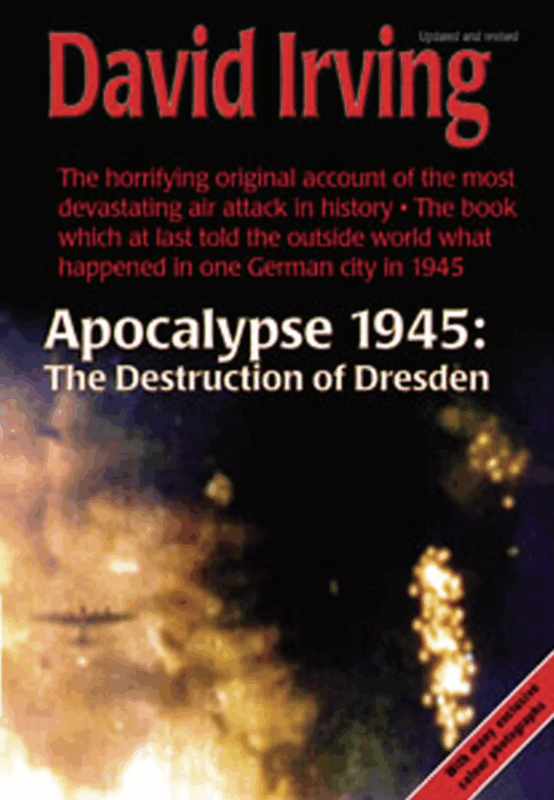
Apocalypse 1945: The Destruction of Dresden by David Irving examines the Allied air raids on Dresden in February 1945 through a combination of archival research, eyewitness accounts, and military records. The book tracks the origins of British and American bombing strategies, the planning and execution of the Dresden attacks, and the aftermath of firestorms that consumed the city. Irving reconstructs how the destruction unfolded across fourteen hours, weaving military directives with the human experience of survivors who endured suffocation, fire, and collapse.
The Precedent of Aerial Warfare
Irving traces the evolution of aerial bombardment policy from limited strikes on military targets to large-scale attacks on cities. He identifies the shift in May 1940 when the Royal Air Force moved from leaflet drops to bombing German towns after the German raid on Rotterdam. That event, which killed nearly a thousand people and displaced seventy-eight thousand, influenced British leadership. Churchill’s government recognized that large-scale bombing could cripple civilian morale and industry, which guided subsequent British policy.
Coventry in November 1940 provided another lesson. German bombers using new radio-guided targeting destroyed utilities and paralyzed industry. The raid revealed that disruption of water, gas, and power networks could incapacitate a city more effectively than isolated strikes on factories. British planners adopted this principle. By the time of the Dresden raids, the operational doctrine emphasized overwhelming firepower aimed at city centers to ignite firestorms and collapse infrastructure.
Dresden as a Target
Dresden held symbolic and logistical value. It was known as the “Florence on the Elbe,” a cultural center with minimal wartime damage until 1945. The city contained railway junctions critical to east-west transport, housed armament production, and swelled with refugees fleeing the Soviet advance. Irving documents how Allied planners identified Dresden as both a communication hub and a psychological target.
Operation Thunderclap initially conceived a massive strike on Berlin but evolved into a coordinated assault on secondary cities, Dresden among them. Intercepted communications and Ultra decrypts show how the Allies tracked rail congestion and refugee movement into Dresden, magnifying the strategic rationale for striking the city.
Planning the Raids
Irving reconstructs the operational planning with precision. RAF Bomber Command under Arthur Harris assembled a main force of over 700 Lancaster bombers for the night of February 13, 1945. The first wave used pathfinder squadrons to mark the city center. Within minutes, high explosives shattered buildings, followed by incendiaries that seeded flames across residential districts. A second wave struck hours later, intensifying the fires and overwhelming survivors who sought shelter in basements.
On February 14, American B-17s of the Eighth Air Force joined with daylight raids, dropping additional tons of high explosives on the smoldering ruins. Fighter escorts strafed roads, killing those attempting to flee. The combined effect created a firestorm with hurricane-force winds that consumed oxygen and suffocated thousands.
Firestorm and Human Experience
Eyewitness testimonies anchor Irving’s account. Survivors describe streets transformed into rivers of fire, people crushed in stampedes, and children torn from parents in the chaos. One letter from a soldier in a hospital basement captures the sensory detail: sparks filling the air, walls collapsing, and the recognition of imminent death. Residents clawed through debris to escape cellars, many collapsing from heat exhaustion. Others drowned in water tanks or suffocated as flames devoured available air.
The firestorm reached temperatures high enough to melt streetcar tracks and consume entire neighborhoods. In Striesen and the Altstadt, families vanished without trace, leaving chalk inscriptions on walls with pleas to locate missing relatives. The aftermath revealed corpses mummified by heat, burned beyond recognition, or buried under collapsed masonry.
The Death Toll Debate
Irving examines how casualty figures became contested. Initial estimates suggested over 200,000 dead, a number that circulated in postwar propaganda. Later police reports offered a figure closer to 25,000, though Irving insists the early March 1945 statistics were premature. He cites mass graves, missing persons, and unexcavated ruins as reasons to question official totals. By including eyewitness data and fragmented reports, he argues for a death toll between 50,000 and 100,000.
The uncertainty became fertile ground for political exploitation. East German authorities framed Dresden as evidence of Western barbarity, while West German officials downplayed numbers to align with Cold War alliances. The debate over figures shaped the memory of Dresden as either atrocity or strategic necessity.
Aftermath of the Raids
The city lay in ruins. Railway yards, military workshops, and communications lines were obliterated alongside theaters, churches, and homes. Refugee populations dispersed in panic, with thousands unaccounted for. Dresden’s cultural treasures—including the Semper Opera House and Zwinger Palace—suffered catastrophic damage. Relief efforts struggled to function amid fires, collapsed bridges, and lack of clean water.
Irving details the logistical response. Fire brigades lacked resources to combat widespread blazes. The civil defense services were paralyzed. Burial teams organized mass cremations on the Altmarkt square, where thousands of corpses were incinerated in open-air pyres. These measures were necessary to prevent epidemic disease as spring approached.
International Reaction
News of the destruction reverberated internationally. German propaganda broadcasts highlighted civilian suffering, broadcasting images and reports to neutral nations. The BBC monitoring service tracked responses from Sweden, Switzerland, and Latin America, where commentators described Dresden as an act of cultural annihilation.
Churchill himself expressed misgivings in private memos weeks later, questioning whether the scale of destruction had military justification. American military leadership defended the raids as part of the broader effort to break German resistance and support the Soviet advance. In the Soviet press, Dresden was framed as a strike aiding their offensive. The convergence of these narratives underscores the political volatility surrounding the attack.
Strategic and Moral Legacy
The raids on Dresden crystallized debates about strategic bombing as a tool of war. Irving shows how proponents within the Allied high command viewed Dresden as confirmation that concentrated incendiary raids could paralyze an urban hub. Critics regarded the attack as disproportionate to military needs, emphasizing the civilian toll.
Irving introduces the term “Innocenticide” to describe the killing of noncombatants regardless of ethnicity or nationality. By linking Dresden to broader patterns of civilian targeting—from Hamburg to Tokyo—he situates the event within the evolution of modern warfare. The destruction of Dresden exemplified the culmination of technological advances in incendiary bombing and the willingness of commanders to deploy them at scale.
Sources and Research
Irving’s study rests on a wide foundation of sources. He conducted interviews with RAF officers, Luftwaffe pilots, American bomber crews, and Dresden survivors. He drew upon Ultra decrypts, police reports, USAAF studies, and German municipal surveys. He also incorporated photographs taken by Walter Hahn, a Dresden photographer, which capture streets filled with corpses and leveled buildings.
The book integrates statistical analyses such as the Butt Report, which exposed RAF inaccuracy, and wartime studies of bomb tonnage versus casualty ratios. Appendices include original documents, such as the Dresden Police President’s “Order of the Day No. 47” and RAF Bomber Command’s night operations report. These materials provide a documentary framework that anchors the narrative in verifiable evidence.
Long-Term Impact
The destruction of Dresden entered cultural memory as both historical fact and contested symbol. Survivors transmitted oral histories across generations. Political regimes instrumentalized the event for propaganda. Scholars debated casualty figures, military necessity, and moral responsibility. Dresden’s ruins remained a visible reminder for decades, with reconstruction delayed until after German reunification.
Irving’s work intensified public awareness when first published in 1963. The book generated questions in the British Parliament, newspaper serializations, and widespread debate. Its influence extended into Cold War discourse, where Dresden served as a rhetorical weapon on both sides.
Conclusion
The story Irving presents moves from strategic planning to human devastation, from archival detail to lived memory. It demonstrates how one city became the site of concentrated technological violence that destroyed infrastructure, culture, and tens of thousands of lives. By assembling military orders, eyewitness accounts, and postwar controversies, the book establishes Dresden as a defining case in the history of aerial warfare.
The attack was conceived within an evolving doctrine, executed with overwhelming force, and remembered through conflicting narratives. Dresden illustrates the capacity of modern war to erase a city in hours while leaving questions that endure for generations.
