Be Wise As Serpents – Harmless As Doves
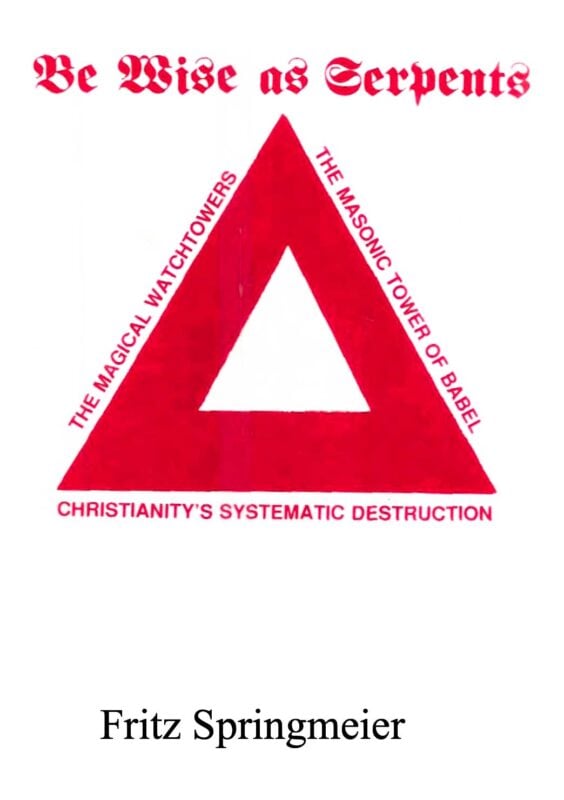
Be Wise As Serpents by Fritz Springmeier exposes the coordinated rise of a global power structure intent on reshaping religion, culture, and governance, positioning the effort as the systematic destruction of Christianity and the orchestration of a one-world-religion. Drawing from direct testimony, confidential interviews, and historical documents, Springmeier maps the convergence of secret societies, financial networks, and religious organizations—demonstrating how these elements serve an agenda that seeks to reorganize the foundations of Western civilization.
The Architecture of Hidden Power
Springmeier identifies the existence of a “composite serpent,” a metaphor for a complex network of actors who engineer cultural and religious transformation under the guise of benevolence or progress. He traces the development of this network from early Masonic and Rosicrucian traditions, highlighting figures such as Sir Francis Bacon and Manley P. Hall, who articulated a vision of wise men—initiates of hidden knowledge—guiding society. The reader encounters historical connections linking Freemasonry, elite bloodlines, and emergent political movements, where each thread tightens the grip of centralized control.
Defining Conspiracy Through Structure and Agency
The book distinguishes conspiracy not as a single, monolithic plot, but as a multilayered structure operating through three distinct classes: the dedicated architects who direct policy, the deluded intermediaries who propagate its philosophy without full awareness, and the masses identified in secret papers as “cattle,” swept along by the prevailing zeitgeist. Springmeier supports his claims with both anecdotal accounts and references to primary documents, arguing that these networks embed themselves within all domains of power—religion, finance, media, education, and government—where alignment with the conspiracy becomes a condition for advancement or survival.
Framing and Manipulating Public Perception
The author details the methods by which these actors manufacture consensus and manipulate public perception. Media conglomerates, textbook publishers, and entertainment companies curate the narratives that shape collective consciousness, constructing a “frame of reference” that excludes any knowledge of the underlying agenda. He asserts that symbolic codes—such as the recurrence of 666 in barcodes and financial systems—signal allegiance and intent within this hidden order, serving as both markers of control and as ritual signatures embedded in daily life. The design of Washington, D.C., according to Springmeier, encodes esoteric meanings, instilling these principles at the very heart of American power.
Religious Engineering: Watchtower Society as Case Study
Springmeier turns his attention to the Watchtower Society, presenting it as a microcosm of the broader operation to reengineer religion. He documents the roots of the organization in Masonic thought, Gnostic philosophy, and esoteric symbolism, emphasizing the transformation of Christian teaching into a vehicle for New Age beliefs. Chapters dissect how the Society’s symbology—winged sun disks, pyramids, and coded language—reflects an agenda synchronized with the goals of global consolidation and social control. Bloodlines, particularly the Russell family, receive scrutiny as vectors through which hereditary power transmits occult knowledge and shapes organizational leadership.
The Cultivation of New Age Religion
Springmeier argues that the transformation of Christianity proceeds through the incremental introduction of Gnostic and New Age elements. This process unfolds within denominational structures and is catalyzed by the penetration of key individuals—often identified as Masons or initiates—into positions of religious authority. The emergence of a double-sexed deity archetype within certain doctrines signals the absorption of ancient mystery cults, facilitating a transition from orthodox worship to a form of religious syncretism that serves the interests of the controlling network.
Economic Control and the Cashless Society
A core component of the strategy centers on economic transformation. The author chronicles the development of a global money system, orchestrated by banking dynasties such as the Rothschilds and Rockefellers, who deploy financial instruments and interlocking directorates to centralize resources. Plans for a cashless society, advanced through the proliferation of credit systems and barcodes, converge with scriptural prophecy—Springmeier cites the association of 666 with the conditions of buying and selling. The introduction of interest-based systems operates as a mechanism for enslavement, extracting wealth while binding populations to the will of a transnational elite.
Education as Cultural Conditioning
Springmeier devotes significant analysis to the ways education serves as a vector for ideological conditioning. He traces the influence of figures like John Dewey, showing how public schooling instills values and historical narratives that align with the objectives of the conspiracy. The text presents evidence that curricula exclude alternative perspectives, reinforce obedience to centralized authority, and prepare students for passive acceptance of radical cultural change. Educational reform, presented as progress, functions instead as the primary means of generational indoctrination.
Media as the Instrument of Deception
The manipulation of media receives particular scrutiny. Springmeier asserts that media conglomerates craft public reality, constructing artificial crises and manufacturing both heroes and villains according to a script designed to manage dissent and foster compliance. The orchestration of major historical events, including assassinations and revolutions, emerges as a recurrent strategy. The book lists numerous individuals—ranging from political leaders to investigative journalists—whose deaths, often ruled as accidents or suicides, reveal a pattern of elimination targeting those who threaten to expose the machinery of power.
Psychological Warfare and Ritual Control
Springmeier explores psychological manipulation as a dimension of the larger campaign. He documents the use of hypnotic techniques, behavioral conditioning, and ritual symbolism to increase suggestibility and enforce compliance. Drawing on testimony and behavioral research, the book suggests that susceptibility to suggestion exists on a spectrum, with a significant portion of the population living in a state of heightened vulnerability to media influence and ideological programming. Symbolic rituals, such as public initiations and coded gestures, reinforce this control at both conscious and subconscious levels.
Reinterpreting Christian Community and Resistance
The author addresses the theological implications of his research, contending that authentic Christian community arises only when individuals recognize and resist the encroachment of the world-system. He draws a distinction between “Pietist” forms of Christianity, which limit engagement to spiritual struggles, and communities such as the Anabaptists, who respond to external threats with both practical solidarity and conscious resistance. The book describes how these communities, often marginalized or persecuted, embody practices—caring for the elderly, refusing state dependency, preserving independent judgment—that insulate them from the mechanisms of control.
Deconstructing Religious Labels
Springmeier clarifies his use of terms such as “Christian” and “Jew,” emphasizing the importance of bloodlines, spiritual allegiance, and cultural heritage in understanding the structure of the conspiracy. He acknowledges the complexity of these identities, documenting cases where individuals traverse boundaries between religious, cultural, and occult traditions. The text maintains that genuine faith aligns with adherence to divine law and moral discernment, whereas labels often function as camouflage, concealing the true orientation and intentions of actors within the system.
The Anatomy of the One-World-Religion
In mapping the trajectory of the one-world-religion, Springmeier traces the progression from infiltration to overt control. He examines efforts to unify diverse denominations under the auspices of ecumenical councils, exposing the influence of secret societies and occult orders in guiding theological development. The rise of New Age religion, characterized by syncretism and the revival of mystery cults, finds its culmination in the planned initiation of the masses—symbolized by rituals, emblems, and the public acceptance of new doctrine.
The Convergence of Power: From Theory to Practice
Springmeier synthesizes the material into a cohesive account of how disparate institutions—religious, economic, political—converge through coordinated action. He asserts that control rests on the ability to orchestrate both opposition and acquiescence, managing crises to expand authority while generating the appearance of diversity and debate. The planning of economic shocks, the execution of scandals, and the engineering of social movements all flow from a common center, where initiates coordinate strategy while shielding the core agenda from public scrutiny.
Strategies for Awareness and Resistance
The closing sections provide a call to action rooted in spiritual and practical courage. Springmeier urges readers to cultivate discernment, seek verifiable evidence, and develop independent judgment capable of identifying manipulation and false leadership. He frames resistance as an active process that requires both awareness of structural realities and the willingness to defy the conventions imposed by compromised authorities. The text encourages the formation of communities that value truth, solidarity, and accountability to higher principles, rejecting the promises of false liberation and manufactured progress.
Enduring Questions and the Path Forward
What constitutes genuine victory in a struggle defined by deception and betrayal? How does a person reconcile the demands of obedience to authority with the necessity of resisting illegitimate power? Springmeier posits that ultimate triumph arises from alignment with divine will, which transcends the machinations of the conspiracy and empowers individuals to act with conviction. The book situates itself as both a scouting report and a manual for spiritual warfare, equipping readers with the tools to navigate a world shaped by forces that operate through secrecy, ritual, and control. In the process, Be Wise As Serpents establishes itself as a definitive work for those seeking to understand—and counter—the hidden architecture of global power.