Churchill’s War The Struggle for Power
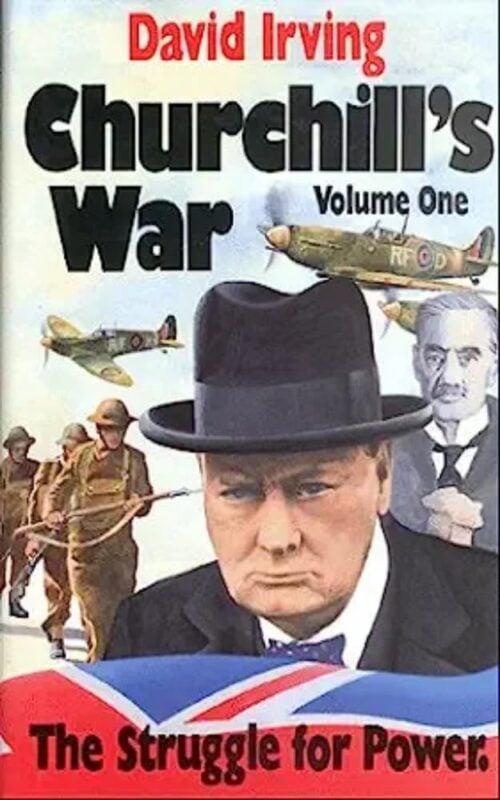
Churchill's War The Struggle for Power by David Irving opens with Winston Churchill stepping into the global stage as a figure of charisma and contradiction. Irving presents a detailed, document-driven portrait of Churchill as both statesman and manipulator, charting his rise through the wilderness years of the 1930s, his struggle for power during the Second World War, and the moral, political, and strategic costs of his leadership. The book grounds its arguments in archival research across Europe, America, and Russia, drawing on Churchill’s papers, diaries of his staff, and intercepted communications that illuminate both his brilliance and his darker impulses.
Churchill’s Political Evolution
The early sections trace Churchill’s path from his aristocratic upbringing through his erratic early political career. Irving emphasizes Churchill’s shifting allegiances, moving from Conservatives to Liberals and back again, guided less by ideology than by ambition. His energy and rhetorical power won him attention, but his recklessness earned mistrust. The book details how his financial struggles, documented through his agent’s papers at the University of Oregon, bound him to wealthy backers and political syndicates such as “The Focus,” which funded his campaigns against appeasement.
The Wilderness Years and the Road to Power
In the 1930s, Churchill’s warnings against German rearmament were entwined with his need for political rehabilitation. Irving uses intercepted Czech communications and British cabinet papers to argue that Churchill positioned himself as indispensable by aligning with foreign interests eager to destabilize Chamberlain. His marginalization shifted dramatically with the outbreak of war in 1939, when his reputation for energy made him First Lord of the Admiralty again. The narrative highlights his orchestration of propaganda, his push for aggressive bombing strategies, and his leveraging of crisis to return to central leadership.
The Fall of France and Churchill as Prime Minister
The chapters on 1940 present Churchill’s ascent to prime minister during Britain’s darkest hour. Irving frames this moment less as heroic inevitability than as a convergence of political collapse and Churchill’s relentless pursuit of power. He draws on the diaries of John Colville and other Downing Street staff to show initial doubts about Churchill’s suitability. These accounts reveal how Churchill’s bluster gradually transformed into admiration as his determination steadied the government during the evacuation at Dunkirk and the Blitz.
Diplomacy, Allies, and the Cost of Strategy
Irving devotes significant attention to Churchill’s relationship with Roosevelt and Stalin. He mines American, Canadian, and Soviet archives to reveal Churchill’s dependence on Roosevelt for financial and military aid, while conceding far-reaching concessions to Stalin. Churchill’s personal charm and rhetorical power obscured the extent to which he yielded to pressures from both allies. At Yalta and other summits, his efforts to preserve Britain’s imperial role clashed with the growing dominance of the United States and the Soviet Union. Irving portrays these moments as the true struggle for power: Churchill’s attempt to preserve Britain’s place in a world already slipping from its grasp.
The Shadow of War Leadership
The book does not shy away from Churchill’s flaws. Irving describes Churchill’s heavy drinking, his impulsive decisions, and his willingness to use bombing campaigns that killed large civilian populations in Europe. His delight in destruction, even in viewing photographs of Dresden, underscores Irving’s central claim: Churchill thrived in war as a destroyer rather than a builder. His decisions often reflected short-term advantage and personal bravado rather than strategic restraint.
Intelligence and Secret Sources
Irving integrates the secret world of intelligence into the narrative, particularly the Ultra decrypts that Churchill used to make rapid, sometimes reckless, operational decisions. Official historians ignored this factor due to secrecy orders in 1945, but Irving reconstructs the story through captured German records and declassified signals. These sources reveal how Churchill’s uncanny ability to anticipate enemy moves was rooted in codebreaking rather than intuition. This insight reframes his reputation, shifting it from genius foresight to exploitation of hidden intelligence.
Empire, Finance, and the Personal Dimension
Beyond strategy, the book explores Churchill’s financial insecurity, his reliance on lucrative publishing contracts in the United States, and his lavish lifestyle during a time when Britain endured rationing. His vacations on the Riviera and North Africa, financed by foreign publishers, highlight the gap between his rhetoric of sacrifice and his personal indulgence. Irving connects this pattern to Churchill’s imperial vision: his belief that Britain must rule vast populations abroad even as its economic base weakened.
A Leader Consumed by War
Irving’s Churchill emerges as a man happiest in conflict. He gloried in battle, immersed himself in military detail, and spoke of war as life’s greatest stimulant. The narrative depicts his command style as exhausting for subordinates but intoxicating in its momentum. His sheer energy and willpower drove Britain through crises, yet the costs in human lives, cities destroyed, and empire lost defined the legacy of his war leadership.
Conclusion: The Struggle for Power
Churchill’s life was a continuous battle to secure and hold power, using war as the stage where his character found purpose. He preserved Britain through its most perilous years but left it weakened, its empire collapsing, its global position eclipsed by America and Russia. The book concludes that Churchill embodied both the grandeur and the tragedy of twentieth-century Britain. He became the hero of survival, but also the architect of decline.
