Cleopatra’s Kidnappers
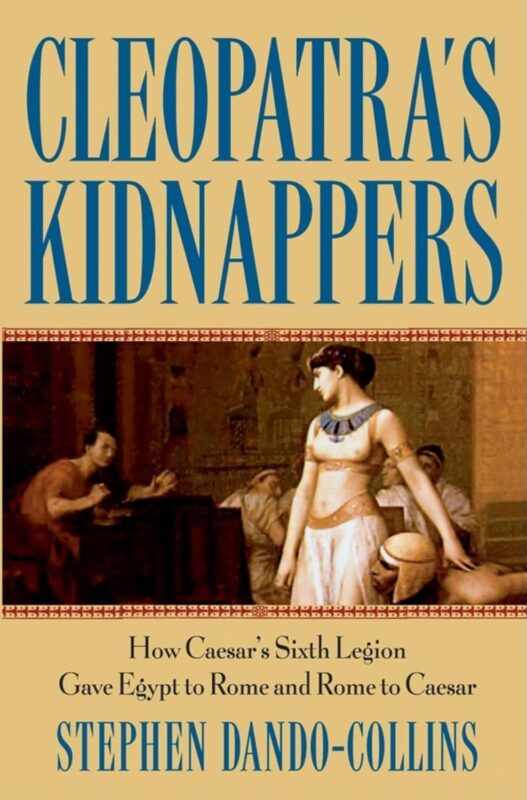
Cleopatra’s Kidnappers by Stephen Dando-Collins reconstructs the campaigns of Julius Caesar in Egypt and Asia Minor through the soldiers of the Sixth Legion, known as Legio VI Ferrata. The narrative traces the legion’s Spanish origins, its transfer from Pompey’s service to Caesar’s army, and its defining role in the Alexandrian War. The book situates Caesar’s survival within the precision and endurance of the Ferrata, revealing how a few thousand soldiers changed the course of Roman power in the East.
Origins of the Sixth Legion
In 65 B.C., Pompey the Great organized the Sixth Legion in Hispania. The recruits came from the rugged interior of the Iberian Peninsula, men hardened by mountain warfare and accustomed to scarcity. Their discipline grew from constant exposure to direct command and practical training in formation maneuvering, rapid fortification, and endurance under deprivation. When the civil war between Pompey and Caesar divided the Roman state, these same Spaniards surrendered after defeat at Ilerda in 49 B.C. and entered Caesar’s service. Their loyalty formed through tangible acts of reward and recognition, not ideology. Caesar granted double pay, shared spoils, and addressed them as veterans equal to his most trusted guards.
Caesar’s March to Civil War
In January 49 B.C., Caesar crossed the Rubicon River with the Thirteenth Legion and proclaimed defiance of the Senate’s order to disband his army. The act initiated a sequence of campaigns that dismantled the authority of Pompey and the conservative aristocracy. Caesar’s command structure functioned through direct personal control and rapid logistical adaptation. By the spring of 49 B.C., he controlled Italy and secured treasury reserves in Rome. His advance through Spain forced Pompeian commanders Afranius and Petreius to capitulate. The Sixth Legion, reconstituted under Caesar’s standard after that campaign, became the core of his mobile striking force.
The Road to Egypt
After the decisive victory at Pharsalus in August 48 B.C., Caesar pursued Pompey to Egypt. Pompey’s assassination by courtiers of the boy-king Ptolemy XIII transformed the political stakes. Caesar entered Alexandria with a small contingent—approximately 4,000 men including the Sixth Legion—and found himself in a dynastic conflict between Ptolemy XIII and his sister Cleopatra VII. His presence forced an immediate recalibration of Egyptian politics. The court’s ministers, including Pothinus and Achillas, sought to expel the Romans. Cleopatra sought Caesar’s patronage as her instrument of restoration.
The Siege of Alexandria
The Alexandrian War unfolded as a confined siege within the royal quarter. Caesar’s troops fortified the palace district, controlled the harbor, and endured continuous assaults from Egyptian forces estimated at over 70,000. The Sixth Legion held the front lines across narrow causeways and rooftops, fighting through smoke, sand, and fire. When the Alexandrians poisoned the wells, Caesar ordered his soldiers to dig for fresh groundwater near the shore. That command preserved morale and created a symbolic moment of unity between commander and legion. The siege produced constant improvisation—wooden towers on barges, artillery set upon the palace walls, and close-quarters fighting in the labyrinth of the city.
The Capture of Cleopatra and the Royal Family
Caesar seized the advantage through decisive audacity. The Sixth Legion executed the capture of Cleopatra’s siblings, including Arsinoë, removing Ptolemaic leadership from enemy hands. Cleopatra herself entered Caesar’s quarters wrapped in a carpet or bedding sack—an episode preserved in ancient accounts and integrated by Dando-Collins as both legend and tactical gesture. Once installed beside Caesar, Cleopatra emerged as co-ruler under Roman protection. Her reinstatement as queen of Egypt marked the first successful imposition of direct Roman authority on the Nile kingdom without formal annexation.
The Battle of the Nile
Reinforcements under Mithridates of Pergamum arrived from Syria and Cyprus, bringing an additional 13,000 troops. Caesar united these with his own forces, including the core of the Sixth Legion, and advanced toward the Nile Delta. The decisive battle occurred near modern Giza. Ptolemy’s army, positioned with chariots and phalanxes, collapsed under coordinated Roman assault. The Sixth Legion’s frontal charge broke the Egyptian center, and Caesar’s cavalry enveloped the flanks. Ptolemy XIII drowned attempting to escape by boat. The outcome secured Cleopatra’s rule and stabilized Roman influence across the eastern Mediterranean.
Alliance and Aftermath
Caesar remained in Egypt through the birth of Ptolemy XV, known as Caesarion. The alliance with Cleopatra unified strategic interests: Roman access to grain and Egyptian dynastic continuity under Roman favor. Dando-Collins portrays Caesar’s decision to remain as a calculated assertion of prestige, not indulgence. The Sixth Legion transitioned from combat operations to ceremonial guard duty, maintaining order in Alexandria and along the Nile. Their conduct embodied the Roman model of disciplined occupation rather than pillage.
The Return to War and the Battle of Zela
In 47 B.C., Caesar departed Egypt with the Sixth Legion and marched north into Asia Minor to confront Pharnaces II of Pontus, the son of Mithridates the Great. Pharnaces had seized territories during Caesar’s absence. At Zela, Caesar’s force of approximately 30,000 men faced a larger Pontic army. The battle concluded in less than five hours. Caesar’s tactical sequence—reconnaissance, false withdrawal, sudden counter-advance—produced complete victory. His dispatch to the Senate read: Veni, vidi, vici. The Sixth Legion led the charge that crushed Pharnaces’s advance guard, confirming its reputation for disciplined aggression.
The Legion’s Legacy
After Zela, the Sixth Legion rejoined Caesar in Rome, participated in triumphal parades, and later followed Mark Antony into the East after Caesar’s assassination. Under Antony and later Augustus, it became part of the permanent imperial army, stationed in Judea and Syria. Its veterans founded colonies in northern Italy and Galilee, carrying with them the identity of Ferrata, “the Ironclad.” Their endurance across decades of service reflected the professional transformation of the Roman army from citizen militia to standing force.
Command and Strategy
The narrative structure emphasizes Caesar’s methodical command style. He relied on clear chains of authority, delegated engineering to centurions, and maintained proximity to front-line operations. His relationship with the Sixth Legion exemplified his command philosophy: shared hardship, immediate reward, and visible leadership. The legion’s battlefield conduct illustrated the Roman integration of engineering and tactics. Soldiers fortified positions nightly, constructed catapults from ship timbers, and used the testudo formation to advance through missile fire. Their efficiency in constructing pontoon bridges and towers under attack demonstrated a blend of mechanical skill and mental resilience.
Alexandria as a Theater of Transformation
The siege transformed Alexandria from a Hellenistic capital into a Roman client city. The palace quarter, the Brucheion, became a fortress of imperial assertion. The destruction of part of the Library of Alexandria occurred during the fighting, when fires spread from the dockyards to adjacent warehouses containing scrolls. Caesar’s fleet operations—control of Pharos Island and the Heptastadion causeway—created naval corridors through which supplies and reinforcements flowed. These actions represented the Roman adaptation of maritime warfare to urban environments.
Cleopatra’s Political Genius
Cleopatra emerges as strategist and survivor. Her fluency in multiple languages, her grasp of economic systems, and her theatrical presentation consolidated her authority. She secured Caesar’s support through intellect and timing. Her command of ceremonial symbolism—incense, attire, and ritual procession—transformed Roman occupation into political alliance. The birth of Caesarion bound Egyptian monarchy to Roman lineage. Dando-Collins reconstructs her agency through contemporary descriptions that portray negotiation, not submission.
The Sixth Legion as Historical Lens
The author structures the book around the legion rather than Caesar himself. Through their campaigns, the evolution of Roman warfare becomes visible: the shift from short, decisive encounters to prolonged siege and occupation. The Sixth Legion’s movements trace the transformation of Roman foreign policy from conquest to administration. Their service demonstrates how military professionalism created continuity amid political upheaval. Veterans of the Ferrata formed colonies that anchored Roman control in conquered provinces.
Tactics and Engineering
Roman military engineering defines the texture of the Alexandrian campaign. The legion built layered defenses of stone, timber, and sandbags. Artillery crews operated ballistae and scorpiones from elevated towers. Field fortifications evolved daily according to the topography of the harbor and canals. Caesar’s engineers diverted water channels to flood enemy trenches and used fire ships to destroy the Egyptian fleet. These operations reveal the integration of hydraulic engineering into combat. The soldiers’ capacity to adapt civilian tools for military use illustrated the Roman conception of war as labor.
Discipline and Morale
Discipline sustained cohesion under siege. Caesar addressed his troops daily, shared rations, and participated in manual work. The legion’s veterans maintained order among less experienced recruits from the Twenty-Eighth Legion. Their chants, standards, and ritual offerings before battle maintained psychological stability. The repeated invocation of the aquila, the legion’s eagle, symbolized endurance. Dando-Collins records instances where Caesar intervened personally to prevent panic, reminding his soldiers that survival depended on unity of action.
The Broader Consequences
Caesar’s victory in Egypt shifted the geopolitical balance of the Mediterranean. The annexation of Egyptian grain supply secured Rome’s food chain. Cleopatra’s rule under Roman auspices created a stable client monarchy. The success of the Sixth Legion validated Caesar’s model of mobile warfare sustained by veteran elites. That model endured into the reign of Augustus, shaping imperial military organization for centuries. The narrative reveals the structural transition from republican campaigns motivated by glory to imperial wars sustained by administration and logistics.
Historical Reconstruction
Stephen Dando-Collins grounds the reconstruction in ancient sources such as Caesar’s Commentarii de Bello Civili, the anonymous Bellum Alexandrinum, and accounts by Plutarch, Appian, and Cassius Dio. He corrects chronological gaps and clarifies the movement of units often obscured by fragmentary evidence. The detail of troop composition, equipment weight, and campaign distance transforms military history into lived experience. His synthesis of literary and archaeological data restores human scale to events often treated as legend.
The Human Dimension of Command
Caesar’s leadership operated through immediacy. He fought in the front ranks, swam to safety during harbor skirmishes, and rewarded valor with immediate promotion. His presence transformed fear into resolve. The soldiers’ devotion arose from tangible proximity, not abstraction. The relationship between commander and legion embodied the Roman concept of virtus—courage proven through endurance.
Enduring Symbolism
The story of the Sixth Legion’s defense of Alexandria endures because it fuses personal ambition with collective will. The soldiers’ endurance under siege, the queen’s rise through alliance, and the general’s triumph through audacity form a continuous sequence of cause and effect. The legion’s title, Ferrata, expresses more than armor; it signifies mental steel. Their march from Spain to Egypt and beyond Asia Minor traces the physical route of Roman transformation from republic to empire. The power of that journey lies in the certainty of action that bound individual survival to historical change.
