Cosmos and Transcendence
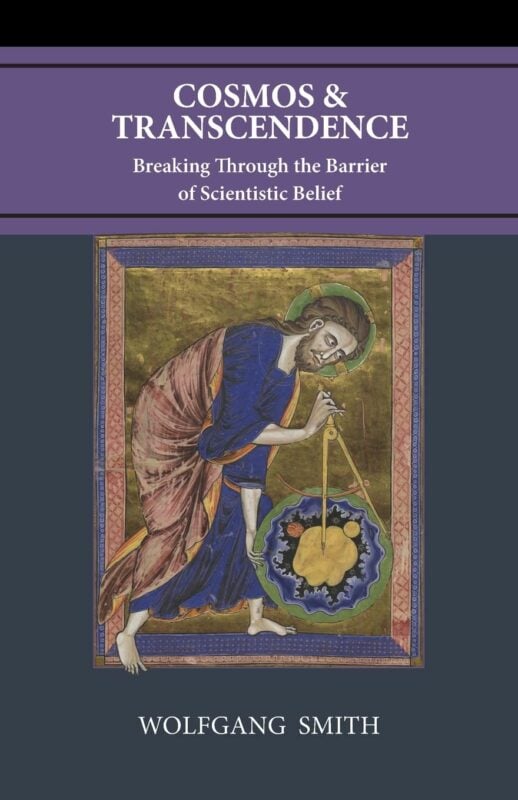
Cosmos and Transcendence by Wolfgang Smith confronts the metaphysical assumptions embedded within contemporary scientific thought and asserts a decisive call for reawakening to transcendent reality. He challenges the credibility of scientism—the belief system that elevates empirical science into a comprehensive worldview—and reintroduces perennial philosophy as the framework for understanding both the cosmos and human consciousness.
The division that defines the age
Seventeenth-century thinkers forged a split between res extensa and res cogitans. Smith traces this bifurcation to Galileo and Descartes, who laid the groundwork for a mechanical universe devoid of intrinsic qualities like color, purpose, and meaning. This split enabled the rise of physics as a discipline rooted in measurement and abstraction. Descartes framed mind and matter as fundamentally distinct substances, confining perception to the mind and excluding the phenomenal world from reality. By encoding this dualism into scientific reasoning, modern physics inherited a metaphysical stance disguised as empirical truth.
What exists when only quantity counts
The modern scientific worldview reduces the universe to what can be quantified. Physical reality becomes identical with mathematical descriptions, and anything that escapes measurement recedes into unreality. Smith demonstrates how Newtonian mechanics institutionalized this abstraction. Newton’s physics did not merely describe empirical patterns; it enforced a metaphysical structure where only measurable phenomena gained ontological status. This model excludes human experience, aesthetic perception, and spiritual insight. By limiting realness to that which can be calculated, it imposes a narrow ontology that constrains human thought and stifles metaphysical inquiry.
The illusion of empirical purity
Smith dissects the claim that science operates independently of metaphysical premises. He shows that the foundational concepts of physics—space, time, matter—emerged through metaphysical choices, not pure observation. These choices shaped the form of inquiry and predetermined its scope. Quantum mechanics and relativity later revealed the limits of this legacy. As science advanced, it exposed internal contradictions. Einstein’s space-time continuum and Heisenberg’s uncertainty principle dismantled the illusion of observer-independent facts. In these developments, science demonstrated its dependence on the very act of perception it once sought to exclude.
When observation reshapes reality
Quantum mechanics does not describe a world independent of observers. It describes relationships. The wave function encodes information, not essence. Every measurement alters what is observed, not because of instrument error, but because of the intrinsic entanglement between observer and system. The dual character of particles and waves confirms that no single model captures reality. What appears as a particle in one experiment behaves as a wave in another. The physical world becomes a dynamic interaction between knowing and being known. Theories reflect patterns of engagement, not fixed substances.
The failure of bifurcation
Smith traces the philosophical collapse of bifurcation. He draws on thinkers like Berkeley, Kant, Husserl, and Whitehead, who dismantled the Cartesian legacy from within. Berkeley affirmed that existence depends on being perceived. Kant showed that space and time are conditions of perception, not properties of things. Husserl introduced intentionality, revealing that consciousness reaches beyond itself to grasp real objects. Whitehead exposed the fallacy of misplaced concreteness, showing how science mistakes abstractions for things. Together, these thinkers overturn the premise that perception occurs entirely within the mind.
Reclaiming the seen world
Smith reasserts the validity of sensory experience. The blueness of the sky, the scent of a flower, the cadence of a melody—these are not illusions. They arise within a world suffused with meaning, accessed through a mode of knowing that science disregards. The apparent subjectivity of perception does not negate its objectivity. It reveals a participatory structure. Human consciousness does not fabricate reality but encounters it through a union of form and meaning. Sensory experience is not a veil but a window.
Transcendence and the limits of mechanism
Smith calls for a renewed metaphysical vision rooted in transcendence. Transcendence refers to what lies beyond empirical grasp yet remains foundational to being. It is the unseizable, the source of order, meaning, and value. Mechanism, by contrast, confines explanation to material causation and treats purpose as a projection. This leaves modern thought incapable of answering foundational questions. Why does anything exist? What is the ground of unity in experience? What orients knowledge toward truth? Mechanistic frameworks cannot ask these questions without contradicting themselves.
The path of perennial wisdom
The metaphysical tradition known as philosophia perennis offers the framework Smith endorses. It affirms a hierarchy of being, where material, vital, psychic, and spiritual realms interpenetrate. It recognizes the cosmos as a theophany—a manifestation of divine order. In this vision, knowledge means alignment with truth, not manipulation of facts. Reason functions in harmony with intuition, and science serves wisdom rather than displacing it. Smith argues that modern man has severed this tradition under the illusion of progress, but the return is possible.
Where belief masks itself as knowledge
Scientistic beliefs carry the aura of scientific authority while lacking its rigor. These include dogmas like materialism, reductionism, and evolutionary determinism. Smith dissects these assumptions and reveals their speculative nature. He examines how psychological theories, such as Freudian drives and Jungian archetypes, often operate more as myth than method. By treating these ideas as scientific rather than symbolic, modern culture grants them undue power. The result is not greater understanding but conceptual captivity.
The consequence of exclusion
Smith identifies a civilizational estrangement from wisdom. By accepting scientistic belief as the only valid worldview, modern society has excluded the very principles that nurture insight, moral clarity, and spiritual coherence. Education trains the mind to analyze but not to contemplate. Technology extends control but shrinks understanding. Institutions enforce consensus while silencing metaphysical dissent. This system privileges abstraction over presence and yields a culture unable to recognize its own disintegration.
A call to wakefulness
Smith does not propose a new system but urges a recovery of insight. The way forward begins with questioning what has been taken as self-evident. When science relinquishes its metaphysical disguise, it can fulfill its rightful role as a tool within a broader human quest. When philosophy reclaims its grounding in transcendence, it restores the scale of meaning. And when perception regains its status as access to real being, the cosmos reappears—not as mechanism, but as mystery made visible. This is the invitation that runs through Cosmos and Transcendence, and it is one that requires courage, clarity, and a reawakening of wonder.
