Far and Wide
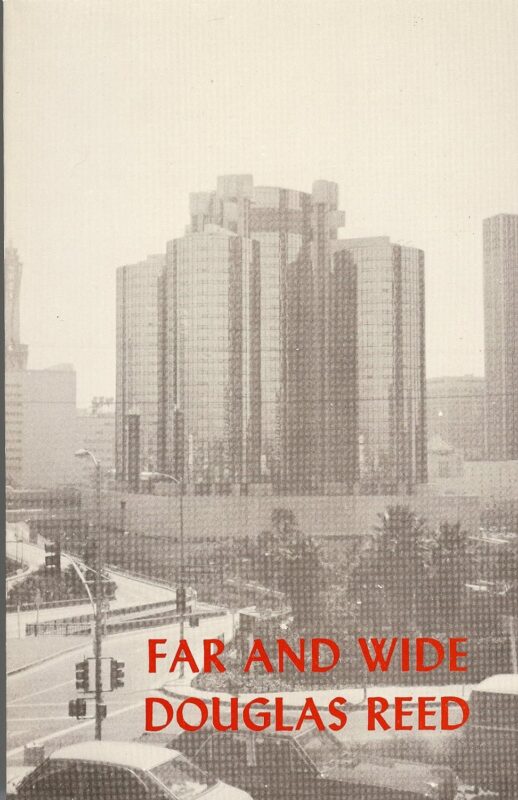
Far and Wide by Douglas Reed documents a journey across the United States during the mid-twentieth century, as Reed scrutinizes the forces that shape nations and the destinies of peoples. Reed’s vantage as a political explorer and journalist catalyzes an inquiry into the shifting epicenters of power, the visible and invisible architects of historical change, and the structural mechanisms of modern society.
America’s Gateways: Arrival and the Regional Tapestry
Reed enters America through Mobile, Alabama, noting the city’s gradual emergence along a dun-colored river, its skyline punctuated by air-conditioned towers. The author recommends beginning in the South or New England to gain a foundational perspective before experiencing the dynamism of metropolitan centers. Alabama’s slow cadence, courteous forms of address, and the interplay of new technologies with older traditions construct the first impressions of a country in flux. Reed narrates encounters with the mechanical novelties of American life—automated hotel doors, playful elevators, and radio-equipped taxis—while observing the underlying continuity of regional customs and hierarchies.
In the Deep South, Reed observes a persistent civility that resists the brusqueness found under the influence of urban centers like New York. He immerses himself in the rhythms of daily life, cataloging the architecture, social codes, and racial distinctions that structure the Southern experience. Reed explores the neighborhoods of Mobile, distinguishing between the pleasant white homes of historical legacy, the quarters of poor whites, and the lively communities of African Americans, where cultural adaptation finds its most visible expression in hair, fashion, and social rituals.
The Color Problem and the Mechanics of Division
Reed frames the American “color problem” as a complex, multi-aspect phenomenon, beginning with the under-examined question of black aspiration, moving through regional disputes over policy, and culminating in the use of race as a tool for political leverage by distant parties. He examines the enduring legacy of Uncle Tom’s Cabin, tracing how literature, activism, and external agitation catalyze political movements and stoke conflicts that outlast their proximate causes.
Reed asserts that the American Civil War exemplifies the deliberate use of racial issues as instruments for consolidating power and dividing electorates. The deployment of “racial discrimination” as a campaign theme, he argues, functions as a wedge, designed to create political opportunities for emerging coalitions, rather than reflecting a genuine interest in emancipation or equality. Reed points to the realignment of parties and the evolving meaning of conservatism and progressivism in America, highlighting the shift of revolutionary forces between the Republican and Democratic parties according to strategic needs.
Southern Identity and Historical Memory
The author walks through the avenues of Southern towns, the white-pillared houses of former plantations enveloped by ancient trees and the silent grandeur of lawns without fences. Reed examines the lingering melancholy—a sense of suspended time and unresolved loss—that hangs over communities still marked by the Civil War’s devastation. He recounts the South’s struggle to recover autonomy and dignity after the trauma of Reconstruction, during which external political actors imposed radical policies and manipulated local populations.
Reed foregrounds the endurance of Southern culture in spite of repeated attempts at marginalization. He considers how the South’s demographic composition—predominantly Anglo-Saxon, Scots-Irish, and Celtic—preserves distinct traditions, martial values, and resistance to imposed ideologies. Southern participation in national conflicts demonstrates both loyalty and the survival of regional martial traditions, which Reed presents as counterpoints to political attempts at transformation from without.
Structures of Political Manipulation
Reed identifies a pattern of revolutionary intervention, where powerful actors capitalize on moments of national vulnerability to install new regimes and enforce social engineering. He analyzes the tactics employed during Reconstruction, including the use of “carpet-baggers,” the manipulation of African American populations through promises and superstition, and the suspension of legal safeguards in favor of expedient revolutionary justice. These interventions, Reed claims, reveal the workings of an organized force, trained to exploit chaos for structural change.
The parallel between postbellum America and postwar Europe forms a central thesis in Reed’s argument. He traces the recurrence of dictatorship, show trials, and orchestrated violence in both periods, suggesting the presence of a permanent revolutionary cadre that acts as the unseen engine of transformation. Reed highlights the consistency with which new power brokers arise, displace native elites, and pursue broader ambitions that extend beyond national boundaries.
Economic Power and Global Ambition
Reed examines the emergence of the United States as a new center of financial and manufacturing power. He contends that the balance of global influence has shifted decisively from Europe to America, rendering the United States the chief arena for contests over world governance. Reed warns of the convergence of economic interests and revolutionary movements in the shaping of international institutions.
He interprets the establishment of the League of Nations and the United Nations as iterations of a single project—a supranational “World State” intended to subordinate national sovereignties to global authorities. Reed describes the interplay between financial elites and ideological agitators as the hammer and anvil of this transformation, their coordinated efforts driving states toward a condition of managed servitude. He quotes Theodor Herzl’s acknowledgment of the “power of our purse” and the “terrible power of the revolutionary proletariat,” asserting that the true logic of political change in the modern era rests upon these twin levers.
Public Figures and the Veil of Power
Reed interrogates the nature of visible leadership, observing that the decisions that shape nations rarely emanate from elected or public figures. He cites examples from the Roosevelt administration, where momentous policies—including the division of Germany—originated in unnamed relationships and unrecorded influences. Reed contends that, in vital matters, presidents and ministers act as proxies for interests that remain obscure, while the real architects of policy operate from behind the scenes.
The mechanism by which these hidden rulers exert control appears in the management of wars and crises. Reed asserts that the primary objective of global conflicts lies not in the goals announced to the public, but in the furtherance of undisclosed designs. He draws on Roosevelt’s legal advisers’ assurances that military operations can be shaped to serve any executive purpose, suggesting a method by which the engines of state become instruments of a broader, concealed strategy.
Social Change, Urbanization, and Modernity
As Reed advances through America’s cities and regions, he notes the growing influence of urbanization, commerce, and standardized culture. He contrasts the material prosperity, technological convenience, and social dynamism of the mid-century with the persistence of historical memory and regional identity. Main Street emerges as the organizing principle of American life—a commercial thoroughfare, a center for civic ritual, and a barometer of changing norms.
The influx of new populations, the erosion of traditional boundaries, and the mass adoption of new fashions and forms of entertainment shape the texture of everyday life. Reed describes the rapid turnover in social customs, the speed at which styles and attitudes circulate, and the pressures exerted by media and commerce to direct collective behavior. The centrality of the automobile, the prevalence of drive-in theaters and diners, and the dominance of retail culture underscore the scale and scope of transformation.
The Architecture of Conflict: The American Civil War and Beyond
Reed’s account of the Civil War emphasizes the instrumental use of division as a tool for securing control over the polity. He asserts that the defeat of the rural South and the triumph of the industrial North laid the groundwork for the transfer of authority to new, less rooted populations. The postwar opening of immigration from Eastern Europe, the rise of new coalitions, and the construction of the United Nations building in New York function as visible markers of the new order.
The aftermath of the Civil War, Reed argues, saw the installation of revolutionary methods: the stripping of political rights from vanquished groups, the enfranchisement of others to serve strategic goals, and the use of violence and intimidation to enforce compliance. He presents the Ku-Klux-Klan as a resistance movement, designed to counter external manipulation, and draws attention to the ways in which fear of future resistance informs the rhetoric and actions of contemporary political actors.
Reed’s historical inquiry expands outward to include global analogies. He connects the American experience of imposed revolution to the fate of postwar Eastern Europe, where foreign armies and imported political cadres engineered social and political transformation. He points to the recurrence of mock parliaments, the celebration of disorder, and the moral collapse of institutions as warning signs of deep structural intervention.
Resilience and the Prospects for Renewal
Reed discovers sources of resilience within the American character and landscape. He describes the capacity for recovery and adaptation, the continued vitality of certain traditions, and the presence of communal forms that nurture resistance to external control. He listens to the music of African American spirituals, witnessing their power to bridge divides and express the unyielding spirit of a people adapting to new worlds.
The persistence of local autonomy, family bonds, and religious faith, according to Reed, serves as the ground for any renewal. He observes how, within homes marked by the losses of war and social upheaval, memory persists as both a burden and a source of strength. The interplay of sorrow and hope, loss and endurance, marks the lived experience of those who inhabit the spaces between past and future.
A World at the Crossroads
The logic of Reed’s inquiry converges on a final question: who will shape the outcome as the world stands at the threshold of new arrangements? The transfer of power to America, the proliferation of supranational institutions, and the consolidation of influence by hidden actors combine to produce a moment of maximum tension. Reed suggests that the next moves—whether toward servitude or renewal—will decide the fate of nations for generations.
The book’s synthesis of travel, historical analysis, and political commentary renders it both a chronicle of a particular journey and a guide to understanding the deeper mechanisms at work in shaping societies. Reed’s vision presses the reader to consider the structural dynamics of power, the recurrence of revolutionary tactics, and the possibility of resistance through the recovery of memory and the assertion of identity. Who steers the course of history, and to what destination? The world, Reed contends, waits for the answer.
