Friendly Fascism: The New Face of Power in America
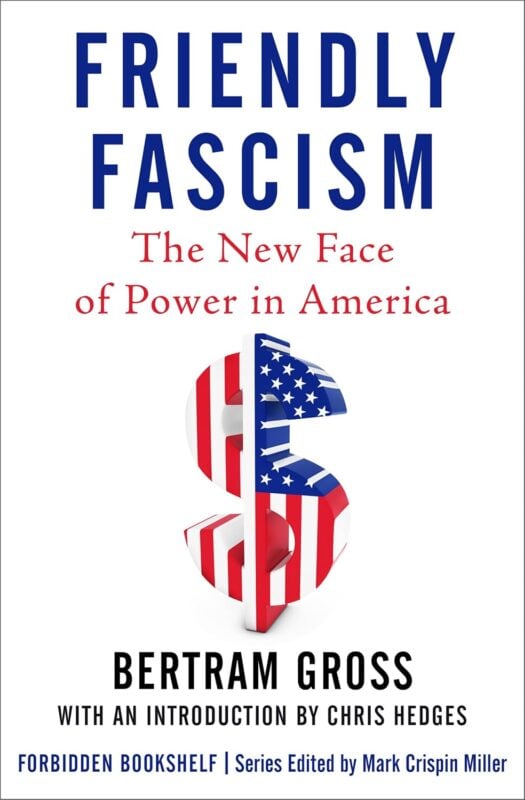
Friendly Fascism: The New Face of Power in America by Bertram Gross investigates the transformation of liberal democracies into systems dominated by corporate power through subtle and seductive authoritarian mechanisms.
The Architecture of Friendly Fascism
Gross identifies the convergence of corporate wealth, bureaucratic governance, and mass media as the structural triad driving a new form of control. Power centralizes within a managerial elite, veiled in benevolence and nationalism. This elite does not rely on spectacle or charismatic dictatorship. It institutionalizes control through legislation, surveillance, and economic dependency, crafting a political order where repression feels like safety.
Within this framework, economic policy becomes a tool of stratification. Regulatory systems favor monopolies and suppress dissent through market manipulation rather than overt coercion. Political campaigns, funded by wealth-concentrated interests, transform public discourse into branding strategies. Voters engage with images, not policies. Legislation passes in the shadows, buried beneath legalese and emergency procedures.
This transformation redefines fascism. The new face bears a smile, speaks the language of democracy, and invokes freedom while narrowing its definition. The old symbols remain—flags, elections, patriotic hymns—but their meaning shifts under bureaucratic hands that shape perception.
Corporate-Government Syzygy
Gross uses the term syzygy to describe the alignment of Big Business and Big Government without loss of identity. These entities do not merge. They synchronize. The partnership generates systemic outcomes: deregulation cloaked in entrepreneurial rhetoric, tax cuts labeled as economic stimulus, privatization framed as efficiency.
This alignment fosters what Gross calls the Big Business-Big Government partnership. Policy serves capital accumulation. Military spending drives corporate profit. Subsidies disguise as growth strategies. Environmental protections erode behind the veil of innovation. Public institutions, repurposed to serve elite interests, operate under the pretense of public service.
Under this structure, crises serve opportunity. Recession justifies austerity. War rationalizes surveillance. Public fear becomes the resource by which authoritarian measures gain acceptance. Control migrates from the visible to the ambient. Fascism no longer marches; it murmurs.
The Role of Media and Mind Management
Mass communication technologies function as the infrastructure of modern authoritarianism. Television, radio, and digital platforms do not only inform—they program responses. Gross demonstrates how the media environment curates reality. Corporate narratives embed into public consciousness through repetition, framing, and omission.
Polling replaces deliberation. Opinion becomes a product of statistical manipulation. Political dialogue reduces to slogans. Issues vanish beneath culture wars designed to absorb public energy into symbolic battles. The structure does not censor—it saturates. Distraction replaces engagement. Entertainment displaces inquiry.
The symbolic environment shapes not only what people know but how they know. Educational systems mirror this design. Curricula emphasize conformity. Critical faculties yield to vocational outcomes. The mind becomes a terrain of governance.
Surveillance as Systemic Norm
Surveillance does not declare itself through totalitarian imagery. It embeds within the normal routines of citizenship. Data collection becomes a byproduct of convenience. Monitoring devices masquerade as tools of productivity. Algorithms predict behavior, assign risk, and determine access to services.
The state no longer needs to watch everyone. Systems do it automatically. Corporate partnerships with intelligence agencies consolidate informational power. Metadata replaces warrants. Dossiers update in real time. Privacy disintegrates beneath the seamless interface of security and commerce.
Gross observes how the logic of monitoring escalates toward a system that knows its citizens better than they know themselves. Control does not require enforcement when submission becomes internalized.
Structural Myths and Cultural Management
Authoritarianism thrives on stories. The American Dream persists as a tale of opportunity while economic mobility collapses. Patriotism invokes unity as institutions dissolve community. Religious symbolism reaffirms the moral authority of systems that disempower.
These myths function as management tools. They distribute emotional energy away from critique and toward ritual. Political participation shrinks to performance. Consumer identity replaces civic agency. Compliance cloaks itself in gratitude.
Education, media, and corporate messaging reinforce these myths through consistent affirmation. Disbelief becomes deviance. Alternative narratives struggle to circulate. Friendly fascism requires no secret police when the cultural atmosphere ensures consensus.
Economic Logic of Domination
The economic dimension of Gross’s argument shows how policy decisions enforce stratification. Tax structures reward capital accumulation. Wage suppression combines with debt expansion to maintain consumer dependence. Social programs, reframed as entitlements, face incremental erosion.
Inflation, unemployment, and recession become engineered outcomes. These tools manage expectations, discipline labor, and reinforce capital dominance. Regulation appears neutral but functions as selective empowerment.
Market logics apply to every dimension of life. Healthcare becomes a commodity. Education becomes an investment. Housing becomes a hedge. The citizen transforms into a risk-bearing unit within a system of transactional survival.
Pathways to System Acceptance
Gross analyzes the incentives that maintain loyalty to the system. Professionalism provides identity. Consumption offers dopamine relief. Managed entertainment occupies leisure. Fear of downward mobility disciplines behavior.
People accept control because it feels like stability. They adapt not because they understand, but because they must. Conditional benefactions—insurance, credit, subsidies—create structures of dependence. The system grants comfort in exchange for consent.
This comfort masks the costs. Ecological degradation, social isolation, and mental health deterioration persist beneath the surface. The logic of the system prevents recognition of these effects as political.
The Ladder of Violence
The architecture of repression does not begin with tanks. It begins with job insecurity, data profiling, and police presence. Gross traces how coercion escalates. It begins with marginalization, moves to surveillance, escalates to suppression, and culminates in strategic violence.
This violence does not require mass mobilization. It operates through selective enforcement. Protesters face arrests. Journalists encounter discrediting. Whistleblowers face exile. The broader population sees the consequence and adjusts behavior.
Systems train the public to self-regulate. The visible fist remains hidden unless resistance emerges. Even then, response is targeted and media-managed.
Resistance and the Democratic Countercurrent
Gross does not leave the reader without hope. He identifies a countercurrent—a long arc of democratic aspiration. This current flows through community organizing, labor movements, civil rights struggles, and decentralized activism.
Democracy manifests not through institutional restoration but through grassroots redefinition. People form networks of mutual aid, localized decision-making, and creative resistance. These formations do not require permission. They emerge through necessity.
The logic of true democracy, as Gross frames it, seeks not to seize power but to distribute it. It transforms relationships, structures, and values. It grows beneath the systems of control, nourished by dignity and shared purpose.
Conclusion: The Present as Outcome
Gross saw patterns emerging that now define the present. Corporate power operates through law, media, and infrastructure. Authoritarian mechanisms integrate into normalcy. Repression disguises itself in service language.
Friendly fascism depends on acquiescence. Its success hinges on invisibility. Power circulates through systems that feel impersonal yet shape every aspect of life. The challenge lies not in rejecting symbols but in understanding systems.
Gross calls for vigilance, organization, and a reimagination of democracy that transcends institutional nostalgia. The path forward does not restore a past. It invents a future. In doing so, it reclaims power not as dominance but as collective capacity.