God, History, and Dialectic, Volume IV: The Apparatus
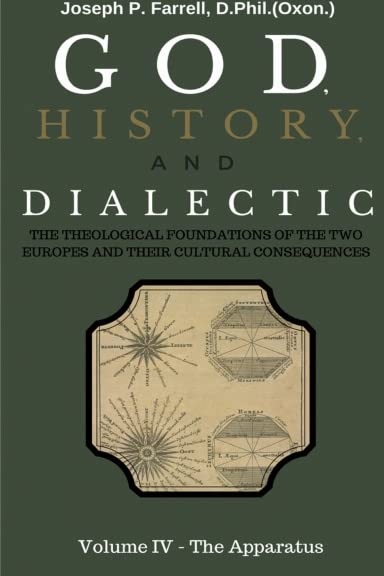
God, History & Dialectic. Vol 4 by Joseph P. Farrell probes the metaphysical architecture underlying theological divergence in Christian Europe, focusing on how dogmatic frameworks reshaped cultures, political institutions, and philosophical assumptions. The book structures a comprehensive critique of the Western theological tradition, isolating its Augustinian foundation and tracing its epistemological consequences through to the rise of secularism, nominalism, and rationalist metaphysics.
The Two Europes and Their Theological Grammar
Joseph Farrell anchors his argument in a structural distinction between what he names the First and Second Europes. The First Europe centers on the patristic ordo theologiae, which begins with the revealed Persons of the Trinity and their operations in salvation history. The Second Europe adopts an inverted sequence. It begins with divine essence, proceeds to attributes, and ends with the persons. This reordering yields a theology abstracted from history, with metaphysical simplicity and logical necessity elevated over the relational dynamism of divine revelation. From this inversion, Farrell derives the core theological pathology of the West.
Augustinian Dialectic and the Problem of Essence
At the center of the Second Europe’s theology stands the figure of Augustine, whose conceptual reconfiguration of God shifted theological focus from the hypostatic relationships of Father, Son, and Spirit to the essential unity of divine being. This move instituted a metaphysical grammar built on absolute simplicity. It displaced the participatory ontology of the Greek Fathers and replaced it with a logic-driven epistemology that privileged inference over mystery. What arises from this shift is not merely a new doctrine but a new mode of knowing. Theology becomes analysis of divine substance rather than engagement with divine persons.
Dogma as Cultural Formation
When metaphysical abstraction becomes the engine of theological reflection, liturgy and culture undergo structural modification. Farrell asserts that the West’s liturgical and doctrinal evolution follows from this restructured theological grammar. The Latin Church, shaped by a God-concept derived from essence and power, codifies its authority in juridical and hierarchical terms. The papacy transforms from a local episcopal office into a metaphysical principle—one that mirrors the Augustinian monad. This doctrinal centralization produces cultural centralization. Authority flows from above, down fixed lines, regulated by rational extrapolation rather than sacramental intuition.
Recapitulation and the Hypostatic Vision
Farrell returns repeatedly to the theme of recapitulation, rooted in the theology of Irenaeus and Maximus the Confessor. In the patristic order, Christ is the archetype who unifies creation through His divine and human natures. His incarnation enfleshes rational principles (logoi) embedded in creation and discloses their telos. In this structure, economy precedes essence. Revelation discloses ontology. Dogma flows from participation in divine energies, not from abstract formulations. This model resists reduction to dialectic because it affirms that persons—not propositions—manifest truth.
Gnosticism and the Logic of Departure
Farrell draws a direct line between the Augustinian inversion and the theological strategies of Gnosticism. Both systems, he argues, rely on extra-historical knowledge and a rejection of the participatory cosmos. Gnosticism abstracts salvation from the world by denying the goodness of creation; Augustinianism, while affirming creation’s goodness, restricts divine activity to univocal acts of will, producing the same effect: separation. Theology becomes a system of concepts to be grasped, rather than mysteries to be entered. This logic necessitates perpetual reformation, since the dialectical engine never rests.
The Law of the Chameleon Godhead
Farrell introduces the concept of the Chameleon Godhead to name the fluidity of theological identity within the West’s Augustinian heritage. Once metaphysics supersedes history, the content of theology becomes adaptable. Ecclesial forms morph to accommodate philosophical shifts—from scholasticism to Cartesianism to Kantianism. What holds the center is not doctrinal stability but structural mutability. The Godhead becomes conceptually elastic, a mirror for human categories. In this model, ecclesial identity reconfigures itself with intellectual fashion, a pattern Farrell traces through the Counter-Reformation, Enlightenment, and Ecumenical movements.
Historical Method as Theological Crisis
The historiographical implications of this transformation are substantial. Farrell critiques Western historical consciousness as a derivative of its theological method. The West constructs a linear, progressive narrative of development—a theology of becoming. This view legitimizes doctrinal innovation as unfolding insight. In contrast, the Eastern tradition grounds history in typology and liturgical recurrence. It views time not as progression toward abstraction but as cyclical return to foundational realities. Theology becomes anamnesis, not speculation. Farrell argues that the Western method displaces this sacred memory with critical distance.
The Synodikon and the Resistance to Pagan Reason
In his analysis of the Synodikon of Orthodoxy, Farrell finds a liturgical declaration of the incompatibility between Orthodox Christianity and pagan metaphysics. The Synodikon anathematizes those who attempt to blend philosophical categories—such as soul transmigration or material cosmology—with Christian dogma. Farrell reads this act as a definitive statement of epistemological boundary. Orthodoxy defines participation not through philosophical similarity but through liturgical union. The attempt to deduce divine truth from abstract reasoning constitutes a fall into the dialectic. Theology must remain rooted in revealed personhood.
Science and the Failure of Theological Integration
In Farrell’s schema, the scientific revolution emerges as a direct consequence of theological abstraction. Once theology places essence before person, the cosmos becomes a mechanical system of objects governed by efficient causes. The Logos ceases to be the rational principle embedded in creation and becomes a distant architect. Knowledge fragments. The integration of metaphysics, cosmology, and anthropology collapses. Farrell sees in this shift the birth of scientific positivism and the alienation of modern man. A theology of hypostatic presence cannot produce mechanistic science; it yields sacramental cosmology.
Modernity and the Pattern of Apostasy
The culmination of Farrell’s argument lands on the ecumenical movement and its theological accommodations. He contends that ecumenism, shaped by the West’s dialectical structures, pursues unity through synthesis rather than communion. The pattern of apostasy does not arise from moral failure but from structural inversion. It originates in the grammar of essence-before-person. Ecumenical theology assumes that doctrinal convergence occurs through reduction to shared principles, which inevitably displace the particularities of personhood, tradition, and liturgy. True unity, in Farrell’s vision, requires return to the patristic order.
A Theological Call to Structural Recovery
Farrell closes his exploration with a call to reassert the patristic ordo theologiae as the only stable foundation for Christian theology, culture, and anthropology. Structural recovery means reordering theological discourse around the Trinity, interpreting history through recapitulation, and discerning doctrinal continuity through liturgical participation. The West’s intellectual achievements—however brilliant—fail to produce theological integration because they proceed from inverted premises. Structural fidelity, not conceptual innovation, defines theological truth.
The integrity of Christian theology depends on the structure of its foundations. God, History & Dialectic. Vol 4 asserts that dogmatic sequence determines doctrinal content. Revelation cannot be retrieved through dialectical reasoning. It must be received through the hypostatic presence of Christ, remembered through liturgy, and enacted in culture. Only this structure sustains the Church’s claim to speak of God.