Gyn/Ecology: The Metaethics of Radical Feminism
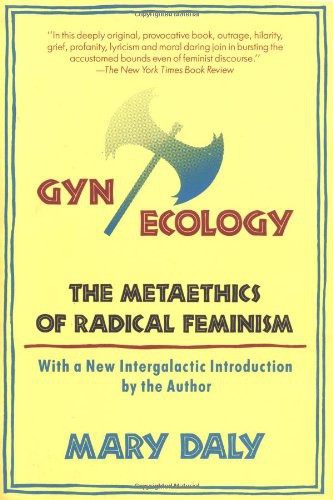
Gyn/Ecology: The Metaethics of Radical Feminism by Mary Daly detonates the boundaries of feminist thought by asserting a relentless interrogation of patriarchal systems. The author navigates the depths of history, myth, religion, and science to reveal a latticework of oppression woven through the lives of women. Daly’s text does not linger on the periphery; it plunges directly into the labyrinth of patriarchal reality, slashing through illusions and exposing the structures that sustain the domination of women. Her language spins, weaves, and forges connections, creating a work that seizes the reader’s intellect and imagination.
Intergalactic Voyaging and the Origin of Gyn/Ecology
Mary Daly launches the narrative from a decisive personal and historical moment—1975—a year that splits open her intellectual universe and catalyzes a transformation in both her own scholarship and the wider feminist movement. The genesis of the book grows from both personal confrontation with institutional patriarchy and the collective surge of radical feminist energy. The confluence of Daly’s denied academic promotion, her immersion in feminist activism, and the widespread backlash against women’s liberation movements pushes her to write with “Spinning Integrity,” as she describes the creative, whirling energy driving her work.
Context shapes vision. Daly roots her approach in lived experience: her rejection by Boston College becomes a microcosm of the wider purging of radical feminists from academia. Her refusal to retreat or dilute her scholarship powers the development of a book that claims new intellectual territory for feminist analysis. She gathers the raw material of outrage, solidarity, and creative longing, shaping them into a philosophical tool—the Labrys—that cleaves through patriarchal myth and restores the possibility of female-centric meaning.
The Watershed of Radical Feminism
Daly’s methodology asserts that the personal is not merely political; it is cosmic. She tracks the movement from the “foreground”—the visible, constructed reality of patriarchy—to the “Background,” a deeper, often submerged stratum of women’s knowledge, solidarity, and being. The feminist movement in the mid-1970s, which some declared dead, instead vibrates with subterranean energy, forging networks, art, music, and ideas that spiral out of institutional control. Sagaris, the feminist summer school, and the growing women’s network signal a proliferation of new forms of consciousness and communal power.
Creative rage defines the propulsion of this period. Daly identifies rage as a generative force—a broom that sweeps away debris, a fire that fuels invention, a staircase leading to liberated thought. She characterizes her writing process as one of relentless shape-shifting, condensation, and discovery. Through etymological forays, poetic incantations, and theoretical precision, Daly refuses the inertia of patriarchal language, instead forging new words and images that name women’s experiences and open routes out of oppression.
Piracy and the Smuggling of Knowledge
Mary Daly frames her intellectual project as piracy—an act of righteous plunder, reclamation, and transformation. She seizes concepts, myths, and symbols stolen or distorted by patriarchal culture, restoring their liberating potential to women. The crafting of philosophical theory becomes witchcraft, an intentional reversal of the vessel motif, with women guiding their own crafts rather than serving as passive containers for male narratives.
Daly’s scholarly training in medieval philosophy equips her for this subversive task. She learns the rules with precision, then breaks them to reveal the inner workings of patriarchal logic—reversal, erasure, particularization, universalization. Her language simultaneously decodes the enemy’s systems and invents a metapatriarchal vocabulary, unleashing the possibility of new myths, rituals, and practices.
Global Atrocities and the Sado-Ritual Syndrome
Gyn/Ecology launches an unflinching investigation of worldwide atrocities against women, connecting diverse practices such as Indian suttee, Chinese footbinding, African genital mutilation, European witch burnings, and American medical abuses. Daly defines these practices as interconnected manifestations of the Sado-Ritual Syndrome—a recurring pattern where patriarchal systems enact ritualized violence to maintain domination and erase female autonomy.
The book’s structure follows a mythic passage: from the deadly deception of patriarchal myths, through the violent fragmentation of women’s bodies and spirits, toward the possibility of exorcism, escape, and renewal. Daly confronts the reader with the horror of these atrocities, but her analysis spirals outward, insisting on the interconnectedness of oppression across time and geography. The depth and recurrence of these patterns demand a philosophical response equal to their scope and ferocity.
Foreground and Background: Reclaiming Reality
Central to Daly’s framework is the distinction between foreground and Background. The foreground operates as the surface-level reality constructed by patriarchy—a realm of control, repetition, and fragmentation. The Background exists as a reservoir of authentic female knowledge, connection, and power. Daly guides women on a metapatriarchal journey that requires breaking through the foreground’s deceptions, rediscovering suppressed histories, and assembling the fragments of identity into a coherent whole.
The act of Re-membering—piecing together erased narratives and experiences—emerges as a primary strategy for survival and liberation. Daly locates hope and transformation in the capacity to recall, retell, and share stories that have been stolen or silenced. This process exceeds therapeutic self-reflection; it constitutes an existential and political leap into free space, where women center their lives, relationships, and meanings.
Feminist Process as Living Verb
Mary Daly asserts that Gyn/Ecology itself functions as a verb—a living process rather than a static artifact. She writes to create movement, to catalyze ongoing transformation in those who encounter the text. The book’s “spinning” quality embodies its refusal to become a fixed idol or sacred text. Instead, Daly encourages women to use her work as a springboard for their own searches, questions, and creative acts.
The radical feminist process generates new connections. Sisterhood emerges as an affirmative, dynamic bond, rooted in shared struggle and the affirmation of freedom. Daly celebrates the diversity of women’s experiences, voices, and origins, recognizing the emergence of new forms of feminist art, ritual, and collective practice. This abundance does not mask conflict; rather, it insists that difference and dialogue are integral to genuine liberation.
Responses, Critique, and Feminist Solidarity
The book acknowledges critical responses, especially from women of color who challenge Daly’s scope and focus. She addresses Audre Lorde’s objections, clarifying her intent and the limits of her project. Daly frames Gyn/Ecology as an open book—a catalyst for conversation rather than a final word. She expresses regret for pain caused by omission, while reaffirming her commitment to a biophilic, inclusive bond among women resisting patriarchal oppression.
Bonnie Mann’s appendix grounds the book’s theoretical insights in the real-world experiences of battered women. Mann demonstrates how Gyn/Ecology provides a framework for women seeking to reconstruct their identities and meaning after surviving violence. The text’s themes and language equip survivors to identify the mechanisms of control, name their experiences, and reclaim agency.
Spinning, Weaving, and the Creation of New Worlds
Daly concludes with an invitation to “spiraling into the nineties,” urging women to embrace the challenge of cronehood, memory-bearing, and intergenerational knowledge. She names desperation as a potential gift, capable of producing a new cognitive minority who learn from past mistakes and drive forward the struggle for liberation. The act of taking charge of one’s craft, of choosing to move and create, becomes essential for collective survival.
Her metaphors of spinning and weaving emphasize the generative, world-building potential of feminist consciousness. As women assemble the fragments of suppressed histories, experiences, and myths, they generate a cosmic tapestry—one that reveals the deep interconnectedness of their struggle and the possibility of ecstasy, renewal, and transformation.
The Book’s Enduring Legacy
Gyn/Ecology by Mary Daly stands as a work of intellectual and spiritual audacity, refusing to accommodate the constraints of patriarchal thought. Its fusion of poetic language, rigorous analysis, and radical vision continues to provoke, challenge, and inspire. By insisting on new language, new myths, and new solidarities, Daly offers a model for feminist thought and action that prioritizes creation, courage, and collective remembering.
