Hegel and the Hermetic Tradition
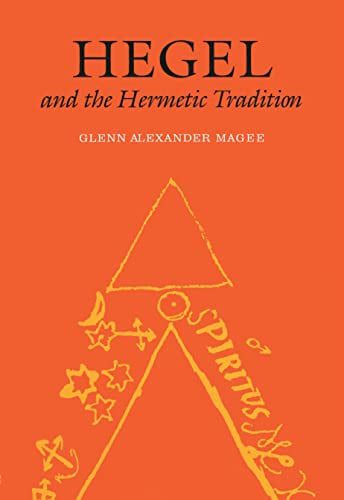
Hegel and the Hermetic Tradition by Glenn Alexander Magee traces the transmission of Hermetic and esoteric currents into the heart of German Idealism, embedding them within the architecture of Hegel’s metaphysics. Magee establishes Hegel’s formative engagement with Renaissance Hermeticism, Neoplatonism, Kabbalah, and early modern esoteric writers whose influence persists within his philosophical vocabulary and systematic ambition. The book asserts that Hegel’s intellectual development converges with key themes from the Hermetic tradition, such as the unity of opposites, the transformative power of spirit, and the aspiration toward gnosis. The result is a portrait of Hegel as a thinker whose legacy carries the energetic signature of Western esotericism into modern philosophy.
Hermetic Roots and the Architecture of Modern Philosophy
Magee begins by mapping the contours of the Hermetic tradition: a lineage drawing together the Corpus Hermeticum, alchemical writings, the thought of Marsilio Ficino and Giovanni Pico della Mirandola, and later, the German mystics Jakob Böhme and Paracelsus. This tradition seeks the divine in all things, pursuing the unity of microcosm and macrocosm through spiritual ascent and the transformation of consciousness. Hegel inherits a world thick with these resonances, and Magee demonstrates how his early education in Pietist circles at Tübingen introduced him to the mystical, theosophical, and Hermetic literature that later reemerges in his mature work.
The Hermetic tradition shapes its adepts through initiatory movement: descent into division, followed by ascent through reconciliation and higher synthesis. Magee finds this structure alive within Hegel’s dialectical method, where spirit traverses alienation, undergoes labor and death, and returns to itself enriched and transformed. Hegel absorbs this initiatory pattern, translating the Hermetic ascent into his logic of becoming.
The Unity of Opposites: Dialectic as Hermetic Principle
Hegel’s dialectic manifests the Hermetic law of polarity—the assertion that reality unfolds through the tension and reconciliation of opposites. Magee traces how Hermetic thinkers before Hegel developed concepts like coincidentia oppositorum (the unity of opposites), the transformative conjunction of masculine and feminine, and the transmutation of base matter into spiritual gold. Hegel’s Aufhebung, the movement through thesis, antithesis, and synthesis, animates this Hermetic dynamic within the realm of reason. The dialectic achieves a reconciliation that does not erase difference but preserves it within a higher unity, echoing Hermetic and alchemical accounts of spiritual unification.
Spirit and the Transformation of Matter
Magee anchors Hegel’s speculative system in the Hermetic conviction that spirit permeates matter, and matter harbors latent divinity. The Phenomenology of Spirit dramatizes a spiritual journey in which the subject moves from immediacy and alienation toward absolute knowing. This journey reflects the Hermetic quest for gnosis—the direct, transformative knowledge of the divine. Magee’s reading establishes that Hegel’s Absolute is not a static concept but a living process of manifestation, self-alienation, and return, charged with the dynamism of Hermetic cosmology.
The Role of Alchemy and Esoteric Christianity
Alchemy, with its language of transmutation and ascent, suffuses Hegel’s understanding of historical and spiritual development. Magee reveals how Hegel appropriates alchemical motifs: the darkness of the prima materia, the fire of purification, the emergence of the philosopher’s stone as the realized union of opposites. Hegel’s system functions as a kind of philosophical alchemy, recasting transformation and redemption as rational and historical processes. In his Lectures on the Philosophy of Religion, Hegel develops an esoteric Christianity that mirrors Hermetic soteriology, locating the divine within human consciousness and history rather than a transcendent beyond.
Magee explores the persistent motif of the “death of God,” both as a Hermetic motif of dissolution and as a drama within Hegel’s system. Spirit must undergo negation and finitude—experiencing alienation, suffering, and death—before it can resurrect itself at a higher level. The dialectical process of death and rebirth mirrors Hermetic and Christian mysteries, enacting the perpetual return of divinity from the depths of matter and finitude.
Kabbalah, Neoplatonism, and the World Soul
Magee uncovers the influence of Jewish Kabbalistic sources and Christian Kabbalah on Hegel’s metaphysics. Kabbalah teaches the emanation of the divine into creation, the shattering and repair of the vessels, and the ascent of soul toward union with the Godhead. These themes find resonance in Hegel’s conception of alienation and reconciliation, fragmentation and return. Neoplatonic doctrines of the World Soul and the procession of the One into multiplicity provide another crucial thread. Hegel’s Absolute traverses the same arc of self-manifestation, descent into division, and eventual reintegration.
Magee demonstrates that Hegel draws on these traditions not as a mere borrower of symbols, but as a system-builder who retools their vocabulary for philosophical ends. Hegel’s use of the “Idea” and “Spirit” unfolds through Neoplatonic and Hermetic frameworks, infusing his logic with the energy of ancient metaphysical drama.
The Initiatory Structure of Hegel’s System
The Hegelian system replicates the Hermetic pattern of initiation. In the Science of Logic, pure being negates itself into nothingness, generating becoming and mediation. In the Philosophy of Nature, spirit descends into the world, confronting finitude, death, and labor. In the Philosophy of Spirit, consciousness rediscovers itself, overcoming alienation through the labor of culture, religion, and philosophy. The final return, in which Absolute Knowing embraces both alienation and reconciliation, recapitulates the Hermetic ascent from matter to spirit, from ignorance to gnosis.
Magee insists that this structure does not arise from accidental parallels but reflects the historical and intellectual currents feeding into Hegel’s work. The esoteric lineage that streams from the Renaissance Hermetica into German Idealism provides the conceptual machinery for Hegel’s dialectical ascent. The book unfolds as a genealogy of ideas, showing how initiatory drama, spiritual alchemy, and philosophical logic intertwine within Hegel’s project.
Modernity and the Hermetic Legacy
Hegel and the Hermetic Tradition intervenes in contemporary debates about the “rationality” of modern philosophy. Magee’s argument insists that the energies animating Hegel’s dialectic belong to the same family as Renaissance Hermeticism and early modern esotericism. The quest for self-knowledge, the urge to reconcile opposites, the belief in spiritual transformation—these Hermetic legacies fuel the engine of modern thought. Magee’s book reframes Hegel’s system as the culmination of a Western esoteric project, carried forward under the banner of philosophy.
What does this legacy mean for readers and thinkers today? Magee’s reconstruction makes clear that Hegel’s system carries the capacity for radical transformation. The labor of spirit, as Hegel conceives it, becomes a process of spiritual alchemy: consciousness traverses suffering and division, encounters the limits of its own finitude, and then recovers itself in a moment of unity. Modernity, in this reading, inherits a project of spiritual ascent and transmutation, embedded in the structures of philosophical reason.
The Challenge of Reading Hegel through Hermetic Eyes
Magee’s interpretation shifts the terrain of Hegel scholarship by restoring the place of esoteric traditions within the genealogy of ideas. Reading Hegel through Hermetic eyes requires rigorous historical and philosophical work: it means tracking textual references, analyzing allusions, and reconstructing networks of influence that have long receded from scholarly view. Magee’s method establishes the links between Hegel’s philosophy and earlier traditions with documentary specificity and conceptual clarity.
The book also addresses persistent questions about the nature of reason and the possibility of gnosis in modernity. If Hegel’s system encodes a Hermetic logic, what follows for our understanding of philosophical method, history, and the prospects for spiritual knowledge? Magee proposes that the dialectic preserves the possibility of transformation—of self and world—by keeping alive the Hermetic aspiration to unite opposites and to ascend from division into unity.
Reception and Impact in Hegel Studies
Hegel and the Hermetic Tradition has reshaped the reception of Hegel among scholars of philosophy, religion, and Western esotericism. Magee’s thesis opens new avenues for research into the transmission of esoteric ideas into the philosophical canon. By illuminating Hegel’s debts to Hermeticism, the book provides a model for reading modern philosophy as the site of converging spiritual and rational energies.
The impact of Magee’s work extends beyond Hegel studies. His reconstruction of the Hermetic tradition speaks to anyone seeking to understand the hidden currents beneath the surface of European thought. The book frames the modern quest for self-knowledge as a continuation of older projects of transformation, revealing how the logic of spirit can operate as a principle of historical change.
Hegel’s Continuing Relevance for Esoteric Philosophy
Magee’s analysis affirms the ongoing relevance of Hegel for those drawn to esoteric and Hermetic themes. Hegel’s dialectic provides a model for integrating polarities, embracing the labor of transformation, and pursuing gnosis within the structures of modern life. The system’s initiatory architecture—its movement through negation, division, and return—offers a template for thinking spiritual ascent and philosophical reason together.
Where does this leave contemporary readers? Magee’s study proposes that Hegel’s legacy depends on recognizing the Hermetic energies at work within his thought. The dialectic’s movement, the aspiration toward unity, the labor of spirit in history—all emerge as philosophical recastings of ancient Hermetic principles. Magee’s work invites renewed engagement with the esoteric roots of Western philosophy, urging readers to rediscover the initiatory force within the dialectic.
Conclusion: Toward a Hermetic Reading of Modern Philosophy
Hegel and the Hermetic Tradition establishes that the transformation at the heart of Hegel’s system derives from a living Hermetic heritage. Magee’s synthesis of intellectual history and philosophical analysis recovers the networks of influence that shape the contours of Hegel’s work. The book’s claims stand on documentary evidence and systematic reasoning, forging new links between the philosophical and the esoteric.
Magee’s achievement reframes Hegel’s system as a site of encounter between spirit and matter, division and unity, history and transcendence. By reading Hegel as the inheritor of Hermetic wisdom, Magee situates the dialectic at the heart of Western spiritual and philosophical ambition. The resulting synthesis offers a dynamic vision of transformation—both for philosophy and for the human spirit—charged with the energies of the Hermetic tradition.

