Hidden History, The Secret Origins of the First World War
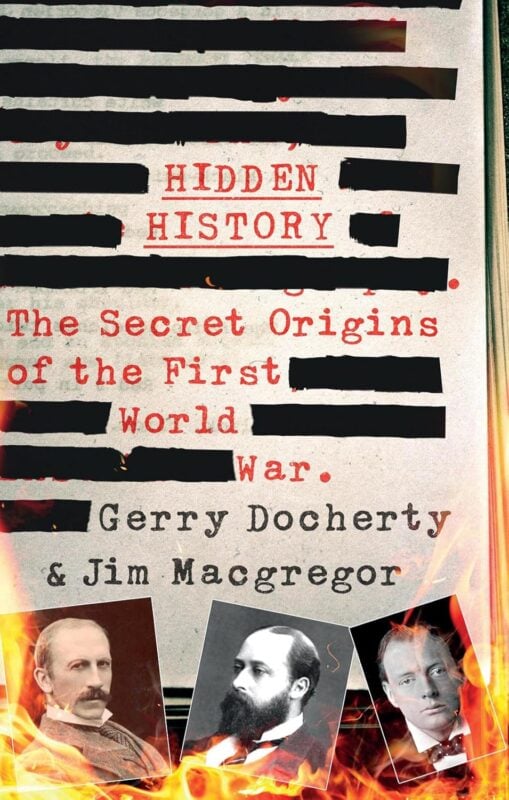
Hidden History: The Secret Origins of the First World War by Gerry Docherty and Jim Macgregor challenges the established narrative of World War I by asserting that a powerful cabal within the British elite orchestrated the war to eliminate Germany as a rival. This account begins not with Sarajevo or entangled alliances, but in London, 1891, where Cecil Rhodes and associates laid the foundations for a secret society aimed at extending British imperial control across the globe.
The Formation of the Secret Elite
In 1891, Cecil Rhodes, Lord Esher, William Stead, Alfred Milner, and Lord Rothschild launched a plan to control British foreign and colonial policy. They created a hierarchical secret society with an inner circle—the Society of the Elect—and a larger network of influencers, the Association of Helpers. Their aim extended beyond empire; they sought to dominate global governance through financial leverage, diplomatic infiltration, and strategic war. Rhodes funded this venture with vast wealth accumulated from diamond monopolies in South Africa, supported by the financial might of the Rothschild banking dynasty.
Imperial Ambition as Strategy
The authors trace the motivations of this cabal through their aggressive expansionist agenda in South Africa. Rhodes, backed by Rothschild capital, used the British South Africa Company to wage wars for control of mineral-rich territories. The 1895 Jameson Raid, a failed invasion of the Boer Republic of Transvaal, exposed this imperial blueprint. The Secret Elite sought to provoke conflict, manufacture consent through media narratives, and eliminate any resistance to British supremacy.
Germany: The Target of Suppression
Germany emerged as a threat not through military aggression, but industrial ascendancy. Its innovations in science, education, and infrastructure outpaced British capabilities. British elites feared economic eclipse. The authors argue that these fears drove a calculated strategy to provoke war under the guise of defense. The objective was containment through destruction. This strategy required diplomatic entrapment and the creation of a hostile international environment around Germany.
Control of Narrative and Institutions
The Secret Elite embedded their influence across the British establishment. They penetrated the Foreign Office, Colonial Office, War Office, and Committee of Imperial Defence. They controlled press coverage through allies like W.T. Stead and influenced academia by funding Rhodes Scholarships at Oxford. They selected historical records for official publication, omitting anything that contradicted the imposed narrative. They suppressed documents, shredded evidence, and rewrote archives. These actions shielded them from exposure and preserved their legacy.
The Schlieffen Plan Reframed
The authors reinterpret Germany’s military planning as a defensive necessity. Facing encirclement by France and Russia, and diplomatic isolation engineered by Britain, Germany implemented the Schlieffen Plan as a last-ditch effort to survive. Belgium’s neutrality, often cited as a moral justification for British entry into the war, was a pretext. Belgium had coordinated with Britain and France in ways that compromised its status. The invasion became inevitable within the trap set by the Secret Elite.
Sabotage of Peace Efforts
In the weeks before war, opportunities for mediation surfaced repeatedly. The Austro-Hungarian conflict with Serbia offered grounds for containment, yet British leaders under elite influence refused viable diplomatic options. The authors document how Edward Grey, the British Foreign Secretary, misled both the public and Parliament. His overtures for peace masked covert preparations for war. July 1914 became a calculated descent into conflict rather than a failure of diplomacy.
War as a Means to Imperial Reordering
By 1915, the war had achieved its initial aim. Germany was under siege, bleeding resources, and surrounded. At this point, the authors argue, the war could have ended through negotiation. Instead, the elite pushed for prolongation. War secured control over contested colonies, weakened Russia to prevent it from challenging British interests in Central Asia, and set the stage for a new American-led financial order under Anglo-American dominance.
Carroll Quigley’s Contribution
The historical framework of this thesis builds upon the work of Professor Carroll Quigley. In The Anglo-American Establishment and Tragedy and Hope, Quigley outlined how an interconnected Anglo-American elite shaped global events. Quigley had access to private records and testified to the existence of a coordinated network operating beyond democratic accountability. Docherty and Macgregor extend his thesis, uncovering more evidence and identifying additional actors.
The Architects of War
The book identifies key figures whose roles converge in a single mission: Alfred Milner, as South African High Commissioner, shaped imperial strategy with unrelenting focus. Lord Rothschild funded operations, controlled media messaging, and bound the aristocracy to the elite cause through financial entanglements. Arthur Balfour, future Prime Minister, served as a conduit between policy and secrecy. Lord Esher managed royal consent. The monarchy, particularly Edward VII, supported these designs and hosted private meetings to advance war planning.
Enduring Control Through Historical Fabrication
After the war, the elite sanitized its record. The Treaty of Versailles enshrined German guilt. Official war histories reinforced the lie. Academic institutions taught a version of history that mirrored elite interests. When dissident historians like Harry Elmer Barnes or Sidney Fay raised questions, mainstream scholars dismissed them. The state refused access to classified documents. When Quigley published damning accounts, his books were removed from circulation. The cover-up became institutional.
The Persistence of Structural Power
The authors argue that the legacy of this elite endures. Control over narratives, institutions, and international policy persists through modern think tanks, financial networks, and transatlantic alliances. The mechanisms that orchestrated World War I evolved but did not disappear. The convergence of banking, military planning, and media manipulation continues to shape global crises. Tracing the origins of this pattern requires recognizing how war served elite interests by engineering catastrophe under the veil of civilization.
Exposing the Hidden Architecture
The book dissects an architecture of deception. It exposes how rhetoric of freedom and defense masked an aggressive imperial agenda. It documents how official records were altered or destroyed. It names the men whose influence determined the fate of nations. It presents evidence from primary documents, eyewitness accounts, and suppressed archives. It builds a case that challenges the core assumptions of twentieth-century history.
Why Does This History Matter?
What decisions do elites make behind closed doors? Who controls the story nations tell themselves? How do wars begin—not in trenches, but in private clubs, banking offices, and university salons? The authors argue that truth must replace mythology. Understanding how power operated in 1914 equips readers to see its patterns in today’s crises. The cost of ignorance is measured in lives lost to manufactured conflict. The reward of knowledge lies in reclaiming agency from the architects of hidden history.