Hocus Pocus: The Magical Power of St. Peter
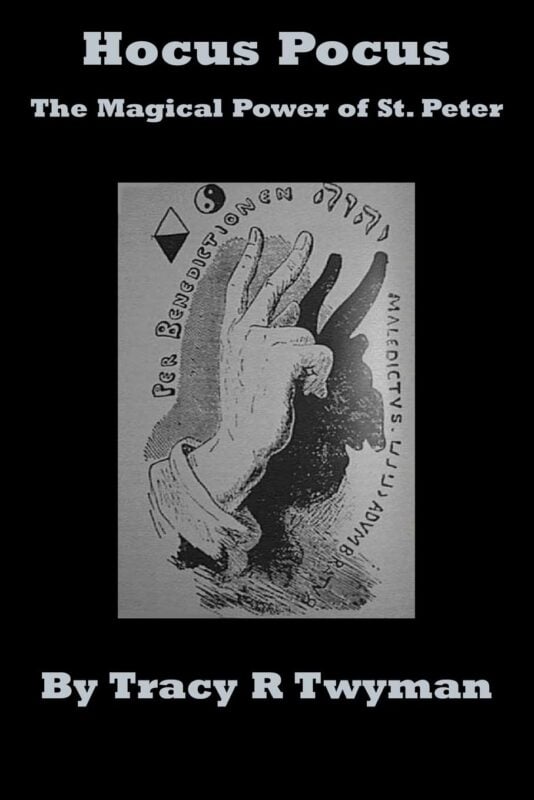
Hocus Pocus: The Magical Power of St. Peter by Tracy R. Twyman explores the intersection of Catholicism, magic, and occult tradition by investigating the mechanisms of spiritual power, ritual, and authority within the Church. Twyman presents a provocative history that situates the rise of Catholic power as the strategic outcome of ritual innovation, mythic appropriation, and the deliberate harnessing of magical currents.
The Transmission of Supernatural Power
Twyman anchors the narrative in the figure of Jesus, whose supernatural acts—healing, exorcising demons, raising the dead, multiplying food, transforming substances—derive from his mastery over a force described in the Gospels as “virtue.” She traces the Gospel language to accounts such as Luke 6:19 and Mark 5:30, where this virtue acts through Jesus both by his conscious command and seemingly independent agency. Jesus, after his baptism by John in the Jordan, receives the Holy Spirit, interpreted as the conduit of this supernatural power. Twyman connects this force to Judaic esoteric tradition, which ascribes miraculous authority to those who know and correctly utter the secret name of God. This esoteric knowledge acts as a magical technology, allowing its bearer to command divine agency for miraculous ends.
From Foundation Stone to Spiritual Empire
The Gospels present Jesus transferring this supernatural authority to Simon Peter, a move Twyman decodes as the institutional foundation of Catholic power. Jesus calls Peter the “rock” and gives him the keys of the kingdom of heaven, granting him the ability to “bind and loose” both on earth and in heaven. Twyman asserts that these keys signify the letters of the divine name, and thus, the power to command spiritual entities—angels, demons, and the souls of the dead. Islamic and Jewish legends concur on the theme that access to the divine name grants dominion over the spiritual world. Moses, Aaron, and Solomon exercise power through invocation of the name; Twyman places Peter and, through him, the Church in this magical lineage.
Mechanisms of Ritual Power
Twyman identifies the Mass and the ritual of the Eucharist as the core technologies by which Catholic priests channel this spiritual force. She traces the etymology of “Mass” to the Mithraic “mizd,” a ritual bread consumed alongside wine in ceremonies commemorating the god Mithras’s ascent. The physical similarity between Mithraic bread and the Catholic Communion wafer points to intentional continuity. Catholic priests, by virtue of ordination, possess the power to invoke the Holy Spirit into bread and wine, effectuating the transubstantiation that transforms them into the body and blood of Christ. The priest thereby becomes a magician, summoning a divine presence into matter, echoing ancient rites that invoked gods or spirits into sacrificial food or sacred vessels.
Twyman frames the Eucharist as both sacrifice and theurgical action, paralleling practices from paganism and witchcraft. The invocation of a spirit into a vessel, the subsequent consumption of that vessel, and the resultant internalization of spiritual power recur across magical traditions. The author draws attention to the ancient legend of the genie in the lamp as an archetype: the spirit’s agency is bound and directed by ritual command. The Catholic doctrine of transubstantiation, far from a symbolic act, functions as a literal magical operation in the author’s reading.
Magic, Heresy, and the Black Mass
Twyman catalogs the persistence of magical and occult elements within Church history, focusing on both sanctioned and heretical practices. The Church’s history contains stories of priests performing masses intended to compel divine or demonic action—invocations for rain, healing, or cursing an enemy. The Mass of Saint Secaire, described by anthropologist James Frazer, functions as a ritual death curse, involving inversion and perversion of the standard liturgy. The Black Mass, performed by renegade priests or those acting for political patrons such as Catherine de Medici and La Voison, operates as an explicit act of sacrilegious magic, employing human sacrifice, sexual rites, and blasphemous inversion of the Mass to force spiritual outcomes. Twyman notes that the Church, through apostolic succession, confers spiritual authority that can be wielded for both blessing and malediction, depending on the intentions of the practitioner.
Institutionalizing Spiritual Power: The Pyramid Scheme of Grace
The Church, Twyman asserts, constructs its spiritual authority by harnessing, multiplying, and channeling magical currents. She introduces the concept of the spiritual pyramid scheme: the priesthood draws power from its founder, Peter, and by extension, from Christ. The laity offers faith, ritual participation, prayer, and tithes; these energies channel upward through the hierarchy, multiplying at each stage and converging at the apex—the Pope—before being redirected downward as blessings, absolution, and intercession. This structure mirrors the organization of magical orders and secret societies, which also distribute spiritual authority through initiation, lineage, and ritual participation.
Twyman claims that the Catholic system incorporates the spiritual capital of conquered religions. As the Roman Empire spread, it absorbed and rebranded local deities, rituals, and feast days. The Church repeats this method by transforming pagan gods into saints, replacing pagan shrines with cathedrals, and recasting ancient myths as Christian narrative. Saints, Twyman notes, function as intercessors with specific spheres of influence, mapped closely to the domains of their pagan antecedents. The veneration of relics—bones, garments, objects associated with saints—preserves the ancient magical practice of housing spiritual power in physical tokens.
Ritual, Relics, and Necromancy
The deployment of relics within Catholic ritual deepens the parallel to necromantic and magical traditions. Churches build altars over relics, believing the sanctity and power of the saint permeates the structure and congregation. Twyman identifies this as a form of spiritual technology, intended to anchor the presence of the dead within sacred space. The veneration of relics, she argues, echoes the foundation sacrifices and ancestor cults of earlier religions.
Twyman traces the evolution of Catholic prayer and devotion, such as the rosary, to ancient practices of repetitive chanting and visualization. The Ave Maria, repeated in structured programs, invokes the Virgin Mary as intercessor and channels the devotee’s intention. The structure and symbolism of the rosary—beads representing prayers, clusters symbolizing petals of the rose, a flower associated with the mother goddess—exemplifies the fusion of pagan and Christian elements. The repetition of prayer acts as a magical chant, focusing intention and calling forth spiritual aid.
Saints, Statues, and Spiritual Multiplicity
Twyman argues that the Church’s approach to saints reflects a deliberate strategy to absorb and redirect pre-existing spiritual currents. Saints replace pagan gods, inherit their symbols, and occupy their feast days. The Church establishes the Communion of Saints as an interconnected network that unites the living, the dead in purgatory, and the canonized in heaven. The faithful participate in a circuit of prayer, intercession, and grace that spans the material and spiritual worlds. The veneration of statues, icons, and relics functions as an invocation of spiritual presence within physical matter.
Twyman posits that the Church’s network of saints acts as a reservoir of spiritual energy, accessible through prayer and ritual. She identifies the theological doctrine of “gratia capitis”—the grace of Christ the Head—as the mechanism by which this energy flows. The Church orchestrates a constant interchange between laity, clergy, saints, and the divine, optimizing the movement of spiritual power for institutional ends.
Occult Lineages and Hidden Currents
Twyman tracks the proliferation of occult lineages that claim descent from apostolic succession. Movements such as the Cathars, Gnostic groups, and secret societies—including the Knights Templar and the Ordo Templi Orientis—derive spiritual legitimacy from their connection to Peter and the early Church. Breakaway bishops and wandering ecclesiastical figures transmit ritual authority to new communities, expanding the network of magical currents.
The author describes a convergence between heresy, occultism, and institutional religion. Many accused witches and heretics stand within Catholic lineage, charged not for their rejection of Christianity but for alternative interpretations and magical practices. Twyman draws on the work of Margaret Murray and Nicholas de Vere, who interpret witchcraft as a survival of original Christian ritual and doctrine, suppressed by the institutional Church for political control.
Conspiracies, Secrets, and the Question of Authority
Twyman concludes with an exploration of Church conspiracies, secret archives, and the recurring accusation that Satanic forces infiltrate the highest echelons of Catholic authority. She references rumors of secret knowledge passed between Popes, grimoires attributed to popes such as Honorius III, and the accumulation of occult literature within the Vatican. The infiltration of secret societies, notably the Illuminati and Masonic lodges, frames a narrative in which the Church becomes the object of occult contestation—a coveted seat of magical power that attracts rivals, heretics, and aspirants.
The structure of Catholicism, Twyman claims, situates it as both the inheritor and the aggregator of global spiritual traditions. Its ambition is universal: to command the powers of heaven, earth, and the underworld, to bind and loose spirits, and to coordinate the worship and spiritual energy of humanity. The Church’s tactics of assimilation, ritual innovation, and magical administration give it unparalleled scope and potency. Twyman ends by raising the specter of corruption: If the seat of spiritual power falls under the sway of malign agents, the consequences extend to the fate of souls pledged to its authority. She invites inquiry into the persistence of magical thinking at the heart of institutional religion and the enduring struggle for control over the forces that shape spiritual destiny.
