In Quest of Catholicity: Malachi Martin Responds to Wolfgang Smith
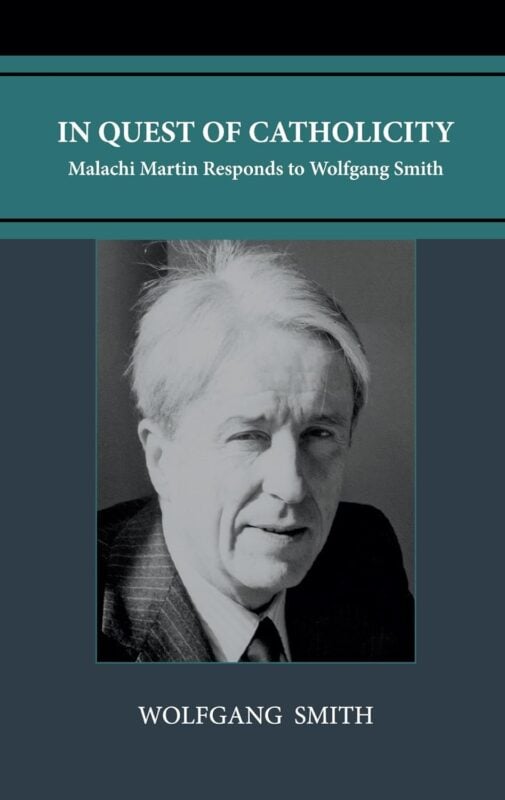
In Quest of Catholicity: Malachi Martin Responds to Wolfgang Smith opens with a correspondence that redefines the role of theology in a post-quantum world. The letters between Malachi Martin, a former Jesuit and Vatican insider, and Wolfgang Smith, a physicist and metaphysician, probe the intersection of modern science, Christian tradition, and esoteric philosophy. The exchange begins in 1997 and extends until shortly before Martin’s death in 1999. Their dialogue moves from Thomistic metaphysics to quantum paradox, from angelology to sacred science, from cosmology to esoterism. Each letter builds an architecture of insight aimed at rediscovering Catholicity in its fullest ontological range.
Recovering the Middle Plateau
The conversation starts on shared ground: both men recognize the inadequacy of contemporary theological categories for interpreting discoveries in modern physics. Smith introduces the idea of the “intermediary domain,” identified in Orthodox Christianity as the aerial world and in Vedic cosmology as bhuvar. Martin, seasoned by years of spiritual warfare and exorcism, affirms this “middle plateau” as a terrain he knows firsthand. Their shared language enables a convergence of metaphysics and mysticism. Martin welcomes Smith’s invocation of Jacob Boehme, the 17th-century German mystic who framed the cosmos as a site of divine restoration layered over a fallenness that predates Genesis.
Martin recognizes in Boehme’s doctrine a cosmological key. The idea that creation overlays the ruins of Lucifer’s kingdom, rather than being an absolute ex nihilo event, clarifies the ontological weight of the demonic and the necessity of grace. He links this view to Genesis through poetic theology, describing the Incarnation as an alien but utterly necessary invasion of the human domain. The middle plateau is not a metaphor. It is a dimension of existence that must be accounted for in any adequate theology.
Quantum Physics and Ontological Expansion
Smith’s interpretation of Bell’s Theorem introduces a pivotal ontological insight. Nonlocality—empirically verified and mathematically sound—exposes a level of reality that transcends space and time. Martin absorbs this paradigm not as scientific novelty but as confirmation of what sacred traditions long intuited. He asserts that what matters now is the readiness of theology to reconceive metaphysics in light of this breakthrough. Bell’s Theorem, Smith argues, proves the necessity of a metaphysical realism compatible with classical theism and perennial wisdom. Martin agrees: Thomism alone cannot handle this expansion. A new synthesis must emerge, one that does not discard tradition but magnifies its depth.
Both men reject the reduction of metaphysics to physics. Instead, they affirm sacred science—the disciplined cultivation of insight into ontological realms beyond empirical reach. Smith describes sacred science as a path of purity and integration where the body, soul, and spirit become instruments of perception. Martin responds by linking this to Catholic sanctity. Only a soul immersed in grace can comprehend the structure of creation as it truly is. Scientific insight must be integrated into a deeper anthropology, one that takes seriously man’s role as microcosm.
Doctrine, Grace, and Ontological Dependence
Martin repeatedly emphasizes the gratuity of grace. He refuses to ground the supernatural in natural potency. Nothing in the human condition—biological, rational, or moral—entitles man to divinization. Grace is not a developmental outcome but a radical intervention. He critiques theological trends that blur the boundary between nature and supernature, including certain readings of Henri de Lubac and Hans Urs von Balthasar. Smith presses this issue, especially in relation to Adrienne von Speyr, the mystical partner of von Balthasar. He asks Martin whether their collaboration reflects authentic sanctity or spiritual deception. Martin does not dismiss the question. Instead, he affirms Balthasar’s brilliance while acknowledging a tension in his theology. Where Balthasar flirts with the idea of an intrinsic human orientation toward the supernatural, Martin anchors divine life solely in Christ’s gratuitous act.
Their dialogue turns theological anthropology into an existential inquiry. What constitutes man’s capacity to receive God? Smith posits that the Son alone is a Person in the Trinitarian order as humans understand personhood. Martin entertains the thought without concession to error. He insists on doctrinal integrity but accepts the speculative framework as a way to engage the ineffable. This fidelity to both dogma and mystery allows their exchange to explore radical territory without losing grounding.
Christian Esoterism and Sacred Transmission
Boehme and the Christian Kabbalah emerge as decisive sources. Smith contends that sacred traditions—preserved in the Vedic, Hermetic, and Kabbalistic lineages—bear fragments of a primordial wisdom he calls sophia perennis. Martin affirms the reality of such a transmission. He refuses to dismiss sacred sciences as pagan superstition. For him, Christian esoterism is not an optional addition but an essential mode of theology capable of penetrating the mysteries that rationalism has obscured. He believes that a Church renewed in doctrine must also recover its esoteric core.
Sacred science differs from empirical science not by rejecting reason but by elevating the perceiver. The human subject must become an instrument purified through asceticism, silence, and grace. Smith identifies this path with the ancient disciplines of Pythagoras and the spiritual practices of Eastern traditions. Martin connects it to the mystical depths of Catholicism. He views Boehme’s vision as an authentic retrieval of pre-Christian Christology—an ontology of light and darkness anchored in the Logos.
Metaphysics of Love and the Theology of Beauty
Their dialogue reaches new intensity as they discuss von Balthasar’s theological aesthetics. Smith sends Martin a passage that describes being as love and affirms love as the only credible rationality. Martin recognizes its rhetorical power but signals a concern. The romanticization of love can obscure the rupture between sin and grace. Without the dogmatic anchor of original sin, theological eros drifts toward sentiment. Martin sees in Balthasar an unmatched intellect. Yet he questions whether the Swiss theologian adequately protects the gratuitousness of salvation.
Smith presses the issue further through Jean Borella, a French metaphysician who defends Catholic doctrine while integrating Eastern metaphysics. Borella, Smith argues, succeeds where Balthasar hesitates. He retains the mystery of the Trinity while addressing the metaphysical questions raised by Vedanta and Neoplatonism. Borella’s account of Christ’s glorified wounds as metaphysical ostension answers the question Smith had long posed to Eastern sages: how does the Infinite retain the finite? The wounds of Christ do not disappear in glory. They manifest eternity through the finite. Borella’s insight crystallizes the synthesis both men have sought.
Prophetic Witness and Ecclesial Destiny
Martin’s vision for the Church unfolds within a prophetic framework. He sees ecclesial structures dissolving under spiritual entropy. He speaks of “entombment,” not destruction, anticipating a resurrection shaped by purification. This new Church will not repudiate tradition. It will emerge from beneath the rubble with deeper comprehension of sacred truth. The dialogue affirms that doctrine remains inviolable, yet its articulation must penetrate the full ontological range of existence.
Smith’s role becomes clear: he offers Martin a metaphysical framework capable of naming realities that Martin has encountered but not conceptualized. Martin responds as a priest who discerns spiritual truth not through abstraction but through prayer, suffering, and grace. Their correspondence reveals not a merger of worlds but a theological ascent. Ontology, mysticism, cosmology, and grace converge.
The Future of Catholic Thought
The letters demand more than intellectual engagement. They invite conversion. Each page affirms the necessity of sanctity for theological understanding. The need for a “new Thomas Aquinas” points to a thinker who can synthesize sacred tradition, metaphysical insight, and scientific discovery without sacrificing doctrinal integrity. This thinker must stand within the Church, yet speak to the mysteries that unfold beyond its current comprehension.
In Quest of Catholicity offers a glimpse into that future. Its structure reflects the form of Catholicity it proclaims: expansive, integrated, sacrificial, and luminous. The Church it envisions breathes with metaphysical depth and eschatological hope. It is a Church purified by suffering, guided by wisdom, and renewed in the crucified and risen Christ. The correspondence between Malachi Martin and Wolfgang Smith becomes a testament to that renewal. It is a map for the rediscovery of ontological vision in a world exhausted by fragmentation. It speaks not only of what the Church has lost, but what it can recover—if it listens.