Inversion — ECDO Theory: The Hidden Mechanism Driving Cataclysm, Cultural Tradition, and Climate
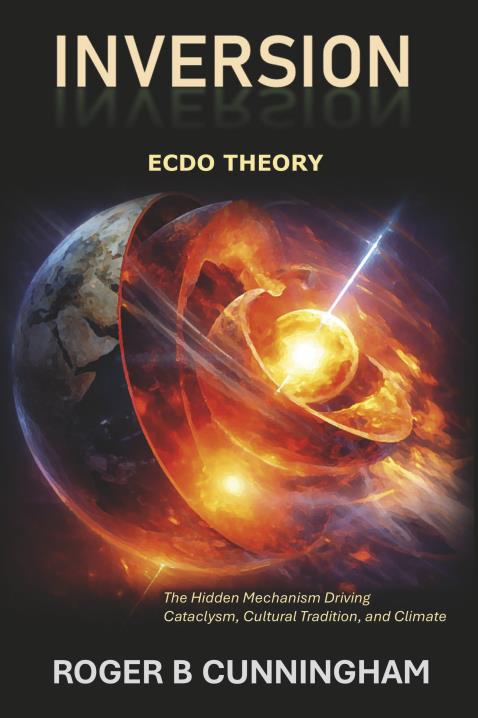
Inversion — ECDO Theory: The Hidden Mechanism Driving Cataclysm, Cultural Tradition, and Climate by Roger B. Cunningham builds a single geophysical process to explain flood myths, the way ancient builders aimed their monuments, deep-Earth energy signals, and the present warming of the planet. Cunningham, who publishes his research under the name The Ethical Skeptic, developed the framework across fourteen years of independent investigation that began in 2010, and he lays it out here across 424 pages as a probative construct that stays open to falsification and refinement. The book draws geology, climatology, archaeology, paleomagnetism, and mythology onto one causal spine, and it holds that the Earth periodically reorients its outer shell through a mechanism the author names Exothermic Core–Mantle Decoupling — Dzhanibekov Oscillation.
The Mechanism at the Center
Cunningham locates the trigger inside the Earth's core. Heat builds, the core sheds denser material downward into the lower mantle, and the planet's magnetic field weakens as this transpires. Once the field fades far enough, the outer rotational body of the Earth — the mantle and crust together — decouples from the core at the D″ layer and pivots toward a fresh gyroscopic equilibrium. The author takes the Dzhanibekov Effect, the documented tumble of a spinning object around its intermediate axis, and applies its principles to the rotational complexity of a planet whose interior carries mass in uneven measure. He terms the result a mediated Dzhanibekov Rotation: a constrained reorientation that swings the crust as the core and the geomagnetic poles hold their place. From this distinction flow the terms he relies on throughout — dynamics, mediated, and rotation — chosen to mark a process that moves under constraint. The construct asks the reader to picture a planet whose spin carries a built-in instability, one that stays dormant for thousands of years and then resolves in a span measured in hours once the magnetic restraint releases.
Two Provinces of Stone Beneath the Mantle
The model rests on two structures that seismic tomography maps deep inside the planet: the Large Low-Velocity-Shear Provinces, one seated beneath Africa and one beneath the Pacific. Cunningham treats these provinces as massive, low-density formations that carry a gyroscopic axis of their own within the lower mantle, and he ties their position to the two equilibrium states the Earth can occupy. What decides which state prevails? The strength of the geomagnetic core. When the core sloughs material and the field drops, the forces that pin the crust in place fall away, and the planet seeks its alternate rotational optimum, swinging the shell across the surface toward the points his exhibits mark along the Euler Axis.
Monuments That Aim at a Vanished Pole
The archaeological heart of the book follows one observation: ancient builders oriented their works toward a celestial and terrestrial north that has since moved. Cunningham labels this displaced position Np′. After inspecting the exterior of the Khafre Pyramid, he read the four shafts of the Great Pyramid of Khufu as instruments trained on that older pole, with the star-shaft geometry centering inside the tail of the constellation Draco and pointing to a construction window near 9200 to 9600 BCE. He carries the pattern outward to Göbekli Tepe and its Pillar 43, to the serpent motif at Karahan Tepe, to the earthwork plaza at Poverty Point in Louisiana dated roughly 1700 to 1100 BCE, and to Cacaxtla in Mexico near 400 BCE. These sites, he argues, align to the same global geometry across separated continents and millennia, and he places the combined odds of such convergence arising by chance at one in four hundred trillion. He folds the Khufu casing record and the long-sealed Void within the Great Pyramid into the same account, reading the displaced Dixon block and the structure's internal voids as physical traces of a builder culture that tracked the moving sky and prepared for its return. He presents this convergence as an observable pattern in the geometry, anchored to the same salient that his tectonic and paleomagnetic data center on.
Flood Memory Held in Stone and Story
Cunningham reads the world's deluge traditions as eyewitness records of an earlier reorientation. He gathers the Mesopotamian Atrahasis, the Egyptian Surid legend, and the account of Noah into one timeline, then binds them to a sea displacement that raised relative ocean levels by roughly 576 feet and scoured coastlines over a span of fifty to four hundred years. The waterline erosion he documents on Egyptian stone supplies one line of physical evidence; the casing history of the Giza pyramids in polished Tura limestone supplies a second; and the depiction of the three pyramids stripped of their casing on the Nubian Egg, dated to 3800 BCE, supplies a third. These threads converge on his reconstruction of cultural memory: communities watched the sky and the sea change, marked the old celestial points with horizon stones, and passed the record forward as myth once the original observation slipped from view.
The Climate Signal and the Indigo Point
The theory carries a direct climate argument. As the core decouples and sheds heat, that energy feeds upward into the mantle, drives sea-surface temperature anomalies across the Pacific and the South American El Niño zone, warms the northern tundra, and forces carbon dioxide and methane out of the ground. Cunningham names the onset of this phase the Indigo Point, and he contends the Earth has already passed it. He assigns part of the measured warming to this internal heat — energy that rises from a core shedding its load toward the next oscillation — and he frames the planet as a system where two mechanisms of equilibrium contend for dominance, with the geomagnetic field strength tipping the balance from one age to the next. He traces the heat path away from the dense Large Low-Velocity-Shear Provinces and toward the surrounding core-fed mantle, and he reads the migrating South Atlantic Anomaly as a present-day marker of a field that continues to weaken on schedule.
Tau Point and the Question of Timing
The forward edge of the book turns predictive. Cunningham defines a coming Tau Point: a true polar wander event in which the outer shell completes its decoupling and shifts. He reads paleomagnetic studies from Chile and Ecuador as clustering around a geomagnetic excursion in the 4900 to 4400 BCE range, drawing on the work of Nami and of Tarduno on the antiquity of the South Atlantic Anomaly, and he frames the recurrence on intervals near 5,200 and 6,443 years. The book presses a harder question onto the reader: how soon does the next oscillation arrive? Cunningham holds the answer open, pending closer watch on polar-motion data, since the planet may have already entered a new interval. He weighs the stakes as civilizational, and he examines the practical matter of refuge, including the constraints that limit the Moon and Mars as havens through such an event.
The Author and the Method
Roger Cunningham brings a systems engineer's training from the Georgia Institute of Technology, an MBA in finance, and a career that spans markets, national infrastructure planning, advanced materials science, and corporate operating strategy. He served as a U.S. Naval Officer in the Persian Gulf and at the Office of Naval Intelligence in Washington, D.C., won the 2017 Sir Richard Branson Talent Unleashed Award, and led teams that advised over 180 clients ranging from global industry leaders to sovereign nations, including a strategy presented to Chinese Vice Premier Wang Qishan at the Fourth Sino–U.S. Economic Summit alongside Senators Claire McCaskill and Kit Bond. A blue-water sailor by avocation, he applies the same deductive, work-the-problem discipline to this theory that he honed across those assignments, and he treats the framework as a construct he committed to only after falsifying the alternatives he and his colleagues could raise.
What the Book Sets Out
Across 424 pages the argument moves from the physics of rotating bodies, through the seismic maps of the lower mantle, into the survey of monuments and myths, and outward to a forecast and a frank discussion of survival. Cunningham builds his claims as probative constructs, supports them with labeled exhibits, paleomagnetic figures, and a citation apparatus, and frames the whole as a working theory that invites testing. Readers drawn to Earth science, the Younger Dryas debate, archaeoastronomy, ancient flood traditions, and the deep mechanics of climate will find a sustained, interdisciplinary case that one process connects ancient monuments, deluge myths, magnetic-field signals, and the warming the planet registers today. The paperback edition runs to ISBN 9798903833627 and prices at $44.95, filed under Science and Earth Sciences, and it stands as the consolidated statement of a body of research the author has refined in public since 2010.