Kids for Cash: Two Judges, Thousands of Children and a $2.8 Million Kickback Scheme
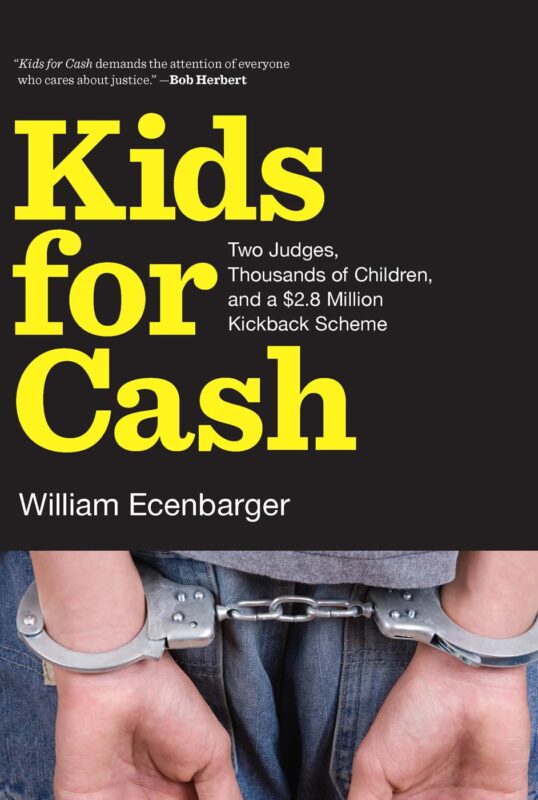
Kids for Cash by William Ecenbarger investigates the Luzerne County judicial corruption that converted juvenile justice into a profit engine. The book dissects the mechanics of a scheme in which two Pennsylvania judges, Mark A. Ciavarella and Michael T. Conahan, accepted $2.8 million in payments from the developer Robert K. Mericle and the co-owner of PA Child Care, Robert Powell. Their arrangement turned a courtroom into a delivery system for private incarceration.
The Scheme That Sold Children
Between 2003 and 2008, Ciavarella and Conahan orchestrated a system that imprisoned thousands of minors for petty infractions. Children as young as eleven stood before Ciavarella without lawyers, hearings that often lasted less than two minutes. He ordered them shackled, handcuffed, and dispatched to for-profit facilities. Their alleged crimes ranged from writing prank notes to minor scuffles at school. The judges ensured that the county shut down its public juvenile detention center so that private facilities—PA Child Care in Pittston and Western PA Child Care in Butler County—would receive exclusive contracts. The payments disguised as “finder’s fees” from Mericle to Conahan and Ciavarella financed cars, vacation homes, and real estate.
The book names this transactional system precisely: children became commodities. The courtroom operated like a supply chain, its output measured in occupied beds. Probation officers, assistant district attorneys, and school administrators observed the assembly line of punishment but kept silent. The bureaucratic rhythm concealed brutality under routine procedure.
The Children and Their Sentences
Ecenbarger reconstructs the lives consumed by this trade. Matthew, age thirteen, was detained for forty-eight days after throwing a piece of steak during an argument. Angelia, fourteen, spent nights in detention for scrawling “Vote for Michael Jackson” on a stop sign and suffered a grand mal seizure after being denied her epilepsy medication. Lisa, sixteen, was arrested for writing a parody note about a school shooting and locked up for nine days at a wilderness camp. Charlie, fifteen, spent three years in juvenile custody for unknowingly buying a stolen minibike. Each child entered court expecting judgment; each encountered a machine designed to extract value from their punishment.
The cumulative detail produces a map of systemic cruelty. The hearings took place in Luzerne County Courtroom Four. The probation officers, the clerks, and the police escorts followed a practiced choreography. Handcuffs clicked into place. Vans idled at the sally ports of PA Child Care. Parents stood speechless as their children disappeared into detention buildings built by Mericle’s construction company, financed through county contracts that Conahan approved as president judge.
The Geography of Corruption
Ecenbarger situates the scandal in Luzerne County’s economic and cultural landscape. The region once thrived on anthracite coal, a resource that forged both wealth and organized crime. The “coal barons” of the nineteenth century built monopolies that merged with local politics. When the mines closed, the networks of patronage survived. County governments multiplied, creating hundreds of small offices where jobs and favors circulated among relatives and political allies. From this soil, a durable culture of transactional power grew.
Conahan rose through it. His father, Joseph Conahan, served as Hazleton’s mayor and owned a funeral home. Michael Conahan entered public life as a district magistrate at twenty-five through a gubernatorial appointment secured by local influence. His ties to the Scalleat family, identified by state investigators as part of the Bufalino crime family, anchored him within a system that blurred civic and criminal enterprise. William D’Elia, successor to Russell Bufalino as northeastern Pennsylvania’s organized crime boss, maintained open social and business connections with Conahan.
Ciavarella came from Wilkes-Barre’s East End, the son of a brewery worker and a telephone operator. Known by the nickname “Scooch,” he cultivated a reputation for discipline and athletic vigor. His campaign for the bench in 1995 projected the slogan “A ReMarkAble Choice for Judge.” He promised toughness, won the election with heavy contributions from local lawyers, and treated punishment as moral pedagogy.
The Judicial Machine
When Ciavarella became juvenile court judge in 1996, he declared that violence in schools would result in automatic detention. He charged parents up to $400 per month for their children’s confinement. He enforced his rules without listening to mitigating evidence. The hearings became procedural funnels: defendants entered, received a few perfunctory questions, and left in chains.
Conahan, as president judge, held administrative power over budgets and facilities. He used that authority to close the county’s public detention center, citing unsanitary conditions, and redirected contracts to the private company PA Child Care. Mericle constructed the facility, Powell co-owned it, and Conahan guaranteed it would stay full. The scheme relied on the veneer of civic improvement: the new detention centers appeared modern, efficient, and cost-effective. Behind the public rationale, money moved through shell accounts and disguised payments.
Exposure and Collapse
The first cracks appeared when the Juvenile Law Center in Philadelphia, led by Robert Schwartz and Marsha Levick, began receiving complaints from parents. Their petition to the Pennsylvania Supreme Court argued that Ciavarella violated juveniles’ constitutional right to counsel. The court initially dismissed the petition. Years later, as the federal investigation unfolded, the same court reversed thousands of adjudications.
Federal prosecutors in Scranton and Harrisburg gathered evidence of tax evasion and wire fraud. The investigation revealed that Mericle paid the judges in cash and through intermediaries. On January 26, 2009, U.S. Attorney Martin C. Carlson announced charges. Conahan and Ciavarella attempted to plead guilty in exchange for reduced sentences, claiming the payments were “finder’s fees,” but the deal collapsed when Ciavarella denied that his sentencing practices were linked to the money. A federal jury later convicted him on multiple counts, including racketeering, money laundering, and fraud. He received a 28-year sentence. Conahan pleaded guilty and received 17½ years.
The Silence of Institutions
Ecenbarger records the institutional paralysis that surrounded the judges. Prosecutors observed unconstitutional proceedings and did nothing. Public defenders failed to demand due process. Teachers and school administrators continued referring students for minor infractions. Local newspapers published puff pieces about Ciavarella’s “zero tolerance” philosophy. The community admired his image of order and discipline. The myth of moral rigor concealed a pipeline of exploitation.
Why did the system obey? The answer lies in habit and hierarchy. Luzerne County’s professional networks rewarded loyalty and punished dissent. Officials who challenged the judges risked isolation or retaliation. The Interbranch Commission on Juvenile Justice, established after the scandal broke, concluded that the system’s insularity enabled years of abuse.
The Aftermath for Victims
When the Pennsylvania Supreme Court vacated the juvenile convictions, it could not erase the consequences. Many victims carried criminal records into adulthood. Their detentions interrupted schooling, estranged families, and deepened mistrust of authority. Some, like Matthew, struggled with depression. Others, like Charlie, drifted into adult criminal behavior. Angelia and Lisa rebuilt their lives through education, but the memory of shackles and confinement remained fixed in their identities.
Ecenbarger connects these stories to a structural critique. Juvenile detention in the United States holds about 100,000 minors on any given day. Less than one-third face charges for violent offenses. The rest represent the continuum of minor delinquency that could be addressed through community supervision, counseling, or family support. Instead, jurisdictions rely on incarceration as social management.
The Market Logic of Punishment
The privatization of juvenile facilities introduced corporate imperatives into public justice. Companies such as PA Child Care and Western PA Child Care negotiated contracts that guaranteed minimum occupancy levels. County governments paid per diem rates for each detainee. Profit required bodies in cells. The Luzerne County arrangement revealed the vulnerability of a system that monetized confinement. The economic mechanism transformed discipline into inventory control.
Ecenbarger presents this structure through precise documentation: contracts, financial transfers, and testimony. The Mericle Development Company received multimillion-dollar construction payments. Powell’s firm managed daily operations. The judges ensured a steady influx of detainees. When Ciavarella bragged that he practiced “zero tolerance,” he described an economic principle disguised as moral certainty.
The Cultural Legacy of Corruption
Luzerne County’s moral landscape shaped its institutions. The coal industry’s paternalism taught generations to accept authority as protection. Political machines inherited the role of company bosses. Jobs, permits, and contracts circulated through networks of kinship and obligation. Under these conditions, corruption became governance.
Ecenbarger traces this lineage through figures like Congressman Daniel J. Flood, whose political theatrics and federal appropriations masked bribery scandals, and through the persistent intertwining of local politics with organized crime. The book treats the “kids for cash” episode as the late evolution of that lineage—a modern variant of the same transactional logic that once defined coal mining and union manipulation.
The Role of Journalism and Law
The exposure began with a New York Times article by Ian Urbina in 2009, which presented the first national account of the scandal. Local reporters in Wilkes-Barre and Scranton followed. The Juvenile Law Center’s litigation gained traction as federal indictments surfaced. Ecenbarger’s own reporting extended over two years, encompassing interviews with more than two hundred individuals: victims, parents, attorneys, judges, and law enforcement officials. His narrative combines testimony with historical analysis, linking personal tragedy to institutional pathology.
The Interbranch Commission’s final report in 2010 cited systemic failure at every level of oversight. It documented the absence of written procedures for juvenile waivers of counsel, the lack of transcripts in thousands of cases, and the submission of falsified detention statistics. These findings corroborated the book’s argument: corruption succeeded because structure allowed it.
The Broader Reckoning
The scandal forced Pennsylvania to reform juvenile procedures. The Supreme Court mandated that minors must have legal representation in all delinquency proceedings and that transcripts and audio recordings must be preserved. The Juvenile Court Judges’ Commission established ethics training. Yet Ecenbarger argues that procedural repair cannot erase the moral damage inflicted when public servants treat children as revenue streams.
What vision of justice replaces this failure? The book advances a clear position: transparency sustains legitimacy. Courts must open their processes to scrutiny. Detention centers must remain accountable to public oversight, not private shareholders. The state must separate profit from punishment.
The Human Equation
At its center, Kids for Cash measures cost through human experience. The financial figure—$2.8 million—anchors the scheme, but the book’s moral arithmetic counts lost adolescence, fractured families, and disintegrated trust. The courtroom scenes demonstrate how institutional power reduces individuality to case numbers. Ciavarella’s phrase “remanded” carried the weight of a command economy. Each time he uttered it, a child’s future disappeared behind steel doors.
Ecenbarger writes with investigative precision rather than sentiment. His narrative architecture builds tension through causality: corruption emerges from history, authority produces silence, silence enables profit, and profit destroys lives. The book achieves resonance through factual density, not moral abstraction.
Conclusion
The Luzerne County scandal stands as one of the most detailed documented cases of judicial corruption in the United States. Kids for Cash reveals the anatomy of a local system that converted justice into commerce and transformed civic institutions into instruments of extraction. It defines the conditions that allow such systems to exist: economic dependency, institutional opacity, and cultural submission to authority.
William Ecenbarger’s investigation converts outrage into record. His documentation restores agency to the children who lost it in courtrooms where due process collapsed into performance. The story of Luzerne County warns that any society that delegates moral authority to markets risks producing a justice system that functions as a business plan.
