Killing History: The False Left-Right Political Spectrum and the Battle between the ‘Free Left’ and the ‘Statist Left’
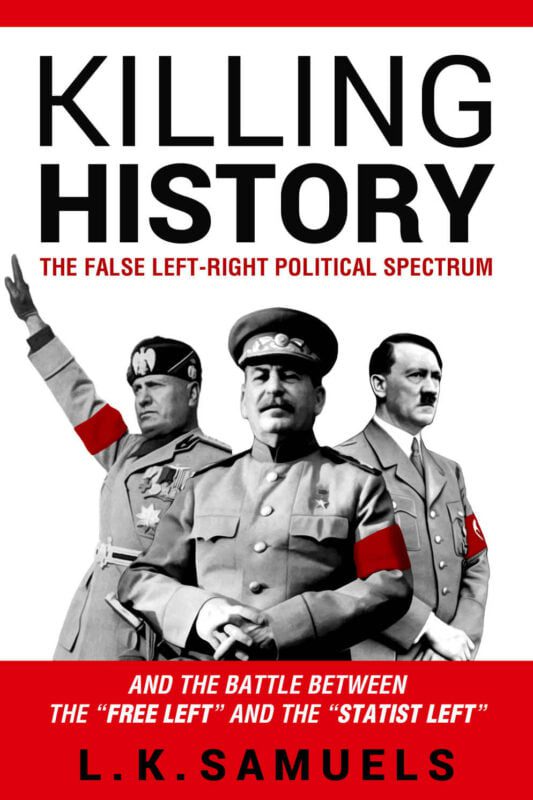
Killing History: The False Left-Right Political Spectrum and the Battle between the 'Free Left' and the 'Statist Left' by L.K. Samuels initiates a sweeping reconsideration of the way societies classify political ideologies. In the decades following the French Revolution, political thinkers and power brokers shaped a dichotomy—the left-right spectrum—that would dominate perceptions of ideology and authority. Samuels reveals how the origins, manipulations, and legacies of this spectrum obscure fundamental truths about the nature of power and the ideological currents that drive state actions. His work draws on over six years of research, academic scholarship, and more than 1,500 citations to trace the evolution of these categories and their consequences for modern political life.
The Origins of the Political Spectrum
The roots of the left-right spectrum emerge from the French National Assembly’s seating arrangement. The Girondins, representing merchants, the bourgeoisie, and advocates of constitutional limits, took the left side. The supporters of monarchy and centralized authority took the right. This visual and spatial arrangement provided a temporary clarity, mapping revolutionary actors onto a legible field. As the revolutionary fervor subsided, new factions—socialists, nationalists, and statists—appropriated the “left” label, displacing the original legacy of the bourgeois and classically liberal forces. The conceptual clarity of the original seating faded. Ideological opportunists, eager to claim revolutionary legitimacy, recast themselves as heirs to a tradition they had not created. Samuels demonstrates how historical actors and theorists then manipulated and redefined left-right categories, concealing crucial distinctions and fostering division.
Authoritarianism’s Many Masks
The traditional left-right spectrum frames authoritarianism as the exclusive property of a single end of the political axis. Samuels refutes this premise. He defines authoritarianism as the concentration of power, the dominance of the collective over the individual, and the subordination of society to coercive authority. This syndrome recurs across the ideologies assigned to both the left and right. Whether implemented by fascists, communists, or socialists, authoritarian governance expresses similar traits: suppression of dissent, hostility to private property, collectivist economics, and an insistence on ideological conformity. Samuels traces the genealogy of these similarities through the careers of figures like Mussolini, Hitler, Stalin, and Mao, identifying an “authoritarian brotherhood” that persists regardless of the assigned political label.
Redefining Liberalism
Samuels traces the transformation of the term “liberalism.” Originating with thinkers such as John Locke and Adam Smith, liberalism defended individual liberty, natural rights, limited government, and free markets. The classical liberal tradition emphasized negative rights—freedom from coercion and aggression. In the 20th century, intellectual and political currents—especially those arising from European immigration to America—appropriated the label “liberal,” but redirected its focus. Modern liberalism evolved to champion positive rights: claims to resources, redistribution, and collective welfare. This new configuration positioned the state as guarantor of outcomes, enabler of equality by fiat, and agent of compulsory social programs. Samuels insists that this shift distorts the original meaning of liberalism, effectively hijacking its legacy and replacing liberty with state-administered social engineering.
The Machinery of State Power
Classical liberals resisted state monopolies, mercantilism, and the merging of business with government. They regarded state-backed corporations and colonial ventures as antithetical to freedom and prosperity. Samuels details how mercantilist practices, far from disappearing, reemerged in different guises: crony capitalism, state socialism, market socialism, and the corporatist regimes of fascist and Nazi states. Authoritarian states, whatever their stated ideology, display a recurring pattern: capture of economic power by political elites, the proliferation of bureaucratic controls, and the entrenchment of legal privileges for favored groups. The political spectrum’s simple binary—left against right—veils the underlying logic that connects these regimes: the pursuit of concentrated power, enabled by the machinery of the modern state.
Historical Manipulation and Ideological Engineering
Samuels demonstrates that political actors, historians, and propagandists have systematically revised historical records to protect favored ideologies from criticism. He recounts his own attempts to correct Wikipedia entries about Mussolini and Italian Fascism, citing primary documents where Mussolini identifies Fascism as a left movement, rooted in revolutionary socialism. Resistance to these corrections, Samuels argues, reflects an enduring effort to maintain ideological distinctions that cannot withstand scrutiny. He documents extensive evidence linking fascist and socialist ideologies, showing how both movements emerged from similar revolutionary syndicalist and Marxist currents. The effort to conceal these connections, he contends, results in a false historical narrative, protecting socialism’s reputation and deflecting scrutiny from the crimes of authoritarian regimes.
The Battle Between Free Left and Statist Left
Central to Samuels’s thesis is the distinction between what he calls the “Free Left” and the “Statist Left.” The Free Left, grounded in the legacy of the Girondins and classical liberal thinkers, advocates for liberty, individual autonomy, limited government, and the open society. The Statist Left, claiming descent from later revolutionary and socialist movements, demands collective solutions, central planning, redistribution, and the subordination of the individual to the group or state. Samuels places these two tendencies in direct conflict, contending that the confusion and distortion of political terminology perpetuates the ascendancy of statist tendencies while marginalizing genuine champions of freedom.
State-Directed Monopolies and Economic Control
Economic systems across the spectrum, Samuels argues, have gravitated toward forms of state-directed monopoly and intervention. He explores the evolution of mercantilism into modern crony capitalism and state socialism. The author reveals how regimes in Italy, Germany, and the Soviet Union implemented centralized control, state-backed corporations, and top-down allocation of resources. State capitalism, in Samuels’s analysis, arises whenever political elites merge with economic power, using government as an instrument of privilege, protection, and exploitation. This dynamic recurs regardless of the labels employed by those in power.
Suppression of Civil Liberties
Throughout the book, Samuels identifies suppression of civil liberties as a defining trait of authoritarian regimes. He documents the abridgment of speech, the persecution of dissidents, the outlawing of free association, and the routine violation of property rights under both fascist and socialist governments. He recounts examples from American history—such as laws banning education for slaves and the use of government power to enforce racial hierarchies—alongside European cases of censorship and violence. For Samuels, genuine liberty requires the defense of negative rights and the resistance to state encroachments, regardless of ideological justification.
The Reign of Ideology and the Danger of Binary Thinking
Political actors have an incentive to maintain simplistic categories. Samuels explains how binary thinking—left against right, socialism against capitalism—functions as a tool of ideological control. Elites deploy these categories to divide the populace, obscure historical realities, and justify the concentration of power. The narrative of polarity invites tribalism, fosters suspicion, and discourages genuine debate. Samuels proposes that societies must look beyond binary frameworks to discover the underlying dynamics of freedom and coercion.
The Nolan Chart and the Reimagining of Political Space
Seeking a more accurate model, Samuels introduces alternatives such as the Nolan Chart. This two-dimensional chart maps ideologies along axes of personal and economic freedom, exposing the limits of a single left-right line. He advocates for charts that group all authoritarians—regardless of their stated ideology—on one side, while clustering classical liberals and libertarians on the side of liberty. Samuels contends that this approach allows citizens to locate themselves meaningfully on the political map, recognizing affinities and differences based on principles of power, freedom, and state authority rather than misleading labels.
Consequences of Historical Confusion
Mislabeling and ideological obfuscation foster division, mistrust, and animosity. Samuels observes that when citizens lose the means to accurately orient themselves in political space, public debate collapses into tribalism and dogmatic bigotry. He points to the rise of what he terms a “new form of acceptable bigotry”—the demonization of political adversaries based solely on arbitrary labels. When masters of propaganda control the spectrum, society drifts toward confusion, disinformation, and susceptibility to manipulation. Samuels sees this dynamic as a deliberate campaign by those who benefit from public disorientation.
Reclaiming Political Clarity
To break the cycle of confusion, Samuels calls for a return to historical accuracy and intellectual honesty. He insists on a faithful reconstruction of political genealogy, tracing the real currents of power, ideology, and revolution. He frames this project as an urgent defense of liberty, contending that societies can only defend freedom when citizens possess the conceptual tools to identify threats—regardless of rhetorical disguises. He frames the work as both reference and warning: political mislabeling obscures the mechanisms by which states consolidate authority, erode liberty, and reshape societies in their image.
Implications for Contemporary Politics
Samuels’s arguments reverberate through contemporary debates. He cites the confusion sparked by recent political events—such as the election of Donald Trump—and the growing polarization within American and European societies. He suggests that without a reckoning with history, these conflicts will deepen, fostering cycles of radicalization and reaction. He encourages readers to scrutinize the real motivations behind policy proposals, the true lineage of political movements, and the structure of power that links past and present.
Call to Inquiry
The closing chapters press the reader to reconsider basic questions: Who sits on which side of the aisle? Which forces drive political evolution? How do societies distinguish between the defense of liberty and the pursuit of control? Samuels argues that the search for honest answers demands a break with the ideological frameworks that have governed discourse for centuries. Only through such inquiry can citizens reclaim autonomy, resist manipulation, and sustain the legacy of liberty in a world of competing powers.
Narrative Causality and the Future of the Spectrum
By documenting the causal connections between ideological movements, state actions, and historical outcomes, Samuels maps a new political topography. He tracks how revolutionary rhetoric transitions into state-building, how claims of equality morph into systems of privilege and control, and how historical amnesia enables new cycles of authoritarian consolidation. The book thus functions as both diagnosis and roadmap, exposing the recurring mechanisms that kill history and fortify the authoritarian state. Readers who follow this narrative will recognize the patterns of ideological engineering, the stakes of historical clarity, and the promise of a renewed inquiry into the real nature of political power.